How to Humanize ChatGPT Content: 7 Edits That Work (2026)
Humanizing ChatGPT content means adding the experience, specifics, and voice the model can't supply. Here are 7 edits, a checklist, and when a humanizer helps.

Updated October 4, 2026 · 10 min read
The TL;DR
To humanize ChatGPT content, edit for what the model cannot supply: your experience, specific examples, a clear opinion, and a voice that fits your reader. Swapping synonyms does not do it. Google says it rewards helpful, original content however it is produced, so the goal is a better page, not a disguised one. Use the seven edits below, then run a final accuracy check before you publish.
What You'll Learn
- Why ChatGPT drafts sound robotic even when the grammar is perfect
- Seven edits that turn a generic draft into something worth publishing
- What Google's guidance and spam policy mean for AI-assisted content
- When an AI humanizer tool helps and when it does not
- A checklist to run before any AI-assisted article goes live
The Breakdown
Why does ChatGPT content sound robotic?
ChatGPT is built to give safe, clear, broadly useful answers. That makes it a good drafter and a predictable writer. The problem is rarely grammar. It is that the draft reads as if nobody lived it.
| Pattern | What it looks like | The fix |
|---|---|---|
| Generic claims | "AI can improve productivity for marketers." | Name the user, the task, and the tradeoff |
| Even rhythm | Every sentence is the same length and shape | Mix short and long sentences, then read it aloud |
| Stock transitions | "Furthermore," "Moreover," "In conclusion" | Delete them, or replace with the actual link between ideas |
| No opinion | "There are many ways to improve content." | State which way matters most and why |
| No proof | Claims with no example, number, or source | Add a real case, a named source, or cut the claim |
The best editing question is not "does this sound like AI?" It is "would a reader believe someone who has done this work wrote or reviewed it?" For the full method across all AI text, see our guide to how to humanize AI text.
How do you humanize ChatGPT content step by step?
Work in layers. One rewrite pass will not fix a draft that started without a point of view. Use these seven edits in order.
1. Fix the prompt first
A vague prompt gives you a vague draft. "Write an article about AI writing" produces filler. Give the model your audience, the search intent, the tone, the examples to include, the claims to avoid, and the perspective the brand takes. The more specific the brief, the less you have to remove later. Our guide to how to use AI for writing covers prompting in depth.
2. Add experience the model cannot know
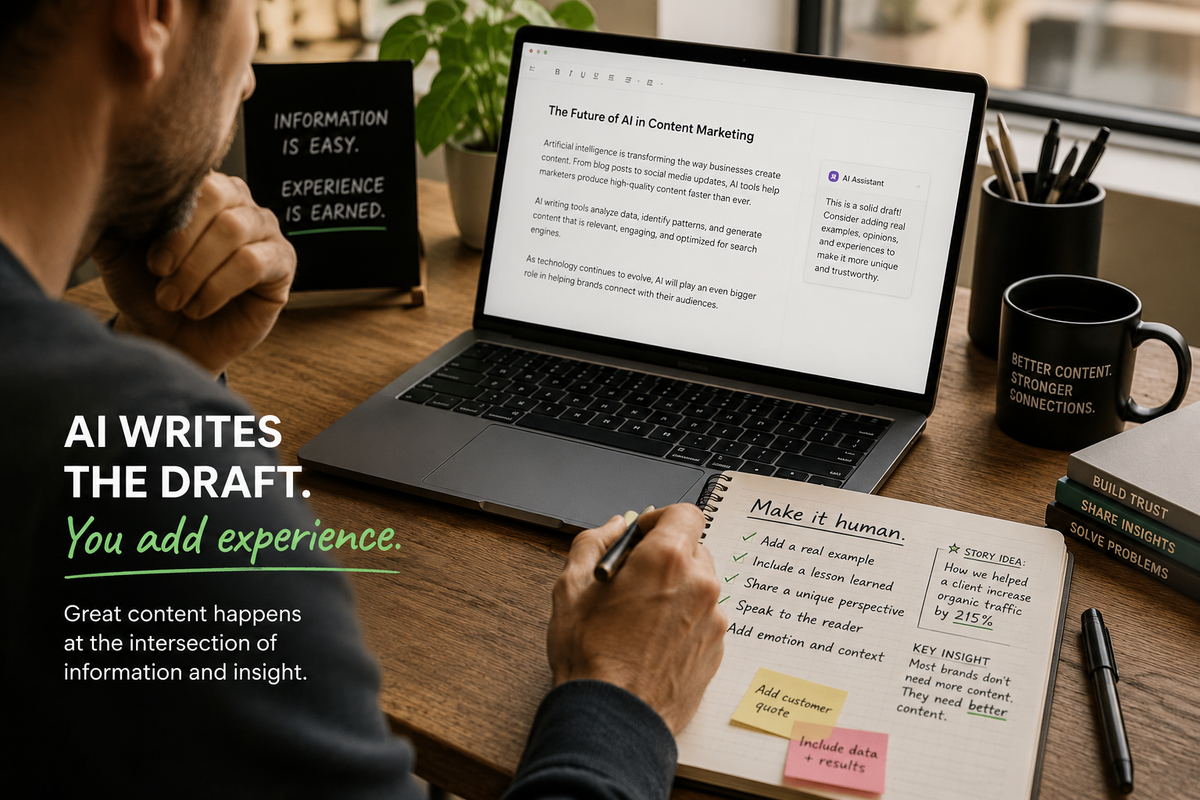
Ask what you have seen in real projects, what beginners get wrong, and what you would warn a client about. Then write that in. "AI content should be edited before publishing" is true and forgettable. "The usual problem is not that the draft is wrong. It is that it says the obvious and never tells the reader what to do next" reads like someone who has reviewed many drafts.
3. Replace generic claims with examples
A concrete example is the fastest way to build trust, and it is also easier for AI search systems to quote. Instead of "good content should connect with the reader," show a stiff paragraph next to a natural one that keeps the same meaning.
4. Rewrite for rhythm
Break long paragraphs apart, vary sentence length, cut empty transitions, and use contractions where they fit the brand. Compare "Furthermore, it is important to note that humanizing AI-generated content can significantly improve readability" with "Humanizing usually starts with readability. If a sentence sounds like a corporate memo, rewrite it."
5. Take a position
ChatGPT avoids strong opinions unless you ask for one. Add judgment: "The most effective fix is not rewriting every sentence. It is adding the missing context." A position does not have to be aggressive. It tells the reader what matters most.
6. Match the audience
A guide for students should not sound like a guide for enterprise SEO teams. Students need clarity and ownership of their wording. Marketers need brand voice and conversion intent. SEO teams need topical depth and first-hand examples. A tool can smooth the prose, but a person decides whether the message fits the reader.
7. Check meaning and facts before style
Make sure the text is still accurate. Humanizing should never change the meaning, add unsupported claims, invent experience, or turn a weak claim into a confident one. On health, finance, legal, education, and employment topics, human review is required.
What does a before and after look like?
Illustrative example, not a client project.
Before (typical ChatGPT draft): "AI-generated content is useful for businesses because it can save time and improve productivity. However, it is important to edit the content so that it sounds more natural and engaging."
After: "ChatGPT can save a content team hours on a first draft, but the draft usually should not go live as is. The value comes after editing: adding customer examples, removing generic phrasing, checking the facts, and shaping the voice so it sounds like your brand instead of a default answer."
The second version names a specific user (a content team), describes the actual workflow, lists concrete editing tasks, and carries a judgment. That is what humanizing means in practice.
Does humanizing ChatGPT content help SEO?
It can, when it makes the page more helpful and original. It is not a ranking shortcut. Google's guidance on AI-generated content says appropriate use of AI is not against its guidelines, and that quality is judged on helpfulness and experience, expertise, authoritativeness, and trust (February 2023). Its spam policies are the other half of the picture. They list using generative AI to produce many pages without adding value for users as scaled content abuse (policy page updated August 28, 2026). Humanizing is only worth doing if it adds value. For the full evidence, see our post on whether humanizing gets penalized by Google.
Humanized structure also helps AI search visibility. Clear definitions, short answer blocks, tables, FAQs, and numbered steps are easier for answer engines to extract. For more on that, read SEO vs AEO vs GEO.
Is humanizing the same as editing for AI detectors?
No. Detectors estimate whether text resembles patterns found in AI writing, such as predictable sentences and repetitive phrasing. They are imperfect, and they do not measure whether your article is useful. Editing for experience, clarity, and accuracy will often change those patterns as a side effect, but the goal is reader trust. If detection is your concern, read can ChatGPT be detected and our comparison of AI vs human writing.
Should you use an AI humanizer tool?
Use one as an editing assistant, not a replacement for judgment. A humanizer helps when the structure is sound but the wording is stiff, repetitive, or hard to read. It is a fast first pass for sentence variety, flow, and awkward transitions while keeping the original meaning.
| Use a humanizer when | Do not rely on it alone when |
|---|---|
| The draft is accurate but robotic | The topic needs expert review |
| You want a faster first editing pass | The draft contains claims, data, or citations |
| You want to compare versions before final edits | The content affects health, finance, legal, or academic decisions |
| Readability is the main problem | You have not added original examples or a point of view yet |
The workflow that works is: ChatGPT draft, humanizer pass, human edit, fact-check, publish. Try the AI Humanizer for the second step. For a sentence-level look at which patterns to fix, see the common AI words and phrases list.
What mistakes should you avoid?
- Only swapping synonyms. Changing "important" to "essential" leaves the same generic idea.
- Removing all structure. Human writing can still be organized and scannable.
- Overdoing casual tone. Human does not mean slang. It means appropriate and believable.
- Inventing experience. Never fabricate stories, results, or case studies. If you have no real example, label a hypothetical clearly.
- Skipping the fact-check. Natural-sounding text can still be wrong.
- Chasing a detector score. One score is one signal, not the goal.
What should you check before publishing?
| Area | Check |
|---|---|
| Content | Does it answer the main question early? Does it include original examples? Does it say when the advice does not apply? |
| Voice | Does it read naturally aloud? Are sentence lengths varied? Does it take a position? |
| SEO and AI search | Are headings question-based? Are there short answer blocks, a table, and a useful FAQ? |
| Trust | Is every claim sourced? Is every example real or labeled? Has an expert reviewed sensitive topics? |
How We Judge Whether a Draft Is Ready
When we review an AI-assisted draft, we ask three plain questions. Can a reader tell who wrote this and why they should trust them? Is there at least one thing in it that the next search result does not already say? And would we stand behind every claim if someone asked for the source? A draft that passes all three is ready. A draft that fails any one goes back, no matter how smooth the sentences are.
Founder Observation
When I took over HumanizeAI.com, the AI-built articles already on the site had been marked down by Google. The grammar was fine. What was missing was anything a reader could not find in the next result. That changed how I review drafts. I no longer ask whether a piece sounds like AI. I ask whether it contains one thing only we could have written, whether that is a test we ran, a mistake we made, or a number from our own data.
Research & Supporting Evidence
- Google Search Central, "Google Search's guidance about AI-generated content" (February 2023): AI use is not against guidelines. Content is judged on helpfulness and E-E-A-T, and automation used primarily to manipulate rankings violates policy.
- Google Search Central, "Spam policies for Google web search" (updated August 28, 2026): generating many pages with generative AI without adding value for users is listed as scaled content abuse.
Mini Case Study: Editing One ChatGPT Paragraph
Illustrative example, not a client project. Take the draft sentence "AI-generated content is useful for businesses because it can save time and improve productivity." It names no user, no task, and no tradeoff. Four edits fix it: name the user (a content team), name the task (first drafts), add the real cost (the draft still needs checking), and add a judgment (it should not go live as is). The result is the "After" version above, 17 words longer than the original and noticeably more useful.
Key Takeaways
- ChatGPT drafts sound robotic because they lack experience, specifics, and a point of view, not because of grammar.
- Edit in layers: prompt, experience, examples, rhythm, position, audience, then facts.
- Google judges AI-assisted content on helpfulness and trust, and treats mass-produced, low-value pages as spam.
- Use a humanizer for flow and readability, then add your own proof and review the facts.
- Run the pre-publish checklist on every AI-assisted article.
Frequently Asked Questions
What is the best way to humanize ChatGPT content?
Add what the model cannot supply: real examples, your experience, a clear position, and a voice that fits your audience. Then vary sentence rhythm and check every fact. Synonym swaps alone do not work.
How do I make ChatGPT content sound more human?
Rewrite generic phrases, vary sentence length, remove stock transitions, add a specific example, state an opinion, and read the draft aloud before publishing.
Can I use an AI humanizer for SEO content?
Yes, as a first editing pass. The final page should still be accurate, original, and matched to search intent. The AI Humanizer can smooth flow and wording, but it cannot add your experience or verify your claims.
Is humanizing AI content just about AI detectors?
No. Humanizing aims to improve quality, clarity, and trust. Detectors estimate patterns and are imperfect, so a detector score does not measure whether content is useful.
Does Google penalize AI-written content?
Not for using AI. Google says appropriate AI use is not against its guidelines, but it treats generating many pages without adding value as scaled content abuse. Quality and usefulness decide the outcome.
What is the difference between AI-generated and humanized AI content?
AI-generated content is a first draft from a model. Humanized content has been edited to include experience, natural voice, specific examples, and accuracy checks.
Ready to Make Your Drafts Sound Like You?
ChatGPT writes the first draft. You decide whether it deserves a reader.
Content Studio is launching this month with a Content Creator and Brand Voice module, so your drafts start closer to your own voice, plus a Content Optimizer and the Humanizer for the final polish. Start with the Humanizer on a draft you already have.
Read the full humanization guide
Additional Resources
- How to Humanize AI Text and Make It Sound Natural
- How to Use AI for Writing
- Do AI Humanizers Work? Honest Answer, Limits, and Best Uses
- AI Humanizer for SEO Content
- Is It Ethical and Legal to Humanize AI-Generated Content?
About the Author
Steve Palomares is the founder of HumanizeAI.com, where he builds tools and publishes research on AI writing, AI search visibility, and content quality.