How to Humanize AI Content at Scale for Agency and Client Work

Humanizing one AI-assisted article is an editing task. Humanizing dozens of client drafts without losing brand voice, product facts, search intent, or editorial quality is an operations problem.
The answer is not simply to rewrite faster. Agencies need a repeatable AI humanization workflow with clear briefs, locked facts, client-specific voice rules, defined review stages, and someone accountable for final approval.
Scale the system, not the shortcuts.
Quick Answer
To humanize AI content at scale, standardize the process around client-specific briefs, voice guidelines, protected facts, a consistent rewriting stage, batch-level quality checks, and final human review. Humanization should improve tone, sentence variation, flow, and readability without changing the client's meaning, product information, positioning, or search intent.
For search-driven content, humanization should sit inside a broader workflow that also includes fact-checking, editorial QA, and content optimization before publication.
Key Takeaways
- Scale the workflow rather than simply increasing the number of AI-generated pages.
- Keep separate voice rules, terminology, and approved examples for every client.
- Lock product facts, claims, sources, and CTA intent before humanization begins.
- Humanization should be one stage in the editorial process, not the entire process.
- Batch QA makes review more consistent, but every article still needs page-level judgment.
- Humanization and SEO optimization solve different problems and should be treated as separate stages.
Why Humanizing AI Content at Scale Is Different
A single AI-assisted article can be reviewed line by line.
That approach becomes harder when an agency is managing multiple writers, clients, verticals, deadlines, and editorial standards at the same time.
The challenge is not just volume. It is consistency.
At scale, several problems become more likely:
Different Clients Start Sounding the Same
If every draft goes through the same prompts, tone instructions, and rewriting process, different brands can slowly converge toward the same neutral style.
The result may read smoothly while losing the differences that made each client's voice recognizable.
Facts Can Drift Between Versions
A first draft may contain the correct product name, price, feature, or claim.
After multiple rounds of rewriting, that information can be shortened, softened, exaggerated, or unintentionally changed.
The more steps in the workflow, the more important it becomes to identify which facts are locked.
Review Becomes a Bottleneck
Manual editing may work for five articles.
It becomes harder when an editor is responsible for 30 or 50 drafts from several accounts.
Without a repeatable checklist, review quality becomes dependent on how much time the editor has for each piece.
Different Writers Apply Different Standards
One editor may focus heavily on tone. Another may prioritize SEO. A third may rewrite aggressively.
Without clear rules, “humanize this article” can mean something different to every person on the team.
An agency-scale workflow removes that ambiguity.
Build a Client-Specific Humanization Profile First
Before humanizing client content at scale, create a reusable profile for each client.
This does not need to be complicated software. It can live inside the same brand documentation, content brief, or editorial system the agency already uses.
A useful client humanization profile can include:
- Target audience
- Brand tone
- Level of formality
- Preferred terminology
- Terms the brand avoids
- Product names
- Feature names
- Approved factual claims
- CTA rules
- Preferred sentence style
- Examples of approved copy
- Compliance-sensitive wording
- Required SEO terminology
- Common mistakes to avoid
For example, one SaaS client may prefer short, direct language and avoid exaggerated adjectives.
Another may sell to technical buyers and require precise terminology even when that makes the writing more formal.
A third may use a conversational voice but require all product claims to match approved documentation exactly.
Those are not differences an agency should expect a generic rewriting prompt to infer automatically.
Document them first.
What Should Be Locked Before Humanization?
The safest way to reduce meaning drift is to divide the draft into two categories:
Information that must remain accurate and language that can be improved.
This distinction is especially important for agency work.
A smoother sentence is not an improvement if it changes the product.
A more conversational CTA is not better if the campaign was designed around a different action.
A rewritten heading is not useful if it removes a required topic from the page.
Treat protected facts as constraints, not suggestions.
A Scalable AI Humanization Workflow for Agencies
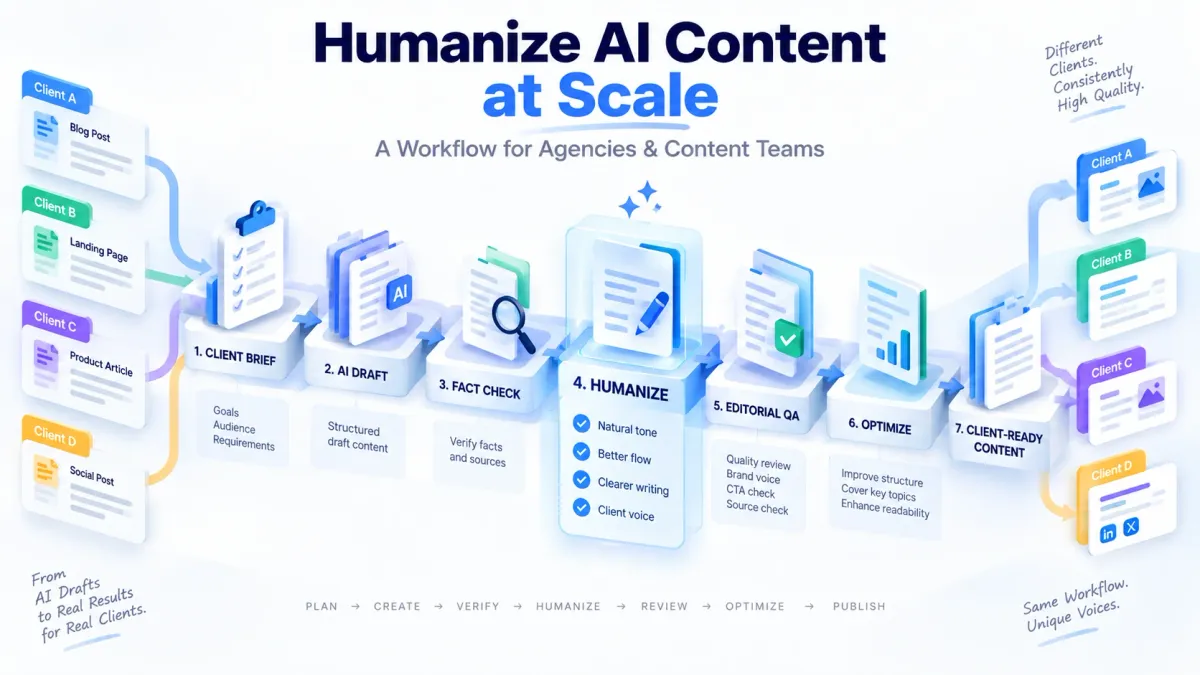
A reliable agency workflow should separate content creation, verification, humanization, optimization, and approval into distinct stages.
Step 1 — Start With a Standardized Client Brief
Every piece should start with a clear brief.
At minimum, define:
- Content goal
- Target audience
- Search intent
- Content format
- Client voice
- Key facts
- Required sources
- Product terminology
- CTA
- Required claims
- Prohibited claims
The brief becomes the reference point for every later stage.
If the content changes during drafting or humanization, the team can compare it against the original instructions.
Step 2 — Generate the First Draft
The draft should solve the content problem before the team worries about making every sentence polished.
For teams using a dedicated creation workflow, HumanizeAI's AI Article Agent currently combines article planning, SERP research, entities, questions, internal-link opportunities, and drafting into one workflow. HumanizeAI positions the product for marketers, SEO teams, agencies, and long-form formats such as how-tos, comparisons, and guides.
The important point is that generation and humanization are separate jobs.
The first stage builds the article.
The later humanization stage improves how it reads.
Step 3 — Verify Facts Before Rewriting
Do not wait until the end of the process to discover that the draft contains incorrect information.
Before humanization, check:
- Product names
- Feature names
- Prices
- Dates
- Statistics
- Claims
- Citations
- URLs
- Client-specific details
- Competitor information
Why do this before rewriting?
Because a humanizer can preserve an incorrect claim just as effectively as it preserves a correct one.
Fact-check first.
Then refine the language.
Step 4 — Humanize the Draft
Once the content is accurate, move it into the humanization stage.
A structured AI humanization workflow should improve the way the content reads without changing the intended message.
HumanizeAI's current AI Humanizer page describes the tool as improving tone, structure, flow, sentence variation, and readability while aiming to preserve the original meaning. The live product page currently lists Basic, Advanced, and Ultra rewriting modes and support for content produced with platforms such as ChatGPT, Gemini, and Claude.
For agency content, the main review question should be:
Did the writing improve without changing what the client is actually saying?
If you need the detailed sentence-level process for an individual document, use the guide on how to humanize AI text.
Step 5 — Run Batch-Level Editorial QA
Scaling does not mean reading one article carefully and assuming the rest of the batch is fine.
Use the same QA framework across every deliverable.
Check:
- Correct client voice
- Factual accuracy
- Duplicate phrasing
- CTA consistency
- Heading structure
- Formatting
- Links
- Source accuracy
- Generic AI phrasing
- Meaning drift
- Unsupported claims
- Search intent
Standardization makes QA faster because editors know what to look for.
It should not turn QA into a simple pass/fail automation.
Each article still needs judgment.
Step 6 — Optimize Search-Driven Content
Humanization and optimization should not be combined into one vague editing step.
Humanization focuses on language quality:
- Tone
- Rhythm
- Flow
- Sentence variation
- Readability
Content optimization focuses on search and topical completeness:
- Search intent
- Topic coverage
- Entities
- Headings
- Internal links
- Missing subtopics
- Questions
- Competitor gaps
HumanizeAI's current AI Content Optimizer analyzes content against current search competitors and identifies opportunities involving structure, keywords, entities, headings, FAQs, readability, and related content gaps.
The sequence matters:
Make the draft accurate → humanize it → optimize it where necessary.
Step 7 — Assign Final Human Approval
Every piece should have a clear final owner.
Depending on the team, that may be:
- Senior editor
- Account manager
- SEO lead
- Content manager
- Client
- Subject-matter reviewer
That person owns the publish decision.
The final reviewer should confirm:
- The information is accurate.
- The article still matches the client's positioning.
- The content is genuinely useful.
- Compliance-sensitive statements are acceptable.
- The CTA is correct.
- The page is ready to represent the client publicly.
Automation can help move content through the workflow.
It should not make accountability disappear.
Who Should Own Each Stage?
Every agency is structured differently, but assigning ownership reduces duplicated work and missed checks.
Smaller teams may combine several roles.
The principle is more important than the job title: every stage should have someone responsible for its outcome.
How to QA Humanized Content in Batches
Batch QA works best when every article is evaluated against the same core standards.
1. Meaning Preservation
Compare the final draft against the approved brief and original factual content.
Look for:
- Changed claims
- Removed qualifications
- Altered numbers
- Stronger promises
- Missing limitations
2. Client Voice
Ask:
- Does this sound like this client?
- Could this paragraph have been written for another account?
- Is the level of formality correct?
- Does the vocabulary match approved content?
3. Factual Accuracy
Recheck:
- Product facts
- Names
- Dates
- Prices
- Statistics
- Quotes
- Sources
4. Duplicate Phrasing
When several articles move through the same prompts and tools, similar wording can appear across the batch.
Review intros, transitions, conclusions, and CTA language for excessive repetition.
5. CTA Consistency
Make sure the final CTA still supports the intended action.
Humanization should not accidentally turn:
“Start a free trial”
into:
“Contact our team”
unless that change was intentional.
6. Search Intent
For SEO content, confirm that the page still answers the query it was built around.
Improving prose should not remove useful subtopics or turn a focused guide into a generic article.
7. Links and Sources
Check:
- Internal links
- External citations
- Broken URLs
- Source relevance
- Correct anchor context
8. Formatting
Review:
- H2/H3 hierarchy
- Lists
- Tables
- Paragraph length
- Emphasis
- CTA placement
9. Unsupported Claims
Humanization can sometimes make language sound more confident than the original.
Watch for words such as:
- guaranteed
- always
- proven
- best
- fastest
- safest
unless the evidence actually supports them.
10. Readability
Finally, read the content as a normal user would.
Does it feel clear?
Does the pacing work?
Are there sections that still sound repetitive?
A checklist catches patterns. A human editor catches context.
You need both.
How to Keep Different Clients From Sounding the Same
One of the biggest risks of scaling an AI-assisted workflow is voice homogenization.
If every client uses the same:
- prompts
- rewrite instructions
- transition patterns
- CTA style
- tone settings
the output can become consistent in the wrong way.
Every client should have separate voice guidance.
Useful inputs include:
Approved Examples
Keep examples of content the client has already approved.
These show tone more clearly than abstract instructions such as “professional but approachable.”
Client-Specific Vocabulary
Document:
- Preferred product names
- Technical terminology
- Common phrases
- Industry language
- Terms the client avoids
CTA Style
One client may prefer:
Start your free trial.
Another may use:
See how it works.
A third may avoid direct-response language entirely.
Preserve that distinction.
Tone Range
Voice is not one fixed setting.
A client's product page may be direct and concise, while its educational content can be more explanatory.
Define what changes by format.
Human Review
Do not assume any automated rewriting system will perfectly reproduce an undocumented brand voice.
If the client cares about a particular style, write it down and review against it.
Scaling Content Without Scaling Low-Value Pages
Scaling content production is not the same thing as producing as many pages as possible.
Google's current spam policies define scaled content abuse as generating many pages primarily to manipulate search rankings rather than help users. Google explicitly states that the issue applies regardless of how the pages were produced, and its examples include generating many pages with AI when those pages add little or no value.
That distinction matters for agencies.
Scale these:
- Research systems
- Brief templates
- Fact-checking
- Voice guidelines
- QA processes
- Editorial roles
- Content templates
- Approval workflows
Do not scale these:
- Thin keyword variations
- Near-duplicate pages
- Unreviewed AI drafts
- Pages that exist only to target a phrase
- Mass-generated articles with no additional value
The goal should be to make useful work repeatable.
Not to make low-value publishing faster.
What an AI Humanizer Cannot Automate for an Agency
An AI humanizer can improve the language of a draft.
It cannot automatically know everything an agency or client knows.
It cannot reliably replace:
- Client strategy
- Fact verification
- Legal approval
- Compliance review
- Undocumented brand preferences
- Editorial judgment
- Client approval
- Subject-matter expertise
- Search strategy
- Original experience
It also cannot guarantee:
- Rankings
- Traffic
- Conversions
- AI detector outcomes
- That every scaled page provides unique value
The tool should remove friction from one stage of the process.
It should not become the process.
Recommended Agency Content Workflow
A practical end-to-end system looks like this:
Client Brief ↓ AI Draft ↓ Fact Check ↓ Humanize ↓ Editorial QA ↓ SEO / Content Optimization ↓ Client Review ↓ Publish
Client Brief
Define who the content is for, what it needs to accomplish, what facts it must contain, and how the client should sound.
AI Draft
Create a useful first version that follows the approved structure and content requirements.
Fact Check
Confirm claims, sources, product information, numbers, and client-specific details.
Humanize
Improve flow, tone, sentence structure, and readability while protecting the approved meaning.
Editorial QA
Review the article against the client profile and agency standards.
SEO / Content Optimization
For search-driven content, verify intent, topical coverage, internal links, entities, and structure.
Client Review
Allow the appropriate client or account owner to review content where required.
Publish
Publish only after the article has passed the same quality standard the agency would apply to manually produced content.
Scale the System, Not the Shortcuts
The best agency workflow becomes faster because decisions are standardized.
Create reusable:
- Brief templates
- Voice profiles
- QA checklists
- Fact-lock sections
- Source requirements
- Editorial roles
- Approval processes
Those systems reduce unnecessary work without removing the judgment that protects quality.
That is what “humanize AI content at scale” should mean.
Not less oversight.
Better operations.
Frequently Asked Questions
How do agencies humanize AI content at scale?
Agencies can humanize AI content at scale by standardizing briefs, client voice profiles, fact checks, rewriting rules, editorial QA, and approval stages. The goal is to make the workflow repeatable while keeping each client's content distinct and accurate.
Can you bulk humanize AI content?
Bulk humanization can refer to processing or managing many drafts through a repeatable workflow, but teams should not assume every humanizer offers a verified bulk-processing feature. Even when tools speed up rewriting, each document still needs checks for meaning, client voice, facts, and final quality.
How do agencies preserve client voice when using AI?
Create separate voice guidelines for every client that define tone, vocabulary, product terminology, CTA style, banned phrases, and approved examples. Review the humanized output against those rules instead of relying on a single generic prompt across all accounts.
How do you QA AI-assisted content at scale?
Use the same checklist for every article: meaning preservation, factual accuracy, client voice, sources, CTA consistency, search intent, links, formatting, unsupported claims, and readability. Standardized QA makes review more consistent without eliminating article-level judgment.
Does Google penalize scaled AI content?
Google does not describe AI-generated content itself as automatically penalized. Its spam policies target scaled content created primarily to manipulate search rankings rather than help users, including large quantities of AI-generated pages that add little or no value.
Should every AI-generated article be manually reviewed?
For professional client work, a responsible workflow should include human review before publication. The reviewer should confirm factual accuracy, client positioning, search intent, brand voice, claims, links, and whether the final article is genuinely useful.
What is an AI humanization workflow?
An AI humanization workflow is a repeatable process for improving AI-assisted drafts while protecting meaning and editorial quality. At agency scale, it typically includes client instructions, fact verification, humanization, QA, optimization, approval, and final publication.
Sources / References
HumanizeAI — AI Humanizer Current product information on humanization, meaning preservation, rewriting modes, supported AI-generated content, and editing workflow.
HumanizeAI — AI Article Agent Current information on article planning, SERP research, entities, drafting, internal-link opportunities, and intended agency/content-team use cases.
HumanizeAI — AI Content Optimizer Current information on SERP analysis, content structure, keywords, entities, headings, FAQs, readability, and optimization recommendations.
Google Search Central — Spam Policies for Google Web Search Primary-source policy for scaled content abuse and low-value mass-generated pages.