How Text Length Affects AI Detector Accuracy: Short vs. Long Samples


Paste one sentence into an AI detector, then scan the complete document, and you may receive two different results. That does not automatically mean the tool is broken. The detector received different amounts of evidence and may calculate sentence-level and document-level outputs differently.
Text length matters, but there is no universal number of words that makes an AI detector accurate. A useful interpretation must consider the tool's current requirements, whether the sample represents the work, and what the score actually measures.
Quick Answer
Short text usually provides less evidence for an AI detector, so a sentence, caption, or isolated paragraph may be rejected or produce a less stable result. Longer coherent text can support better classification in some systems, but longer does not always mean more accurate. Reliability also depends on the detector, training data, language, genre, editing history, threshold, and whether the sample mixes different authors or writing processes.
Key Takeaways
- There is no universal minimum word count for every AI detector.
- A vendor's minimum input is an acceptance rule, not a promise of reliable authorship identification.
- Sentence highlights and an overall document score answer different questions and should not be treated as interchangeable.
- More relevant text can provide more evidence, but adding unrelated material can make the result harder to interpret.
- Repeatedly testing selected fragments can produce different scores without establishing which result is correct.
- High-stakes decisions require drafts, sources, version history, policy, and human review.
What Does “AI Detector Accuracy by Text Length” Mean?
An AI detector is a classifier. It analyzes a text sequence and returns a label, likelihood, highlighted passage, or product-specific score. Accuracy by text length asks whether that classification performance changes when the input contains fewer or more words or tokens.
Three different ideas are often confused:
- Minimum accepted input: the smallest submission the product will process.
- Recommended sample length: the amount of text the vendor suggests for a more useful result.
- Empirical accuracy by length: performance measured on labeled human and AI samples of different lengths.
Only the third is an accuracy evaluation, and its result applies to the detector version, dataset, language, genre, generator, and thresholds that were tested. A product accepting 50 words does not mean 50 words are sufficient for every decision.
For the broader mechanics behind classifications and percentages, read how AI detectors work.
Why Text Length Can Change the Result
A short sample gives a detector fewer observations. One sentence may contain a common phrase, a required definition, or a conventional transition, yet provide little evidence about patterns across the writer's work. Some systems analyze variation among sentences or aggregate local predictions, which is difficult when only one or two sentences are present.
Research supports a relationship between available text and detectability, but not a universal rule. In a 2024 ICML position paper, Chakraborty and colleagues developed sample-complexity arguments and tested several generators, datasets, and detectors. Performance improved with more samples or longer sequences in their experiments. The authors did not establish one word threshold for all commercial tools.
A 2025 review by Fraser, Dawkins, and Kiritchenko identifies document length as one of several factors affecting detectability. It also emphasizes distribution mismatch: performance can change when the real input differs from a detector's training data in domain, language, generating model, or degree of human editing.
Length therefore changes the evidence available to the model, but it does not remove the other sources of error.
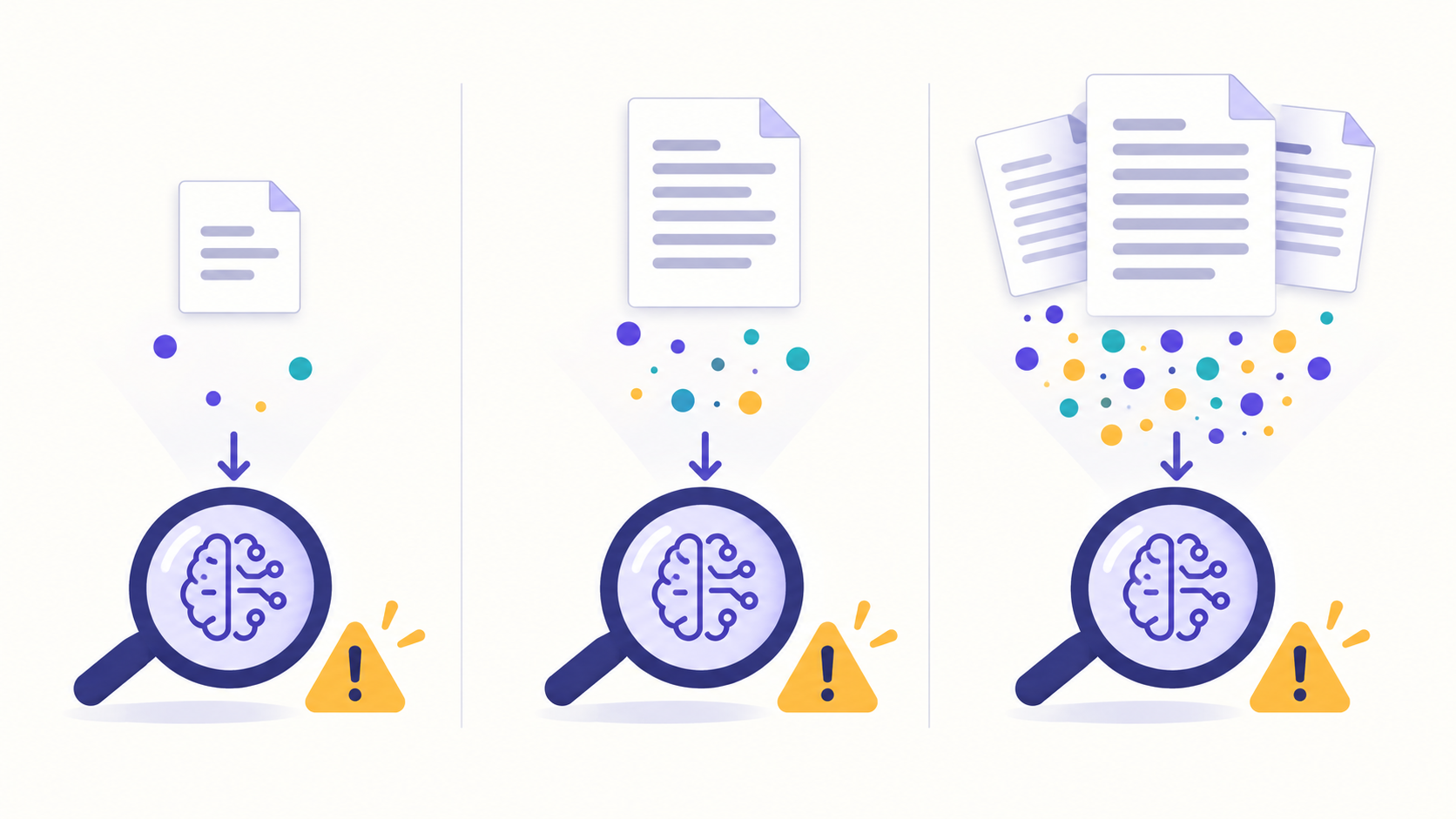
Short, Medium, and Long Samples Require Different Interpretation
These categories are relative to the tool and the writing task. They are not universal word bands.
| Sample type | What the detector can observe | Main interpretation risk | Better practice |
|---|---|---|---|
| One sentence or very short excerpt | A small number of word choices and structures | A common or formulaic sentence may dominate the result; some tools will reject the input | Avoid an authorship conclusion; use the complete relevant passage when permitted |
| Paragraph or short passage | More local structure and vocabulary, but limited document context | The passage may be unrepresentative, especially if it is an introduction, conclusion, definition, or template | Record why the passage was selected and compare it with the complete relevant work |
| Representative section | Several paragraphs from one author, genre, and writing process | A score can still be affected by editing, language, subject, and detector version | Use as a screening signal and preserve process evidence |
| Full document | The broadest view of that document's patterns | One overall score may blend human, quoted, translated, templated, and generated sections | Read the score definition and review eligible or highlighted text separately |
The important question is not simply “Is this long?” It is “Does this sample represent the writing decision being reviewed?”
CMS instruction — do not publish this line: [IN-CONTENT IMAGE 1: short-paragraph-full-document-comparison.webp — place after “Short, Medium, and Long Samples Require Different Interpretation”]
Vendor Minimums Are Not Universal Accuracy Thresholds
Current product rules illustrate how different the input floors can be. They also change as products are updated, so check the documentation on the date of use.
| Detector documentation | Current length guidance | What it establishes |
|---|---|---|
| HumanizeAI AI Detector documentation | Recommends at least 100–200 words and warns that very short text may be unreliable | First-party usage recommendation, not an independent accuracy benchmark |
| Turnitin AI Writing Report | Requires at least 300 words of qualifying long-form prose | Eligibility for that report; it does not prove every 300-word result is correct |
| GPTZero benchmarking documentation | Describes a 250-character dashboard minimum, approximately 50 words | A product-specific technical floor used in its vendor benchmark |
| Copyleaks API documentation | Requires at least 255 characters for the API example; its help content lists different limits for some interfaces | An interface-specific submission requirement |
| Originality.ai | States a 100-word minimum and says shorter text may affect accuracy | A vendor rule and caution for that product |
Do not compare these numbers as if the tool with the lowest minimum is necessarily the most accurate on short text. Each rule belongs to a different model, interface, score definition, and validation process.
Sentence-Level Scores vs. Document-Level Scores
A document score may summarize all eligible text, combine segment predictions, or estimate how much qualifying prose matches an AI-related class. A sentence highlight usually identifies a local passage that contributed to the report or crossed a local threshold.
Neither output automatically proves how a specific sentence was written. A sentence has less context than a full passage, and a document-level result may hide substantial variation within the file. This creates two common mistakes:
- Treating one highlighted sentence as an independent finding of AI authorship.
- Treating an overall percentage as the literal share of words written by AI.
Read the product's current definition before interpreting either result. If the report contains highlights, review them within the surrounding paragraph and the writer's process rather than removing them from context.

Why Longer Text Does Not Always Mean a Better Result
Adding text can improve the amount of evidence while reducing the clarity of the question. A longer sample may be less useful when it includes:
- Multiple authors or collaborators.
- Quotations, references, tables, code, or copied assignment instructions.
- Sections written with different levels of AI assistance.
- Machine-translated and originally written passages.
- Different languages, genres, or time periods.
- Material added only to satisfy a detector's minimum.
The detector may return one blended score even though the document contains several distinct writing processes. A complete document is therefore preferable only when the whole document is relevant to the question and supported by the tool.
Long inputs can also be truncated or divided into internal chunks. If documentation does not explain how the tool handles long files, do not assume every word contributes equally to the displayed result.
Should You Combine Several Short Samples?
Combine samples only when the tool supports that method and the texts come from the same author, task, language, genre, time period, and writing process. Even then, the combined score describes the merged input, not each original item.
Do not combine unrelated discussion posts, answers from different assignments, work from several writers, or passages created under different tool-use rules. Combining them may meet a technical minimum while creating a sample that no longer represents any single document.
For high-stakes review, preserve the boundaries between original files. Separate results are easier to connect to drafts, sources, timestamps, and policies.
A Practical Workflow for Interpreting Results by Length
- Define the question. Decide whether you are reviewing one sentence, one assignment, a complete article, or a writer's broader process.
- Check current requirements. Confirm the supported language, format, minimum length, maximum length, and definition of qualifying text.
- Choose a representative sample. Prefer complete relevant prose from one consistent writing process. Do not pad the input with unrelated material.
- Preserve the exact input. Save the text, document version, date, detector name, and model version when available.
- Run the scan without fragment shopping. Repeatedly testing small sections until one returns a desired score introduces selection bias and does not validate the outcome.
- Read the score definition. Separate document classification, qualifying-text share, sentence highlighting, and confidence.
- Add contextual evidence. Use drafts, notes, sources, version history, permitted-tool records, and the writer's explanation before making a decision.
CMS instruction — do not publish this line: [IN-CONTENT IMAGE 2: responsible-ai-detector-interpretation-flow.webp — place after “A Practical Workflow for Interpreting Results by Length”]
You can check a representative passage with HumanizeAI's AI Detector. The current HumanizeAI documentation recommends at least 100–200 words. Keep the exact input and treat the output as one diagnostic signal rather than proof of authorship.
If a human-written passage receives an unexpected result, follow the evidence-preservation and review steps in AI Detector False Positives: Causes, Evidence, and What to Do.
Frequently Asked Questions
How many words does an AI detector need?
There is no universal minimum. Each detector sets its own technical and recommended limits. Current examples range from character-based minimums to 300 words of qualifying prose. Check the exact product and interface before scanning.
Can an AI detector check one sentence?
Some interfaces may accept one sentence, but acceptance does not make the result suitable for an authorship conclusion. A sentence offers little context and may be dominated by common, technical, or formulaic wording.
Are short AI detector results reliable?
They should be interpreted cautiously. Short samples provide fewer patterns, and some tools explicitly reject or warn about them. Reliability also depends on the detector, language, genre, model, editing, and threshold.
Does longer text always improve AI detection accuracy?
No. More relevant text can help some systems, but added material may introduce multiple authors, quotations, translations, genres, or writing processes. A longer unrepresentative sample can answer the wrong question.
Should I scan a paragraph or the whole document?
Use the complete relevant prose when the tool supports it, then inspect any local highlights in context. If the document contains mixed authorship or excluded formats, preserve the sections and interpret the overall score carefully.
Why do different sections receive different scores?
Sections can differ in vocabulary, structure, subject, editing history, quotations, and writing assistance. A detector may also apply local and document-level calculations differently. Score variation does not by itself reveal who wrote each section.
Should I combine short samples to reach the minimum?
Only when the samples belong to the same author, task, language, genre, and writing process and the tool supports combined analysis. Do not merge unrelated work simply to cross a technical threshold.