AI Humanization Quality Checklist: 25 Checks Before Publishing
Use this 25-point AI humanization checklist to review accuracy, voice, citations, SEO, accessibility, and final approval before publishing.


A humanized draft is not ready to publish just because it sounds less robotic. It still needs a quality gate for accuracy, voice, rhythm, specificity, citations, search intent, accessibility, and human approval. This 25-point AI humanization checklist turns that final review into a repeatable editorial decision.
Quick Answer
After humanizing AI text, verify the claims first, then review voice, sentence rhythm, specificity, repetition, citations, SEO elements, and accessibility. A detector score is not a publishing standard. The draft passes only when a responsible reviewer can confirm that it is accurate, useful, readable, and appropriate for the intended audience.
Key Takeaways
- Accuracy and unsupported claims are stop-publish issues.
- Natural wording is specific to an audience; it is not automatically casual.
- A pre-publish gate should test usefulness and evidence, not only grammar.
- SEO review protects search intent, headings, entities, and internal links without keyword stuffing.
- A named human reviewer should own the final decision.
What Is an AI Humanization Quality Checklist?
An AI humanization quality checklist is a fixed set of editorial checks applied after an AI-assisted draft has been rewritten for a more natural voice. It helps an editor decide whether the text is ready to publish, needs revision, or must be returned for source verification.
The checklist is not designed to prove that a person wrote every sentence. It is designed to catch problems readers actually experience: wrong facts, vague claims, generic language, missing context, broken citations, forced keywords, weak structure, and inaccessible formatting.
Google’s guidance for generative AI content tells site owners to focus on accuracy, quality, and relevance, and to manually fact-check and review AI-generated content before publication. A written checklist makes that responsibility visible and repeatable.
How to Use This 25-Point Checklist
- Review the source and brief together. Keep the original evidence, target audience, search intent, and conversion goal open.
- Check the stop-publish items first. Accuracy, attribution, fabricated details, and unsafe advice come before style.
- Mark Pass, Revise, or Stop. “Revise” is for editorial fixes. “Stop” means the draft needs new evidence, approval, or subject-matter review.
- Record the reviewer and date. A checklist without ownership is only a suggestion.
- Recheck changed sections. A fix can create a new error elsewhere.
If the draft is accurate but still stiff or repetitive, run only the affected section through the HumanizeAI AI Humanizer. Keep the source beside you and review the new output before replacing the approved text.
The 25-Point AI Humanization Checklist
Accuracy and claims
- The main answer matches the evidence. The introduction and Quick Answer do not overstate what the sources establish.
- Names, dates, numbers, and units are correct. Verify them against the original source, not against memory or another generated summary.
- Uncertainty and scope are preserved. Words such as may, in this sample, and under these conditions have not disappeared.
- No new facts were invented during rewriting. Added examples are either verified or clearly labeled as hypothetical.
- High-stakes advice has the right review. Legal, medical, financial, safety, HR, and compliance claims go to an authorized subject-matter reviewer.
Voice and tone
- The tone fits the real audience. “Human” does not mean playful when the reader needs calm, formal, or technical guidance.
- The brand’s point of view is visible. The article makes useful editorial judgments instead of presenting interchangeable summaries.
- The language avoids false familiarity. It does not pretend to know the reader’s feelings, behavior, or results.
- Confidence matches evidence. Superlatives and promises are removed unless they can be substantiated.
Sentence rhythm and clarity
- Sentence openings and lengths vary naturally. The draft does not repeat the same subject–verb pattern in every paragraph.
- Paragraphs have one main job. Long blocks are split where the reader’s question changes.
- Transitions reflect real logic. Connectors such as “however” and “therefore” are used only when a contrast or conclusion actually exists.
- The copy sounds clear when read aloud. Awkward phrasing, stacked clauses, and unnecessary formality are revised.
Specificity and original value
- Generic claims have concrete support. The page includes useful examples, steps, evidence, or decision criteria.
- The article adds something beyond a summary. A framework, example, comparison, template, or informed point of view gives the reader a reason to use this page.
- Examples fit the audience and topic. They are not recycled from unrelated articles or presented as real customer outcomes without evidence.
Redundancy and structure
- Each section answers a distinct question. The introduction, Quick Answer, and conclusion do not repeat the same paragraph.
- Repeated claims are consolidated. Keep deliberate reinforcement; remove filler that only restates a point.
- Headings describe the content beneath them. Avoid vague labels such as “More Information.”
Citations and source integrity
- Every important factual claim has suitable support. Prefer official documentation, original research, regulators, or other primary sources when available.
- Each citation supports the exact nearby statement. The rewrite has not expanded the claim beyond the source.
- Links work and attribution is accurate. Confirm the author or organization, title, date, URL, and quotation wording.
SEO, accessibility, and final approval
- Search intent and key entities remain clear. The title, opening answer, headings, and body still address the intended query without unnatural repetition.
- The page is easy to navigate and understand. Use a logical heading hierarchy, descriptive links, meaningful image alt text, clear instructions, and concise paragraphs. These practices align with W3C Web Accessibility Initiative guidance.
- A named human reviewer approves publication. The reviewer checks the rendered page, metadata, links, image, CTA, and any required disclosure—not only the body copy.
Printable Pass, Revise, or Stop Scorecard
Copy this table into your content brief or project tracker. A single Stop result blocks publication until it is resolved.
| Review gate | Pass when | Revise when | Stop when |
|---|---|---|---|
| Accuracy | Claims match verified evidence | Wording is imprecise but fixable | A claim is unsupported, false, or high-risk |
| Voice | Tone fits audience and brand | Copy is generic, stiff, or overly casual | Language is deceptive or creates an unapproved promise |
| Usefulness | Reader can act on a complete answer | Examples or steps are too thin | The page exists only to target a query and adds no value |
| Sources | Citations support exact claims | Links or formatting need repair | A source cannot be found or contradicts the copy |
| SEO | Intent, entities, title, and links are clear | Keywords or headings need natural adjustment | The page duplicates an existing URL’s intent |
| Accessibility | Structure, links, and image text are meaningful | Formatting makes scanning difficult | Essential information is unavailable to some users |
| Approval | Owner, date, and final version are recorded | Minor edits remain | No qualified reviewer accepts responsibility |
Two Failed vs. Passed Editing Examples
Example 1: Natural language, inaccurate claim
Source: In five usability interviews, three participants asked where to export the report.
Failed humanized edit: Most users struggled to export reports.
Why it fails: “Most users” expands a five-person qualitative observation into a general population claim. “Struggled” also adds an interpretation that the source did not state.
Passed edit: During five usability interviews, three participants asked where to find the report export.
Why it passes: The wording is direct, but the sample, observation, and scope remain intact.
Example 2: Polished copy, no original value
Failed humanized edit: High-quality content is essential for success. By focusing on your audience and optimizing your writing, you can achieve better results.
Why it fails: The sentences are readable but give the reader no decision, example, or action.
Passed edit: Before publishing, ask an editor who did not write the draft to answer two questions: “What should the reader do next?” and “Which claim would you verify first?” If the answers are unclear, the page needs another structural pass.
Why it passes: The advice is testable and reveals a concrete quality gap.
For evidence-heavy drafts, follow the separate process for preserving facts, citations, and keywords while humanizing AI text. If the article is part of a broader campaign, the brand-voice workflow for AI marketing content adds controls for approved terms, offer language, and conversion copy.
Why an AI Detector Score Is Not Enough
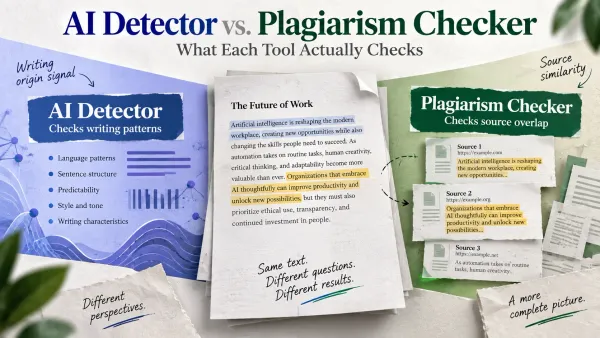
An AI detector estimates patterns in text. It does not confirm that a statement is true, that a citation supports it, that the advice is safe, or that the page answers the reader’s question. HumanizeAI’s own documentation says detector results can vary and that no tool can guarantee the same result across every detector.
Use a detector score, if your workflow requires one, as one signal—not as the editorial release gate. A fluent page can still be wrong, derivative, inaccessible, or commercially misleading. The 25 checks above evaluate publication quality rather than authorship appearance.
How to Add This Checklist to a Team Workflow
- Attach it to the brief. Writers should know the release criteria before drafting.
- Assign source ownership. The writer marks claims; the reviewer opens and verifies the underlying sources.
- Separate editorial and subject-matter approval. A copy editor can improve clarity, but may not be qualified to approve specialized advice.
- Save versions. Keep the source draft, humanized output, final approved copy, and change notes.
- Review the rendered page. Check the title, meta description, headings, table, links, image alt text, CTA, and mobile readability.
- Refresh the checklist. Add recurring failures from real reviews and remove checks that never change a decision.
A checklist should reduce ambiguity, not create ceremony. If a check cannot change Pass, Revise, or Stop, rewrite it so the editor knows what action to take.
Frequently Asked Questions
What should I check after humanizing text?
Check facts, numbers, scope, citations, voice, rhythm, specificity, repetition, search intent, headings, links, accessibility, and the final CTA. Compare important claims with their original sources.
How do I know AI text sounds natural?
It should sound appropriate for the audience, use specific language, vary sentence structure without becoming erratic, and make its point without generic transitions or exaggerated confidence. Read it aloud and ask an independent editor to explain the main action.
Is an AI detector score enough?
No. A detector score does not verify truth, usefulness, originality, citation quality, brand fit, or accessibility. Treat it as one optional signal, never as the sole publication decision.
Who should approve humanized content?
A responsible editor should approve the final page. High-stakes or specialized claims also need review from an appropriately qualified subject-matter, legal, compliance, or policy owner.
Should every checklist item have the same weight?
No. Accuracy, source integrity, safety, and required approvals are blocking issues. Sentence rhythm or minor repetition usually call for revision rather than a full stop.
How often should the checklist be updated?
Review it whenever your workflow, product, policy, or recurring error pattern changes. A quarterly review is a practical internal cadence, but there is no universal required interval.
Turn Humanization Into a Controlled Editorial Step
The purpose of humanization is not to make a draft look finished. It is to make accurate, useful writing easier for a real audience to understand. Use the checklist as a release gate, record who approved the page, and send failed claims back to their sources.
Try HumanizeAI with your own text, then apply the 25-point review before publication. For higher usage limits and ongoing content workflows, compare HumanizeAI plans.
Sources / References
- Google Search guidance on using generative AI content — accuracy, quality, relevance, and manual fact-checking; updated October 1, 2026.
- Google Search: Creating helpful, reliable, people-first content — originality, completeness, sourcing, and self-assessment.
- W3C Web Accessibility Initiative: Writing for Web Accessibility — descriptive headings, meaningful links, clear language, and image text alternatives.
- HumanizeAI: How to use the AI Humanizer tool — result variability, post-humanization review, and meaning-preservation guidance; updated April 29, 2026.