Is GPTZero Accurate? What Independent Research Shows
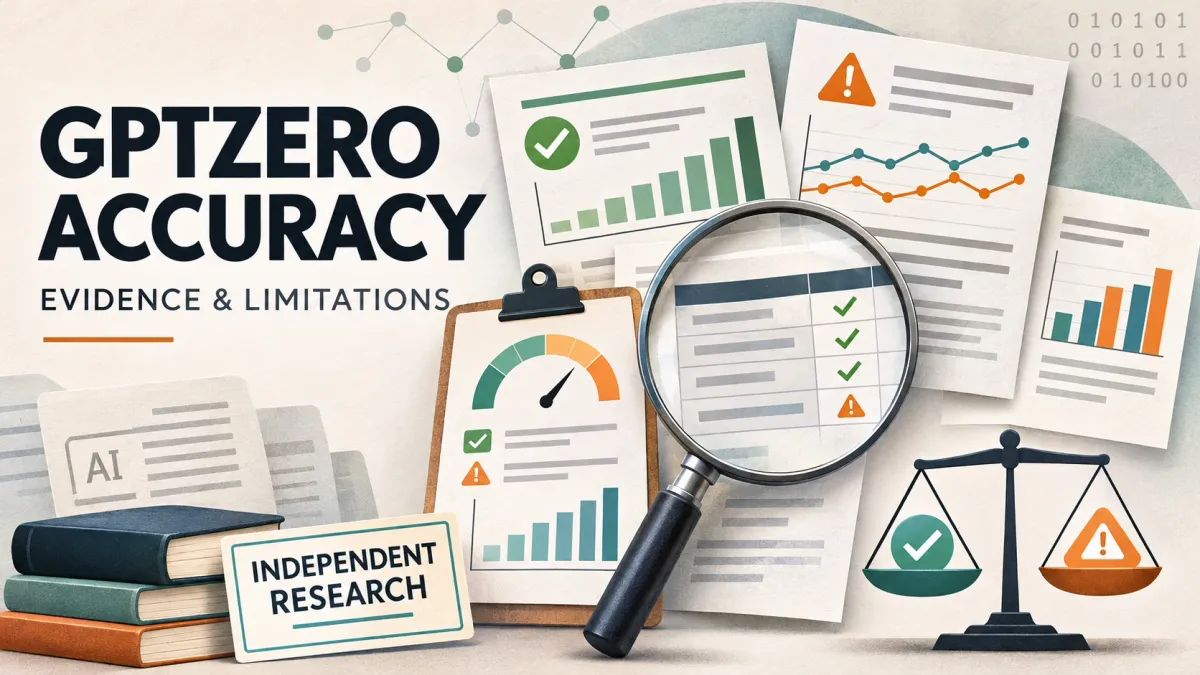
GPTZero accuracy review comparing independent AI detection studies, false positives, and reliability limitations.GPTZero can accurately identify AI-generated writing in some conditions, but its accuracy varies substantially across studies, text types, and detector versions. Independent research has found strong results on straightforward human-versus-AI classification tasks, alongside significant failures with mixed, edited, and certain newer AI-generated texts.
In one 2025 study, GPTZero achieved 97.22% accuracy on a controlled academic-abstract dataset. A separate 2026 study found that an earlier GPTZero version failed to correctly identify most fully AI-generated academic papers in its test. Neither result establishes the accuracy of every current GPTZero scan.
That makes GPTZero potentially useful as an initial screening tool, but not reliable enough to serve as standalone proof of authorship or academic misconduct.
If you want another perspective on a writing sample, HumanizeAI offers an AI detector. A second classification can add information, but agreement between detectors does not prove how a document was written.
Editorial disclosure: HumanizeAI operates an AI detection tool and is commercially interested in this category. This review evaluates GPTZero using published research, official product documentation, and the limitations of each source. HumanizeAI has not conducted the independent experiments discussed below.
How Accurate Is GPTZero? The Evidence at a Glance
There is no scientifically defensible single accuracy percentage for GPTZero across every writing scenario.
A detector's measured performance depends on which version was tested, the dataset, the AI models used to create the text, and the classification threshold.
Here is what several published evaluations found.
Sources: PeerJ study, Dik et al. preprint, International Journal for Educational Integrity study, and GPTZero's official benchmark.
These studies do not measure the same task. Their results should not be averaged into a single GPTZero accuracy figure.
The most important takeaway is that GPTZero has demonstrated useful detection capabilities, but performance on one benchmark does not guarantee the same reliability on another document.
What Independent Research Says About GPTZero's Accuracy
1. A 2025 study found strong accuracy on academic abstracts
The 2025 study The Accuracy-Bias Trade-offs in AI Text Detection Tools and Their Impact on Fairness in Scholarly Publication, published in PeerJ Computer Science, evaluated GPTZero, ZeroGPT, and DetectGPT.
Researchers examined two scenarios:
- Distinguishing original human-written abstracts from fully AI-generated abstracts.
- Evaluating abstracts that began as human writing and were later improved using AI tools.
In the first scenario, GPTZero recorded:
GPTZero performed better than ZeroGPT and DetectGPT on the study's primary binary-classification task.
That is meaningful positive evidence. It shows that GPTZero can perform well when the evaluation conditions and categories are clearly defined.
The picture changed for AI-assisted writing.
In the second scenario, the researchers observed that GPTZero's scores varied considerably. AI-assisted abstracts received higher average AI-related scores when the original authors were non-native English writers than when they were native English writers.
The researchers also reported an over-detection rate of 18.06% in this scenario, using their definition of classifying the entire AI-assisted abstract as AI-written despite human contributions.
These findings suggest that distinguishing fully AI-generated text from fully human text can be substantially easier than interpreting mixed-authorship documents.
What this study establishes: GPTZero can show strong classification performance in a controlled academic setting.
What it does not establish: That every GPTZero version will maintain the same accuracy across all writing styles, languages, and levels of AI assistance.
2. A 2025 essay evaluation identified a meaningful false-positive risk
Researchers Selin Dik, Osman Erdem, and Mehmet Dik evaluated GPTZero using 50 human-written student essays and 28 AI-generated essays.
Their 2025 preprint reported that GPTZero correctly identified all 28 AI-generated essays.
But it also classified eight human-written essays as AI-generated.
That represents a 16% false-positive rate among the 50 human essays in this sample.
The study also examined writing length, with more classification problems observed among some shorter human-written texts.
This evaluation is relatively small, and its results should not be generalized to every current GPTZero model.
Nevertheless, the false positives matter because a system can correctly identify AI writing while still incorrectly accusing genuine human writing.
The study is also summarized in Stanford's SCALE research repository. Repository inclusion should not be confused with the experiment being conducted or independently validated by Stanford.
3. A 2026 study found major failures on longer academic papers
The study Who Wrote This? Evaluating the Reliability of AI Detection Tools in Higher Education was published in the International Journal for Educational Integrity on June 29, 2026.
Researchers compared GPTZero, Pangram, Copyleaks, and Turnitin using 160 academic papers.
The dataset contained four categories, each with 40 documents:
- Fully human-written papers.
- Fully AI-generated papers.
- Hybrid documents containing human and AI-generated text.
- AI-generated content modified to resemble human writing.
Each paper contained at least 4,000 words.
The results were significantly different from those reported in the 2025 PeerJ evaluation.
All four detectors correctly classified the fully human-written documents in this study.
But GPTZero underestimated AI-generated content in several other categories.
For the fully AI-generated papers, 70% fell within the researchers' false-negative score band, while the remaining 30% fell within a partially false-negative band.
For the hybrid papers, GPTZero correctly identified none of the 40 papers under the study's strict scoring criteria.
For the humanized papers, only one of the 40 was correctly identified under those criteria.
These results are not interchangeable with a conventional binary document-classification accuracy figure. The researchers evaluated how closely the reported AI-content estimates matched the known composition of each document.
They nevertheless demonstrate a substantial limitation in this particular academic evaluation.
A correction published on October 6, 2026 clarified the naming of the model used for the fully AI-generated texts. The study's published results were not replaced by new measurements.
What this study establishes: The tested GPTZero version performed poorly on several long-form academic and mixed-text scenarios.
What it does not establish: That GPTZero's subsequently released models have exactly the same failure rates.
GPTZero's Official Accuracy Claims vs. Independent Evidence
GPTZero also publishes its own benchmark results.
On February 5, 2026, the company released an evaluation comparing its detector with Pangram, Originality.ai, Grammarly, and QuillBot.
For GPTZero model 4.3b, its reported average results across four domains were:
The company describes how it constructs benchmark datasets, identifies tested detector versions, and provides access to many of its predictions.
That transparency is useful because it gives researchers more information about how the figures were produced.
However, these numbers come from GPTZero's own evaluation.
They should be described as vendor-reported benchmark results, not independent confirmation of universal performance.
The methodology also differs from the academic studies discussed above. GPTZero's benchmark uses particular domains, AI generators, examples, and classification mappings.
See GPTZero's benchmarking methodology.
Has GPTZero improved since those independent studies?
GPTZero releases frequent detection-model updates.
Its official release notes identify model 5.0b, released November 4, 2026, with improvements intended to address polished and AI-paraphrased text, reduce false positives across several domains, and increase model capacity.
That is relevant because older independent studies could not have evaluated a model released in November 2026.
GPTZero also released updates during September and October 2026 addressing false-positive performance and detection of mixed or modified text.
These changes provide plausible reasons why current performance may differ from historical studies.
But a product update and its accompanying claims do not independently establish how much performance improved in real-world use.
The unresolved question is how GPTZero 5.0b performs on recent, independently collected datasets covering realistic writing and editing workflows.
See GPTZero's official release notes.
What Is GPTZero's False-Positive Rate?
A false positive occurs when a detector classifies genuinely human-written text as AI-generated.
For educational and professional users, it is one of the most important accuracy measures.
Different studies have reported very different false-positive outcomes.
The 2025 PeerJ evaluation reported a 0% false-positive rate for GPTZero in its initial binary-classification experiment.
The 2025 essay evaluation incorrectly flagged eight out of 50 human-written essays, corresponding to a 16% rate within that sample.
The 2026 higher-education study correctly classified all 40 fully human-written papers.
These findings are not necessarily contradictory.
The studies differed in text length, subject matter, writing population, detector version, scoring method, and evaluation procedure.
An observed false-positive rate of 0% in one dataset does not mean the true rate is zero across all possible documents.
Likewise, 16% in a small historical study is not a validated estimate of the current product's overall false-positive rate.
Why false positives matter
Imagine an instructor reviewing 200 essays.
Suppose, purely as an illustrative scenario, 190 were genuinely human-written and 10 were entirely AI-generated.
A hypothetical detector with 95% recall and a 5% false-positive rate could flag approximately 10 human essays incorrectly while identifying approximately 9 or 10 AI essays.
Even strong detection performance would leave substantial work for a fair review process.
Those numbers are hypothetical, not measured GPTZero performance.
The example demonstrates why accuracy alone is insufficient when the cost of a false accusation is high.
For a detailed explanation of error types, evidence preservation, and appeals, read our guide to AI detector false positives.
Can GPTZero Detect ChatGPT and Other AI Models?
Yes, GPTZero has demonstrated an ability to identify text generated by ChatGPT and other language models in several evaluations.
The 2025 academic-abstract study tested generated text associated with ChatGPT o1 and Gemini 2.0 Pro Experimental.
The 2025 essay evaluation included ChatGPT-generated writing and reported successful detection of the AI essays in its sample.
GPTZero's own benchmarks also test outputs from a selection of language models.
But detecting one model's unedited writing does not prove that the detector will identify every output from every subsequent model.
Text domain, prompt, editing history, and the detector's version can all influence the outcome.
For a broader overview of what different detectors can establish, read can ChatGPT be detected?.
Can GPTZero Reliably Detect Mixed or Edited AI Writing?
This is one of the most important limitations for real-world users.
Writing is not always fully human or fully AI-generated.
A person might use AI to brainstorm, correct grammar, rewrite a paragraph, translate material, or generate an initial draft that is extensively edited afterward.
These activities produce different kinds of documents.
An AI detector evaluates the resulting text, not the complete history of how that text was created.
The 2026 higher-education study found that the tested GPTZero version significantly underestimated AI-related content in hybrid and humanized academic papers.
The 2025 PeerJ study likewise demonstrated that AI-assisted abstracts were more difficult to evaluate consistently than fully human or fully AI-generated examples.
GPTZero has introduced model updates intended to improve handling of these scenarios.
However, current independent evidence should be distinguished from earlier benchmarks and the company's own improvement claims.
Practical conclusion: Mixed-authorship detection is an important capability to evaluate, but an overall AI score should not be interpreted as an exact reconstruction of a document's editing history.
Is GPTZero Accurate Enough for Students and Teachers?
GPTZero can have a useful role in educational screening when its limitations are understood.
For example, an instructor might use a result to identify a document that deserves closer review, especially if there are other concerns about its writing process.
But the score should not be the sole basis for accusing a student of misconduct.
The correct decision depends on the applicable institutional policy and other available evidence.
Practical suitability by use case
A good review process should examine source materials, outlines, revision history, the student's or writer's explanation, and any permitted AI assistance.
The purpose is to establish what actually happened, not merely to collect more detection percentages.
Does Text Length Affect GPTZero Accuracy?
Text length can influence the reliability and interpretation of AI detection results.
Short samples provide less information about a writer's language patterns. Longer samples provide more context but may contain mixed authorship, quotations, or different writing styles.
The 2025 essay evaluation observed a higher rate of incorrect classifications among its shorter human-written examples than among some longer categories.
GPTZero's own benchmarks also examine short texts, but those results remain specific to their tested models and datasets.
There is no universal word count above which every GPTZero result becomes reliable.
For high-stakes review, avoid drawing broad conclusions from a single sentence, and check the current tool's input requirements.
Why Do GPTZero Accuracy Studies Disagree?
The differences are easier to understand when you examine how detector benchmarks are constructed.
Accuracy, recall, precision, and false-positive rate measure different things
A detector might have high recall and still flag too much genuine human writing.
Another might rarely flag human writing but miss many AI-generated passages.
Comparisons become misleading when one study reports accuracy, another reports recall, and a third measures how closely percentages match the amount of generated content.
Other sources of disagreement include detector-version changes, domain differences, new language models, editing methods, sample length, language background, and benchmark selection.
A useful additional perspective comes from the September 2025 NBER working paper Artificial Writing and Automated Detection, by Brian Jabarian and Alex Imas. It evaluated multiple commercial detectors and emphasized the importance of considering false-positive and false-negative tolerances when deciding whether a detector is suitable for a particular task.
The paper should be identified as a working paper rather than automatically treated as peer-reviewed journal research.
GPTZero vs. Other AI Detectors: What Should You Compare?
There is no responsible way to declare one detector universally superior using a mixture of historical studies, vendor benchmarks, and different datasets.
If you are deciding between GPTZero and another AI detection tool, compare the characteristics that matter for your actual task.
You can also compare an additional classification with HumanizeAI's AI Detector.
The value of a second result is that it may reveal agreement or disagreement worth investigating.
It does not create independent ground truth.
A comparison between two detectors should never be presented as proof that the one returning the preferred score is more accurate.
How to Evaluate a GPTZero Result Responsibly
If GPTZero flags a document, use a consistent review process.
- Record the result. Save the score, classification, tested text, date, and model version if available.
- Confirm what the score means. Read GPTZero's current explanation instead of assuming the percentage represents the share of AI-written words.
- Check the input. Confirm that the text meets the product's current length and formatting requirements.
- Review the writing history. Look at outlines, drafts, source materials, notes, and document versions.
- Clarify any AI assistance. Identify which tools were used and whether their use was permitted.
- Use additional evidence appropriately. An alternative detector may provide context, but neither agreement nor disagreement settles the authorship question.
- Apply the relevant policy. Serious decisions should involve a fair human review with an opportunity to explain the writing process.
For more on the underlying classification technology, see how AI detectors work.
Frequently Asked Questions
Is GPTZero accurate in 2026?
GPTZero has shown strong results in some research settings and weak results in others. The company has released newer detection models, including GPTZero 5.0b in November 2026. Historical studies should not be interpreted as direct evaluations of that model without matching version evidence.
How accurate is GPTZero for essays?
Accuracy depends on essay length, writing style, authorship category, and detector version. A 2025 evaluation identified all 28 AI-generated essays in its sample but incorrectly flagged eight of 50 human-written essays. That result is informative but cannot be generalized to every essay or current model version.
Can GPTZero falsely detect human writing as AI?
Yes. False positives have been observed in independent studies. The observed rate varies by dataset and testing conditions.
Can GPTZero detect ChatGPT writing?
GPTZero can identify ChatGPT-generated writing in some tested conditions. It cannot guarantee detection of every ChatGPT-generated or subsequently edited document.
Does GPTZero detect paraphrased AI text?
GPTZero has introduced models designed to improve detection of paraphrased and modified AI text. Earlier independent studies reported difficulties with edited and mixed writing. Current-version performance requires appropriately matched testing.
Is GPTZero reliable for short texts?
Short passages can be more difficult to classify because they provide limited context. Reliability depends on the detector's validated input conditions, and a short-text result should be interpreted cautiously.
Can teachers rely on GPTZero to prove cheating?
No. A detection result alone does not establish that a student violated an academic-integrity policy. A fair review requires additional evidence and the relevant institutional procedures.
Are GPTZero's paid results more accurate than its free results?
That cannot be assumed from price alone. Check whether the current subscription tiers use different detection models, scan depths, or features. Without direct evidence of a comparable accuracy difference, it is not appropriate to claim the paid product is more accurate.
Why might GPTZero and another AI detector disagree?
Different model architectures, training data, thresholds, scoring definitions, and treatment of mixed text can produce different results on the same document.
Is a 100% AI score proof that a document was generated by AI?
No. A displayed percentage reflects the detector's scoring method. It does not independently verify the document's complete writing history.
Final Verdict: Should You Trust GPTZero?
GPTZero is useful as a screening tool, but its results should not be treated as definitive evidence of authorship.
Independent evaluations show that it can perform strongly on some clearly labeled human-versus-AI writing tasks.
They also show that reliability can deteriorate in other contexts, particularly with mixed, modified, and certain long-form academic texts.
The newest versions may perform differently from those studied previously, but claims about their improvements need to be separated from independent validation.
For students and teachers, GPTZero is best considered one potentially useful input within a fair review process.
For publishers and businesses, it can provide a supplemental classification signal, but it cannot replace source verification, editorial judgment, or transparent authorship policies.
If you want to examine a writing sample using another tool, try the HumanizeAI AI Detector and interpret the result alongside the document's history and context.
The question is not whether GPTZero can ever be accurate. It can. The question is whether its accuracy has been demonstrated for the particular text and decision you are evaluating.