What Does an AI Detection Score Mean? Percentages Explained

An AI detection score tells you how an AI detection tool has classified a piece of writing. It may represent the model's confidence that the text is AI-generated, the estimated proportion of text flagged as AI, or a product-specific score.
A 70% AI detection score does not automatically mean that 70% of your words were written by AI. The meaning depends on which detector you used and how that detector calculates its results.
For example, GPTZero uses percentages to express confidence in its document classification, while Turnitin reports the proportion of qualifying text its model identifies as potentially AI-generated. HumanizeAI uses a documented scoring scale with categories ranging from Human-written to AI-generated.
If you want to examine a writing sample, you can use the HumanizeAI AI Detector and compare the result with the scoring guidance explained below.
This guide covers what common AI detection percentages mean, how to read a detector report, why different tools disagree, and what to do when a result seems unexpected.
What Does an AI Detection Score Actually Tell You?
An AI detection score is the output of a statistical classification system. The tool analyzes a submitted text and looks for patterns associated with human-written or AI-generated language.
It does not directly observe how the document was created.
A detector generally cannot reconstruct who typed each sentence, which editing tools were used, or whether AI assistance was permitted under a particular policy.
Four terms are especially important when interpreting a result:
The distinction matters because two detectors can display the same percentage while measuring different things.
For a technical explanation of the underlying classification systems, read how AI detectors work.
What Does an AI Detection Percentage Mean?
There are three common ways to interpret an AI detection percentage.
1. Classification confidence
Some detectors use a percentage to express how strongly their model favors a particular category.
GPTZero, for example, explains that a result of 75% AI describes its model's confidence in classifying the document as AI-generated. It does not mean that 75% of the sentences were written by AI.
This is a model-specific confidence value. It should not automatically be treated as a perfectly calibrated probability of the document's real authorship.
Source: GPTZero — How Do I Interpret a Result?.
2. Estimated proportion of flagged text
Other detectors use percentages to describe how much eligible text they classify as likely AI-generated.
Turnitin uses this approach in its AI Writing Report. Its overall percentage represents the proportion of qualifying prose that the model identifies as potentially AI-generated or AI-generated and subsequently modified by certain rewriting tools.
That does not necessarily equal the percentage of the entire document, because some types of content may not qualify for analysis.
Source: Turnitin — Using the AI Writing Report.
3. A product-specific classification score
Some products use numerical scores with defined interpretation bands.
HumanizeAI's published documentation assigns four labels to scores between 0% and 100%.
The score indicates how the tool classifies the text's writing patterns according to its documented scale.
The documentation does not establish that the percentage should be interpreted as an exact share of machine-written words or a mathematically calibrated probability.
AI detection score meanings compared
Sources: HumanizeAI, GPTZero, Turnitin, Pangram, and Grammarly.
The practical rule: identify what the percentage measures before deciding what it means.
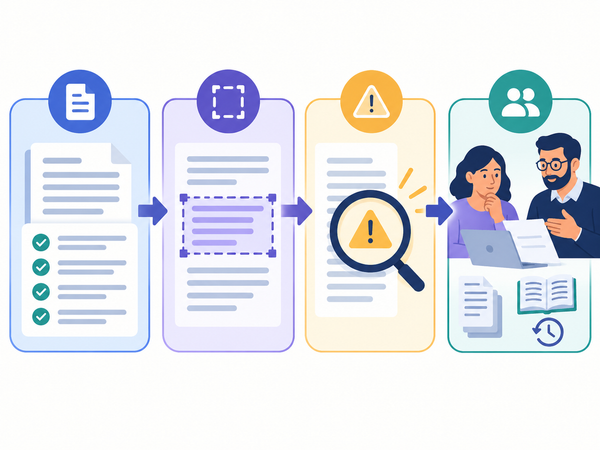
How to Read an AI Detection Report: 7 Steps
A percentage alone is not enough to interpret a detector result responsibly.
Use this process whenever you review an AI detection report.
Step 1: Identify the detector
Record which tool produced the result.
A score from GPTZero cannot be interpreted using Turnitin's scoring rules, and a HumanizeAI score should be evaluated against HumanizeAI's own documentation.
If the version or model is available, record that as well.
Step 2: Find the score definition
Look for the tool's explanation of its percentage.
Ask whether it represents:
- Confidence in a classification
- An estimated share of flagged text
- A composite or proprietary numerical score
Do not assume a percentage is a literal measurement of authorship.
Step 3: Read the classification label
The label may provide more useful context than the number alone.
For example, two results displayed as 50% may have different meanings when one tool calls the document uncertain and another categorizes a portion of its text as potentially AI-generated.
Read the label and any accompanying explanation together.
Step 4: Check the submitted text
Confirm exactly what was analyzed.
Was it a complete essay, a selected paragraph, an email, or several combined passages?
Also check whether the text met the detector's input requirements.
A result based on a short excerpt may not be comparable to one based on the complete document.
Step 5: Review highlighted passages, if available
Some detectors highlight sections that contributed to their classifications.
A highlighted sentence identifies material the system flagged or considered influential. It does not independently prove how that sentence was written.
Read the passage in context.
Do not assume the whole document has the same characteristics as its most heavily flagged paragraph.
Step 6: Consider the writing process
The detector sees the submitted language, not the full history of its creation.
Consider whether the document includes:
- Human-written content
- AI-generated passages
- AI-assisted editing
- Translation
- Quotations or cited material
- Contributions from multiple authors
These distinctions may be relevant even when the detector produces a single overall number.
Step 7: Decide whether further review is necessary
For routine editorial work, a result may simply help identify passages worth checking for clarity and consistency.
For academic, employment, or other consequential decisions, a score should be evaluated alongside drafts, source materials, version history, disclosures, and the applicable rules.
A detector result is a reason to investigate when appropriate, not an automatic verdict.
What Do 30%, 50%, 70%, and 100% AI Detection Scores Mean?
The interpretation of these numbers depends on the detector's scoring system.
The following examples are illustrative, not results from actual document tests.
These descriptions illustrate two different scoring models. They are not universal thresholds or guarantees about any particular document.
What does a 30% AI detection score mean?
A 30% score might indicate a relatively weak AI classification signal under a confidence-based system.
Under a flagged-text system, it could mean that approximately 30% of qualifying text was identified as potentially AI-generated.
Those interpretations are fundamentally different.
You should not conclude that a document is 70% human-written simply because a detector displays 30% AI.
What does a 50% AI detection score mean?
A 50% score is especially easy to misunderstand.
In a confidence-based system, it may indicate substantial uncertainty.
In a flagged-text system, it may describe the amount of eligible content classified as AI-related.
For HumanizeAI specifically, the published documentation places 50% in the Likely Human band.
The same number therefore cannot be interpreted consistently across products.
What does a 70% AI detection score mean?
A 70% result indicates a stronger AI-related signal in some scoring systems.
But it does not automatically establish that 70% of the document was generated by an AI model.
A confidence-based detector may be describing its classification confidence. A text-share detector may instead be estimating how much eligible prose matches AI-related patterns.
If the result is consequential, review the report's definition and the document's writing history rather than treating 70% as a universal misconduct threshold.
What does a 100% AI detection score mean?
A displayed 100% does not give software access to the document's actual creation history.
Under a confidence system, it may represent the highest confidence value the interface displays.
Under a flagged-text system, it may indicate that all eligible text was classified as potentially AI-generated.
Neither interpretation independently proves that every word was created by a chatbot.
The correct conclusion is that the tool produced its strongest possible result under the relevant scoring method. Additional evidence is still needed to establish authorship in a high-stakes setting.
How Does HumanizeAI Interpret AI Detection Scores?
According to the official HumanizeAI AI Detector documentation, the tool uses a numerical scale with four classification categories.
HumanizeAI's documented score ranges
These are HumanizeAI's published classification bands, not universal AI detection standards or independent proof of authorship.
The documentation also describes a color-coded scoring meter, ranging from green for human-like classifications to red for AI-related classifications.
Example: Interpreting a 70% HumanizeAI result
Suppose a sample receives a score of 70%.
Under the documented HumanizeAI scale:
- The score falls within the 66–100% range.
- The corresponding classification is AI-generated.
- The tool has identified patterns associated with its AI-related classification.
What the result does not establish is that exactly 70% of the words were written by AI.
It also does not identify the document's author, establish when or how AI assistance occurred, or prove that a school or workplace policy was violated.
How to check a sample with HumanizeAI
The published workflow is straightforward:
- Open the HumanizeAI AI Detector.
- Paste a representative writing sample or use the available document-submission option.
- Run the detection check.
- Read the displayed score and classification.
- Compare the result with the official scoring guidance.
- Review the original text and its writing context before deciding what action is appropriate.
HumanizeAI's documentation recommends at least 100–200 words for a more informative analysis. This is a product-specific recommendation, not a guarantee of accuracy above that length.
The most useful approach is to treat the score as an editorial or investigative signal rather than a definitive determination of authorship.
Why Can Two AI Detectors Give Different Scores?
It is possible for the same document to receive substantially different scores from two AI detectors.
That does not necessarily mean one tool is broken.
Several differences can affect the result.
Different scoring definitions
A confidence score and an estimated flagged-text percentage are not directly comparable.
A 75% result from one tool may describe its model's confidence, while a 75% result from another may describe the estimated proportion of qualifying text classified as AI-related.
Different training data
Detectors are developed using different combinations of human-written and AI-generated material.
Their performance can vary across genres, subjects, languages, and different generations of writing models.
Different classification thresholds
One detector may use a conservative threshold for flagging text as AI-related.
Another may favor identifying more potentially AI-generated material at the cost of additional false positives.
Different treatment of mixed writing
A document may contain human-written paragraphs, AI-generated passages, and sections edited with AI assistance.
Some tools offer mixed classifications or segment-level breakdowns. Others summarize the document using one overall result.
Different sample requirements
A short paragraph and a full essay provide different amounts of text for analysis.
Some detectors also exclude particular content formats, which changes what contributes to the percentage.
A 2026 study in Studies in Educational Evaluation examined five detectors across 500 academic text excerpts. It reported strong discrimination for fully human versus fully AI-generated material, but weaker performance for hybrid and humanized text.
The study also found that detectors could broadly agree while producing different absolute scores.
Source: Rosenthal et al., "Interpreting AI Text Detection Outputs" (2026).
Practical takeaway: Compare a tool's result with its own definitions and limitations before comparing the numerical score with another product.
Can an AI Detector Be Wrong?
Yes. AI detectors can produce both false positives and false negatives.
A false positive occurs when human-written text is incorrectly classified as AI-generated.
A false negative occurs when AI-generated text is incorrectly classified as human-written.
The consequences of those mistakes depend on the context.
An incorrect flag in a routine content review may lead to unnecessary editing. An incorrect flag in an academic-integrity investigation may have more serious consequences.
What does independent research say?
A 2023 Stanford-led study published in Patterns evaluated seven detectors using essays from non-native English writers and US eighth-grade students.
The researchers reported an average false-positive rate of approximately 61% on the non-native English essay sample, compared with much stronger performance on the native-English student sample.
That result demonstrated a serious fairness concern in the evaluated detectors. It should not be treated as the current false-positive rate of every modern detector.
Source: Liang et al., "GPT Detectors Are Biased Against Non-Native English Writers".
Another study, published in the International Journal for Educational Integrity in December 2023, assessed 14 detection systems and documented reliability problems, particularly when AI-generated text had been modified.
Source: Weber-Wulff et al., "Testing of Detection Tools for AI-Generated Text".
For a more detailed explanation and a fair-review workflow, see AI detector false positives.
Does Text Length Affect an AI Detection Score?
Yes. Text length can affect how much information a detector has available and how its results should be interpreted.
A single sentence may provide too little context for a useful classification.
A longer document may provide more evidence, but it can also contain quotations, multiple authors, mixed AI assistance, or sections written at different times.
There is no universal minimum word count that makes every AI detector reliable.
For example:
A 2026 research review of this specific issue is available in HumanizeAI's guide on how text length affects AI detector accuracy.
When checking a document, use a representative passage that meets the tool's requirements. Avoid combining unrelated pieces of writing merely to produce a longer input.
What Should You Do After Receiving a High AI Detection Score?
A high score is a reason to review the text and its context. It is not, by itself, a reason to assume misconduct or rewrite everything.
Use this checklist.
1. Preserve the original document
Save the version that was analyzed before making changes.
This helps you distinguish the submitted work from later revisions.
2. Record the result
Keep a record of the detector name, date, score, classification, tested passage, and any available settings or version details.
3. Confirm the percentage definition
Establish whether the result describes confidence, qualifying text share, or another scoring method.
4. Review the document context
Check whether the submission includes quotations, translated passages, AI-assisted revisions, collaborative writing, or content outside the detector's supported formats.
5. Preserve writing-process evidence
Relevant evidence may include:
- Earlier drafts and outlines
- Notes and research materials
- Document revision history
- Source references
- Editor feedback
- Records of any AI tools used
6. Disclose AI assistance accurately
If AI tools were used, describe that assistance truthfully according to the applicable school, workplace, client, or publisher policy.
Detection scores should not replace disclosure requirements.
7. Request human review when appropriate
If the result affects a grade, professional decision, or disciplinary process, ask for a review that considers the writing history and applicable rules.
Turnitin itself advises that its AI Writing Report should not be used as the sole basis for adverse academic action.
Source: Turnitin — How Should I Review the AI Writing Report?.
8. Improve the writing for legitimate editorial reasons
If the text is vague, repetitive, unsupported, or confusing, revise it to improve clarity and usefulness.
Do not rewrite genuine work solely to obtain a preferred detection percentage.
If your specific problem involves ZeroGPT, see why ZeroGPT may flag human-written text.
AI Detection Score vs. Plagiarism Score: What's the Difference?
AI detection and plagiarism checking answer different questions.
An AI detector estimates whether writing resembles content generated by an AI system.
A plagiarism checker identifies text that matches or resembles material available in other sources.
A fully human-written document can contain extensive quoted material and receive a high similarity score.
An AI-generated document may contain few direct source matches.
One score cannot substitute for the other.
For a more detailed comparison, see AI detector vs. plagiarism checker.
Common Mistakes When Interpreting AI Detection Scores
Assuming the percentage always means the same thing
A 70% score from GPTZero is not automatically equivalent to 70% from Turnitin or HumanizeAI.
Always check the scoring definition.
Treating a low score as proof of human authorship
A low score means the tool did not identify a strong AI-related signal under its own criteria.
It cannot prove that no AI assistance occurred.
Treating a high score as proof of misconduct
Writing may be flagged incorrectly, and permitted AI use differs by institution or employer.
Policy compliance requires evidence beyond the detector's output.
Assuming highlighted sentences prove individual authorship
A highlighted sentence is a model-generated assessment of a passage.
It does not directly identify the person or software responsible for writing it.
Ignoring sample length and eligibility
Some tools require minimum input lengths or analyze only certain types of prose.
Check what was actually included in the evaluation.
Repeatedly changing the sample until the score improves
Testing selected fragments until a preferred score appears can create misleading comparisons.
If you revise the document, keep the original version and focus on accuracy, clarity, and the legitimate purpose of the writing.
Frequently Asked Questions
What does a 50% AI detection score mean?
It depends on the detector. A confidence-based score may indicate uncertainty, while a flagged-text score may mean that approximately half of the qualifying text was classified as AI-related. HumanizeAI's published scale places 50% in its Likely Human category.
Is 70% AI detected a bad score?
It indicates a stronger AI-related classification in some tools, but "bad" is not a universal technical category. The interpretation depends on the detector, the document, and the relevant use policy. A high score should prompt appropriate review rather than automatic conclusions.
Does 100% AI mean every word was generated by AI?
Not necessarily. Under a confidence-based scoring system, 100% can represent the highest displayed confidence in a document classification. Under a text-share system, it may mean all eligible text was flagged. Neither result independently proves the history of every word.
Can human writing receive a high AI score?
Yes. False positives have been documented in independent research, including studies involving non-native English writing. The likelihood of error varies across tools, data, languages, and writing contexts.
Is a 0% AI detection score proof of human writing?
No. It indicates that the detector did not identify an AI-related signal under the scoring conditions it applied. It cannot verify that the entire writing process was human-only.
Why does Turnitin show a different score from GPTZero?
The tools use different models and scoring definitions. GPTZero describes its percentage as document-classification confidence, while Turnitin reports the proportion of qualifying prose identified as potentially AI-generated.
Can an AI detection score change after editing?
Yes. Editing changes the submitted text, and detectors evaluate the text they receive. A different score does not necessarily prove the new version is more or less authentic.
How accurate are AI detection percentages?
There is no single accuracy rate that applies to every detector or type of writing. Performance depends on the product, evaluation data, language, text length, threshold, and amount of human or AI editing. Review independent evidence rather than relying on a headline accuracy claim alone.
Should I trust multiple AI detectors more than one?
Additional tools can provide alternative classification signals, but their scores may not be directly comparable. Multiple detectors can also share weaknesses or produce correlated errors. Agreement is not equivalent to verified authorship.
Can a teacher prove AI use from a detector score alone?
A detector score alone is not reliable proof of how an assignment was written. Consequential academic decisions should consider other evidence, the student's writing process, institutional policy, and fair human review.
What should I do if my writing is incorrectly flagged?
Preserve the original document, drafts, notes, sources, and revision history. Record the detection result and explain the writing process accurately. If the result has serious consequences, request a review based on the relevant rules and supporting evidence.
Final Takeaway: Understand the Result, Not Just the Number
An AI detection score can tell you how a particular tool evaluates the patterns in your text.
It cannot independently reconstruct the writing process or establish whether someone violated a policy.
Before interpreting any percentage, identify the detector, read its score definition, check the classification label, and review the actual text that was analyzed.
A 30%, 50%, 70%, or 100% result is meaningful only within the scoring system that produced it.
For an additional perspective on a representative writing sample, try the HumanizeAI AI Detector, consult its published scoring guidance, and interpret the result alongside the writing's context and supporting evidence.
The most useful question isn't simply "What percentage did I get?" It's "What does this tool measure, and what evidence do I need before acting on it?"