AI Detector vs. Plagiarism Checker: What Each Tool Actually Checks
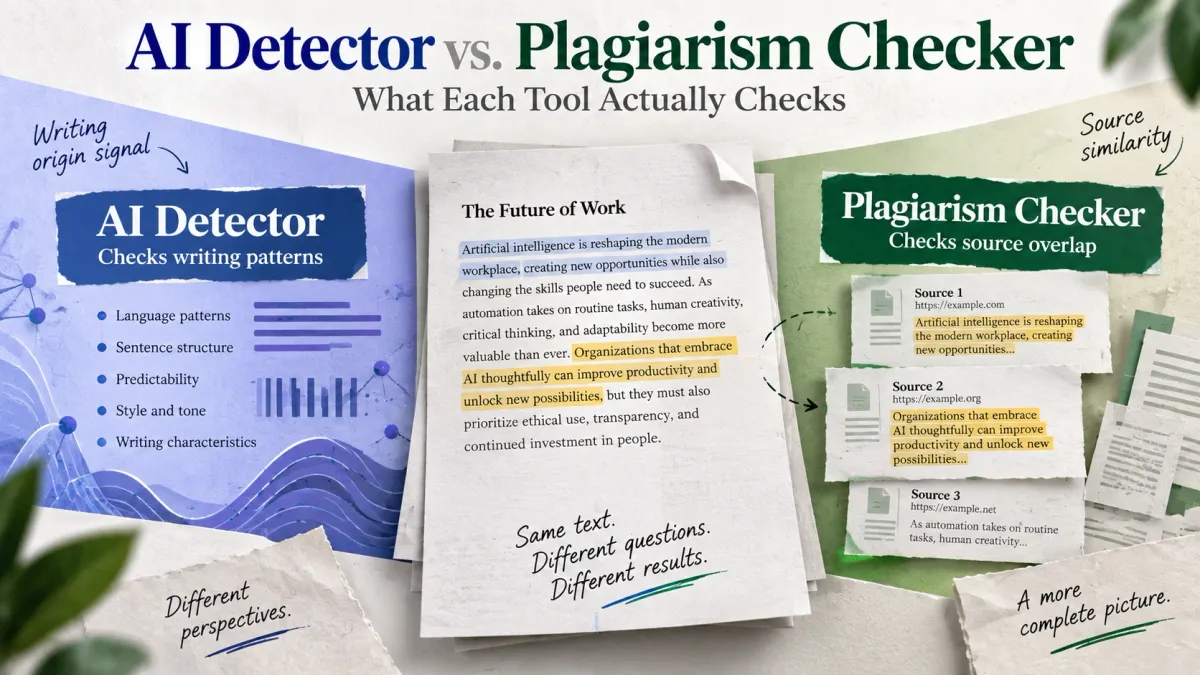
AI detectors and plagiarism checkers are often grouped together because both analyze written content. But they answer fundamentally different questions.
A plagiarism checker asks whether parts of a text match material found in other sources. An AI detector instead analyzes characteristics of the submitted writing to estimate whether it resembles AI-generated or AI-assisted text.
That distinction matters because a document can have very little source overlap and still appear AI-generated—or be entirely human-written while containing substantial matched text.
Quick Answer
An AI detector analyzes writing patterns and returns an estimate or classification related to possible AI-generated writing. A plagiarism checker compares text with sources available to its matching system and identifies similar or matching passages.
They do not measure the same thing, and one cannot replace the other.
Key Takeaways
- AI detection estimates whether text shows patterns associated with AI-generated writing.
- Plagiarism checking looks for text that matches or resembles material in available sources.
- AI-generated writing can have very low source similarity.
- Human-written content can still contain substantial source overlap.
- A similarity percentage does not automatically prove plagiarism.
- An AI-detection result should not be treated as definitive proof of authorship.
What Is an AI Detector?
An AI detector is a text-analysis tool designed to estimate whether writing resembles content produced by a generative AI system.
Different tools use different models and methods, but the basic goal is classification rather than source matching. HumanizeAI's documentation, for example, describes its AI Detector as analyzing writing patterns, sentence structure, and language characteristics to generate a human-versus-AI-related score.
The important word is estimate.
An AI detector does not need to locate an original source that matches the text. Instead, it evaluates features of the submitted writing and produces a signal about how the text is classified by that system.
That also means the result is not direct evidence of authorship.
Research evaluating AI-text detectors has documented false positives, false negatives, and variation between tools and writing types. One experimental study comparing human academic writing with ChatGPT- and Claude-generated text found meaningful classification errors across the tested detectors. More recent research has likewise raised concerns about using detector scores as standalone evidence in high-stakes decisions.
What Is a Plagiarism Checker?
A plagiarism checker is designed to identify textual overlap with other material available to its comparison system.
It typically:
- analyzes submitted text;
- searches for matching or similar passages;
- identifies the relevant sources; and
- produces a similarity or matching report.
HumanizeAI's plagiarism checker follows this general model by identifying matched passages and corresponding sources.
But there is an important distinction between similarity and plagiarism.
A matched passage may be:
- a correctly quoted sentence;
- a reference;
- commonly used wording;
- properly cited material;
- an inadequately paraphrased passage; or
- copied text without attribution.
The matching software identifies overlap. Determining whether that overlap constitutes plagiarism requires context.
Turnitin makes this distinction explicitly: its Similarity Report identifies matching text, but the similarity score alone does not determine whether plagiarism occurred.
AI Detector vs. Plagiarism Checker: Key Differences
| Comparison | AI Detector | Plagiarism Checker |
|---|---|---|
| Main question | Does this writing resemble AI-generated text? | Does this text overlap with available sources? |
| What it analyzes | Characteristics and patterns in the submitted writing | Matching or similar text |
| Requires a matching source | No | Yes, for a source match to be reported |
| Typical result | AI-related estimate, classification, or score | Similarity percentage plus matched sources |
| Best used for | Reviewing possible AI-generated or AI-assisted writing | Reviewing source overlap and attribution |
| Main limitation | Classification errors and cross-tool variation are possible | Results depend on the sources available to the system |
| Proves misconduct? | No | No |
The simplest way to remember the difference is:
AI detection is about writing origin signals. Plagiarism checking is about source overlap.
Those are separate questions.
Can AI-Generated Content Pass a Plagiarism Check?
Yes.
AI-generated content can return a low similarity result if the wording does not sufficiently match material in the plagiarism checker's available sources.
A plagiarism checker does not necessarily ask whether a language model generated the text. It asks whether the text matches something it can identify.
That means a document could theoretically be:
AI-generated + low similarity
For example, a language model might produce an original sequence of sentences that does not closely match any source accessible to the plagiarism checker.
But a low similarity result does not prove that the text was written by a human.
Turnitin explains a similar principle in its own documentation: a similarity score represents matching text found in its comparison database, not an authorship determination.
Can Human-Written Content Be Flagged by a Plagiarism Checker?
Yes.
Human authors can write material that matches other sources.
That may happen because of:
- direct quotations;
- reused wording;
- standard definitions;
- references;
- common phrases;
- insufficient paraphrasing; or
- copied material.
Some of those matches may be completely legitimate.
For example, a properly quoted and cited passage may still appear in a similarity report because the underlying words match another source. Turnitin specifically notes that quoted and referenced text may appear as matches even when it has been used appropriately.
This is why a high similarity percentage should not automatically be translated into "high plagiarism."
Can a Plagiarism Checker Detect AI-Generated Text?
Not by source matching alone.
A conventional plagiarism checker is designed to identify overlap between submitted text and existing sources. It may identify copied or closely matching material within AI-generated writing, but that does not tell you whether AI created the surrounding text.
Consider these two situations.
Example A: ChatGPT generates a completely new paragraph with no significant match to the plagiarism database.
Result: potentially low similarity.
Example B: A human copies several paragraphs from an existing article.
Result: potentially high similarity.
The first text may be AI-generated while the second is human-produced. The plagiarism result does not answer the authorship question.
Some platforms may offer plagiarism checking and AI detection in the same product, but the two analyses still address different properties.
Can an AI Detector Detect Plagiarism?
Not reliably as a substitute for source matching.
An AI detector can classify writing as showing more or fewer AI-like characteristics without knowing whether the text was copied from another source.
For example, a person could manually copy a human-written article word for word.
An AI detector might classify that prose as human-like because the source itself was written by a person.
But a plagiarism checker could identify the direct source overlap.
So:
AI detector ≠ source matcher
and:
plagiarism checker ≠ AI authorship detector
AI Score vs. Similarity Score: Why You Should Not Compare Them Directly
This is one of the easiest mistakes to make.
Suppose a report showed these hypothetical results:
- AI-related score: 70%
- similarity score: 8%
Those numbers do not add up to 78%, contradict each other, or describe opposite ends of one scale.
They measure unrelated things.
The AI score relates to how the detector classifies the writing.
The similarity score relates to how much matching text the source-comparison system found.
Likewise:
- a high AI score does not require high similarity;
- a low AI score does not guarantee original sourcing;
- a high similarity score does not mean a language model wrote the text; and
- 0% similarity does not prove human authorship.
Treat each report independently.
When Should You Use an AI Detector?
Use an AI detector when your actual question concerns possible AI-generated or AI-assisted writing.
Common scenarios include:
- reviewing content that may have been produced with a language model;
- checking your own AI-assisted draft before editorial review;
- examining AI-writing signals during content QA;
- investigating possible AI use alongside other evidence; or
- understanding how a piece of writing is classified by an AI-detection system.
You can use HumanizeAI's AI Detector for this type of analysis.
But the result should remain one signal rather than the sole basis for an important conclusion.
HumanizeAI's own documentation notes that detector results can vary with topic, writing style, and other factors and explicitly advises treating AI detection as guidance rather than definitive judgment.
For a deeper discussion of those limitations, see our guide on whether ChatGPT can be detected.
When Should You Use a Plagiarism Checker?
Use a plagiarism checker when your question is about source overlap.
For example:
- Does this paragraph closely match another publication?
- Did I accidentally reuse wording from one of my research sources?
- Are my quotations correctly attributed?
- Does a submitted article reuse passages from existing content?
- Which sources correspond to the matching text?
A plagiarism checker is better suited to those questions because it can identify the text matches and show the sources associated with them.
The important next step is reviewing those matches rather than reacting only to the percentage.
Should You Use Both an AI Detector and a Plagiarism Checker?
Sometimes.
If you need to answer both of these questions:
- Does this text overlap with existing sources?
- Does this writing show patterns associated with AI-generated text?
then using both tools can give you two different types of information.
A sensible workflow is:
Step 1 — Identify your question
If you care about copied or matched text, start with source similarity.
If you care about possible AI-generated writing, use an AI detector.
Step 2 — Run the appropriate check
Do not use the wrong tool as a proxy for the question you actually want answered.
Step 3 — Review the evidence behind the result
For plagiarism checking, inspect the matched passages and sources.
For AI detection, treat the result as a classification signal rather than proof.
Step 4 — Run the second check only if needed
If both source originality and possible AI use matter, use both tools.
Step 5 — Interpret the results separately
Do not average or combine AI-detection and similarity percentages.
Step 6 — Apply human judgment
This is especially important when the result could affect a student's grade, an author's reputation, employment, publication, or another consequential decision.
What Are the Limitations of AI Detection?
AI detectors are classification systems, and classification can be wrong.
Published evaluations have reported both false positives—human text classified as AI—and false negatives—AI-generated text classified as human. Performance can also vary depending on the model, writing type, editing, and detector being tested.
Recent research has also documented substantial disagreement between multiple commercial detectors when analyzing the same human-authored text, reinforcing the case for caution in high-stakes interpretation.
For that reason, an AI score is better viewed as supporting evidence than a definitive authorship verdict.
What Are the Limitations of Plagiarism Checking?
Plagiarism checking has a different set of limitations.
A similarity system can only report matches against sources available to it.
It also cannot automatically determine why a match exists.
A matching sentence could represent:
- correct quotation;
- legitimate citation;
- formulaic language;
- inadequate paraphrasing;
- accidental reuse; or
- deliberate copying.
Turnitin explicitly states that the Similarity Report identifies textual matches and leaves the determination of plagiarism to human evaluation.
So similarity is evidence to investigate—not a verdict.
Which Tool Should You Choose?
Use this simple rule:
Choose an AI detector when you want to evaluate possible AI-generated writing.
Choose a plagiarism checker when you want to evaluate source overlap.
Use both when you need answers to both questions.
Neither tool universally replaces the other.
And neither result should automatically be used as proof of misconduct.
If the question you're trying to answer is specifically whether writing exhibits AI-generated characteristics, you can start with HumanizeAI's AI Detector. If the concern is copied or matching material, run the text through the separate plagiarism checker and inspect the corresponding sources.
Frequently Asked Questions
What is the difference between an AI detector and a plagiarism checker?
An AI detector estimates whether writing resembles AI-generated text. A plagiarism checker compares text with existing sources and reports matching or similar passages. They evaluate different properties of the same document.
Can AI-generated content pass a plagiarism checker?
Yes. AI-generated text may receive a low similarity result if its wording does not closely match sources available to the plagiarism system. A low similarity score does not prove that the text is human-written.
Can a plagiarism checker detect ChatGPT?
A standard plagiarism checker can identify source overlap in ChatGPT-generated text, but that is not the same as identifying ChatGPT authorship. AI detection is a separate analysis. For more detail, see our guide to detecting ChatGPT-generated content.
Can an AI detector detect plagiarism?
Not as a substitute for a plagiarism checker. An AI detector analyzes writing characteristics rather than searching for matching source material, so copied human-written content could still appear human-like to the detector.
Can human-written text be flagged as AI?
Yes. Independent studies have documented false positives in AI-text detection, which is one reason detector results should be interpreted alongside other evidence rather than treated as proof of authorship.
Does 0% plagiarism mean the content was written by a human?
No. A 0% or very low similarity result means the system found little or no qualifying source overlap under its configured search conditions. It does not establish who or what wrote the text. Turnitin, for example, defines a 0% similarity result in terms of matching sources, not authorship.
Do I need both an AI detector and a plagiarism checker?
Use both when both questions matter. The plagiarism checker evaluates source overlap, while the AI detector evaluates possible AI-writing characteristics. Review each result separately rather than combining their scores.
Sources and References
- HumanizeAI — AI Detector documentation. Used for HumanizeAI's current description of its detector workflow, score interpretation, and stated limitations.
- HumanizeAI — Plagiarism Checker documentation. Used for current source-matching and result-reporting functionality.
- Turnitin — Understanding the Similarity Score / Turnitin and Plagiarism. Used to support the distinction between text similarity and a determination of plagiarism.
- Weber-Wulff et al. / related experimental AI-detection literature summarized in PubMed-indexed research. Used to support discussion of false positives, false negatives, and detector-performance variation.
- Angelier, 2026, AI and Ethics. Used for the discussion of cross-tool inconsistency and the limitations of final-text AI classification in consequential decisions.
The article is ready to publish on the proposed URL without changing the existing AI Detector, Plagiarism Checker, or Can ChatGPT Be Detected keyword ownership.