AI Detectors and Non-Native English Writers: False Positives, Bias, and Fair Review

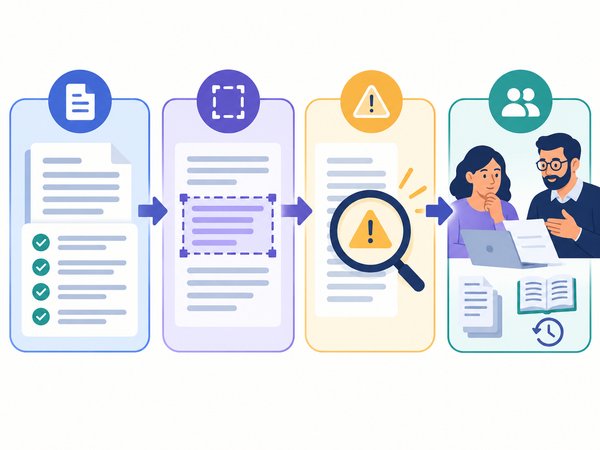
An AI detector can influence how a teacher, editor, or employer views a piece of writing. For a non-native English writer, an incorrect flag can therefore become more than a technical error: it can create an authorship dispute and place an unfair burden on the writer.
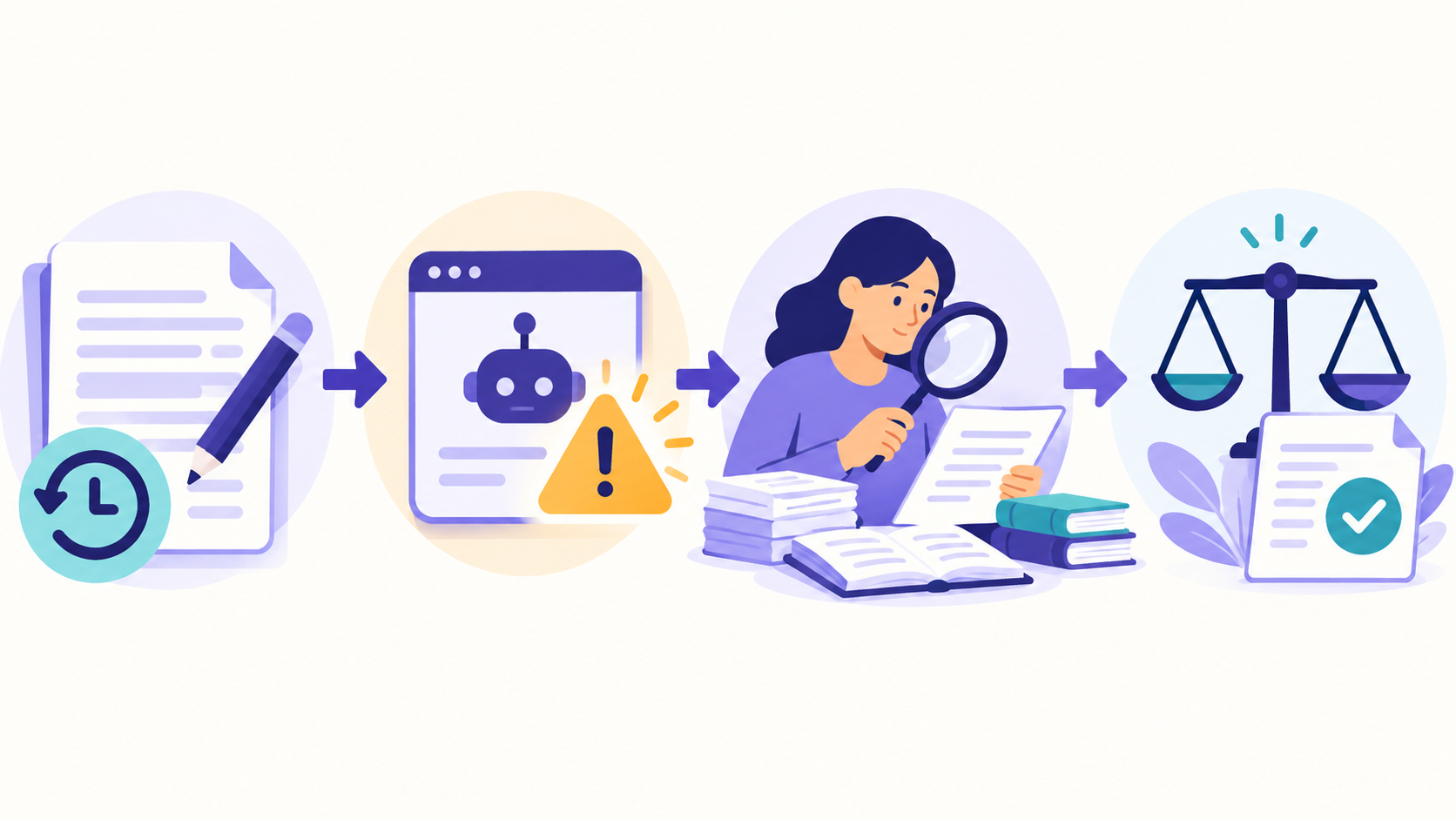
Research has found evidence of this problem, but the evidence does not support a claim that every detector is always biased against every non-native writer. The fairest response is to treat a detector result as a signal that requires context, process evidence, and human review.
Quick Answer
AI detectors can falsely flag writing by non-native English speakers. A 2023 study found a high false-positive rate for one set of TOEFL essays across seven detectors, while a 2026 Czech-language study found no systematic bias in the detectors it tested. Language background may affect some systems in some settings, so a detector score should never establish authorship or misconduct by itself.
Key Takeaways
- Language proficiency and authorship are different questions. Predictable wording does not prove that AI wrote a document.
- A widely cited 2023 study found substantial bias in its test conditions, but its sample and early-generation detectors limit how broadly the result can be applied.
- Newer research shows that the effect can vary by language, dataset, detector design, and time.
- Grammar correction, translation, and generative rewriting are different forms of assistance and should be documented separately.
- Fair review should combine the detector report with drafts, notes, sources, version history, policy, and the writer's explanation.
What Is AI Detection Bias?
AI detection bias is a systematic difference in how a detector performs across groups or writing conditions. In this context, the concern is that human-written text by non-native English speakers may be labeled as AI-generated more often than comparable text by native speakers.
A false positive occurs when a detector classifies human writing as generated. A false negative is the reverse: generated text is classified as human. Both errors matter, but a false positive is especially serious when a score may trigger an accusation, penalty, or employment decision.
An AI detector does not observe who drafted a document. It analyzes the submitted text and estimates whether its patterns resemble the data or signals the system associates with generated writing. The exact meaning of a score varies by product. Our guide to how AI detectors work explains the main signals, score types, and limitations.
Why Can Non-Native English Writing Confound a Detector?
Some detection methods use patterns related to predictability. One commonly discussed measure is perplexity, which describes how surprising a sequence of words appears to a language model. More predictable wording can have lower perplexity, but lower perplexity does not identify the writer or prove that a model produced the text.
Writers may use conventional sentence structures or a narrower range of vocabulary for many legitimate reasons. Language proficiency is one possible factor, but so are genre, assignment instructions, technical terminology, templates, editing, and individual style. Non-native English writers are also not one uniform group. Their proficiency, education, first languages, and writing practices differ.
The core error is to turn a statistical resemblance into a conclusion about authorship. A detector can recognize patterns without knowing how those patterns arose.
What Does the Research Show?
The research is best read as evidence that fairness must be tested for a specific detector and population, rather than as one universal error rate.
| Study | What the researchers tested | Main finding | Important limitation |
|---|---|---|---|
| Liang et al., 2023 | Seven detectors, 91 human-written TOEFL essays from a Chinese educational forum, and 88 U.S. eighth-grade essays | The average false-positive rate on the TOEFL set was 61.22%. All seven detectors flagged 18 of 91 TOEFL essays, and at least one detector flagged 89 of 91. | The samples were small and differed in age and source. The detectors were accessed in March 2023, and most relied on older GPT-2-based methods. The result is not a current rate for every tool or writer. |
| Weber-Wulff et al., 2023 | Fourteen systems tested on human, translated, generated, manually edited, and paraphrased documents | Performance varied by tool and condition; machine translation affected classification. The authors concluded that the tested tools were not reliable enough to serve as sole evidence in academic misconduct decisions. | The document set was limited, and products can change after evaluation. Translation results should not be generalized to every language or tool. |
| Al Ali et al., 2026 | Native and non-native Czech writing plus detectors from three methodological families | The researchers found no systematic bias against non-native Czech writers and showed that contemporary detectors need not rely on perplexity. | The setting was Czech, not every language or detector. It shows that bias is not universal; it does not disprove the earlier English result. |
The Liang study also tested whether changing word choice affected classification. Enriching the TOEFL essays' vocabulary reduced the average false-positive rate in that experiment from 61.22% to 11.77%. Simplifying word choice in the U.S. essay set raised the average false-positive rate from 5.19% to 56.65%. These controlled transformations support a relationship between surface language patterns and those detectors' decisions, but they still do not establish a universal cause for every flag.
The most defensible conclusion is narrow: some detectors have produced unequal false positives for non-native English writing in specific tests, while newer evidence shows that outcomes depend on the language, data, and detection method.
Can Grammar Checkers or Translation Tools Affect an AI Score?
They can change the text a detector analyzes, but there is no reliable rule that a particular tool will raise or lower a score.
It helps to separate four kinds of assistance:
- Spelling and basic grammar correction fixes local errors while usually preserving the writer's wording.
- Style suggestions may replace phrases, reorganize sentences, or standardize tone.
- Machine translation recreates the text in another language and can change vocabulary, syntax, and rhythm.
- Generative rewriting may replace whole sentences or paragraphs with newly generated language.
These actions have different authorship and policy implications. A tool name alone does not explain what happened because one product may contain both conventional correction and generative features. Writers should record the feature used, what they accepted, and whether disclosure was required.
Weber-Wulff and colleagues found that machine translation affected results in their test set. That finding justifies caution, but it does not mean translation always causes a flag. The effect can vary across language pairs, text types, and detectors.
Why a False Positive Can Cause Real Harm
In education, a detector flag may lead to an academic-integrity review, delayed grading, or stress for a student who must defend original work. In a workplace, it may affect trust, performance review, or compliance decisions. A person writing in an additional language may also feel pressured to make their prose more idiomatic simply to appear “human,” even when the original text is accurate and authentically theirs.
These consequences are why process matters. Turnitin's current guidance acknowledges that false positives are possible and says its AI writing report should not be the sole basis for adverse action. It also withholds a numerical score below 20% because results in that range are less reliable. Product rules differ, but the general principle is sound: a probabilistic output should start a review, not finish one.
CMS instruction — do not publish this line: [IN-CONTENT IMAGE 1: ai-detector-flag-human-review-flow.webp — place after “Why a False Positive Can Cause Real Harm”]
A Fair Review Protocol for AI Detector Flags
Reviewers can protect academic or workplace standards without treating a score as a verdict.
- Preserve the original report. Record the detector, date, score definition, threshold, highlighted passages, document length, and exact submitted text.
- Check whether the input was eligible. Confirm that the tool supports the document's language, length, format, and genre. For example, Turnitin's current AI Writing Report requires at least 300 words of qualifying long-form prose.
- Identify the applicable policy. Separate allowed spelling help, grammar correction, translation, brainstorming, generative rewriting, and full drafting. Review the policy that applied when the work was submitted.
- Invite process evidence. Ask for drafts, notes, sources, version history, and tool-use records. Do not require a writer to recreate evidence after the fact.
- Discuss the work. Give the writer a chance to explain the argument, evidence, terminology, and revision decisions. Language proficiency should not be treated as proof for or against authorship.
- Reach a documented human decision. Consider all evidence, explain the reasoning, and provide the normal appeal route. Do not convert a detector percentage directly into a finding of intent.
This protocol applies equally when a detector supports or contradicts an initial suspicion. Human review should test the full evidence rather than search only for facts that confirm the score.

What Evidence Should Writers Preserve?
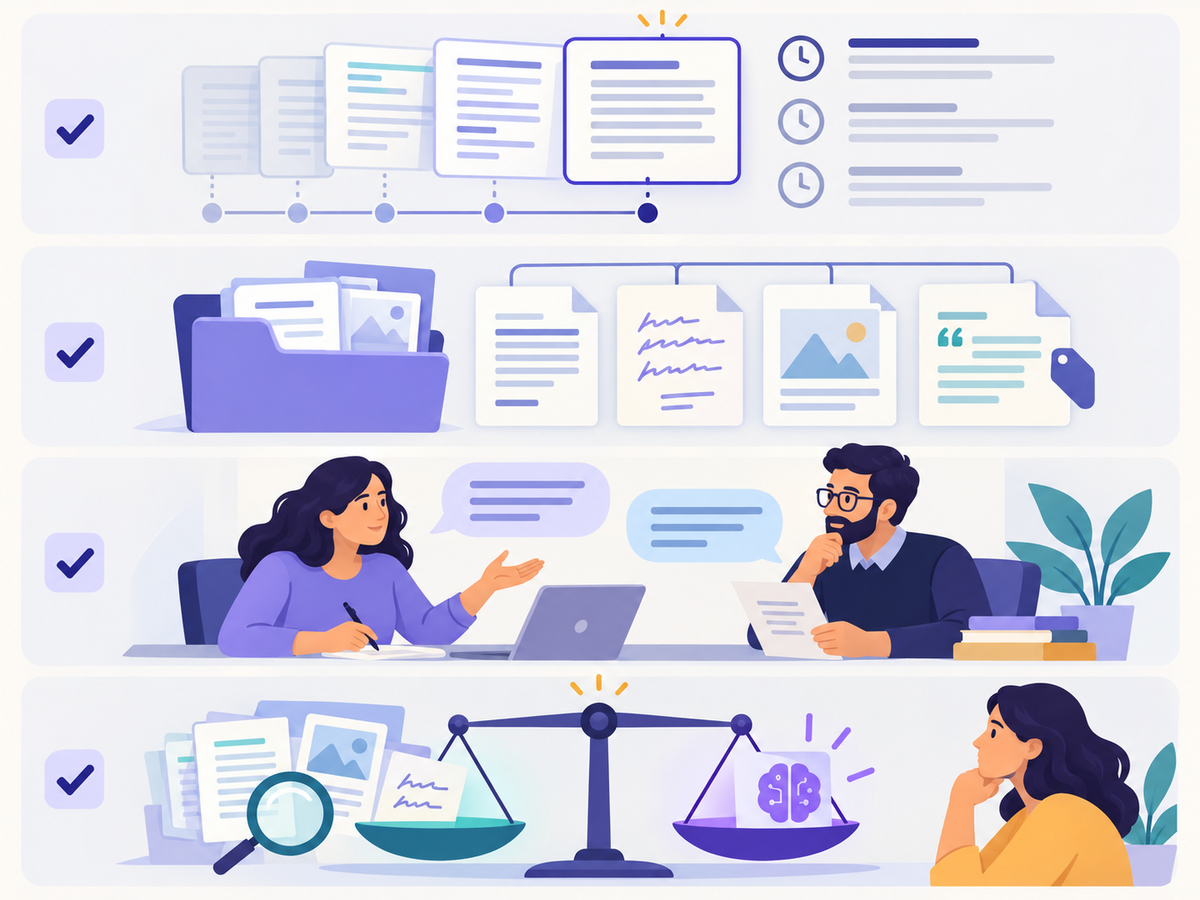
Writers do not need to prove authorship through one perfect artifact. A consistent process trail is usually more informative than another detector score.
| Evidence | What it can show | Practical way to preserve it |
|---|---|---|
| Version history | How the document developed over time | Keep platform timestamps and revision history intact |
| Outlines and notes | Planning, argument development, and original examples | Save dated files, notebook pages, or research notes |
| Source trail | Where facts, quotations, and ideas came from | Keep links, citations, PDFs, and reading notes |
| Earlier drafts | Changes in structure and wording | Retain representative drafts instead of recreating them |
| Tool-use record | Whether help involved correction, translation, rewriting, or generation | Note the product, feature, date, and accepted changes |
| Subject explanation | The writer's understanding and decision-making | Be ready to discuss the thesis, sources, and revisions |
Preserve this material before rewriting a flagged passage. Immediate changes may remove the strongest evidence of how the work was created. For a broader response plan and an appeal template, see AI Detector False Positives: Causes, Evidence, and What to Do.
CMS instruction — do not publish this line: [IN-CONTENT IMAGE 2: fair-ai-detector-review-checklist.webp — place after “What Evidence Should Writers Preserve?”]
How to Use an AI Detector Responsibly
An AI detector is most useful as a screening or quality-assurance signal. It can point to passages worth reviewing, compare how one system interprets a complete text, or support a conversation under a clear policy. It cannot determine who wrote a document, which tool was used, or whether someone intended to violate a rule.
If you want another data point, check a complete passage with HumanizeAI's AI Detector. Keep the original text and report, then interpret the result alongside drafts, sources, version history, and the relevant policy. Agreement between detectors is still not proof, and disagreement does not tell you which system is correct.
Writers should revise for clarity, accuracy, evidence, and their own meaning rather than chase a preferred detector score. Reviewers should focus on process and policy rather than assume that one writing style is the standard for authentic human work.
Frequently Asked Questions
Do AI detectors flag non-native English writing?
They can. A 2023 study found high false-positive rates for a set of non-native English TOEFL essays, but a 2026 Czech-language study did not find systematic bias in its setting. The risk depends on the detector, language, dataset, genre, and version.
Can an AI detector falsely accuse a student?
Yes. A false positive labels human writing as generated. A detector result should prompt further review, not automatically establish misconduct. Drafts, notes, sources, version history, policy, and the student's explanation provide essential context.
Can translation tools affect AI detector scores?
Translation changes the wording and structure that a detector analyzes, so it may affect a result. Research has found an effect in specific test conditions, but there is no universal direction or amount. Record the translation tool and follow the applicable disclosure policy.
Can a grammar checker make human writing look AI-generated?
It depends on the feature and the extent of the changes. Basic corrections differ from generative sentence rewrites. Document which features were used and avoid assuming that the presence of a grammar tool proves who authored the work.
How should a teacher review an AI flag?
Confirm that the submission meets the detector's requirements, examine the full report, check the institution's policy, invite the student's process evidence, discuss the work, and make a documented human decision with an appeal route.
Is a low AI score proof that a person wrote the text?
No. Detectors can produce false negatives as well as false positives. A low score does not verify authorship, just as a high score does not prove generation.
Use Detector Results as Evidence to Review, Not a Verdict
Research supports concern about false positives affecting non-native English writers, but it also shows that outcomes vary across languages, datasets, tools, and time. Fairness therefore requires a specific review of the document and its creation process.
If you choose to scan a passage, use HumanizeAI's AI Detector as one signal and preserve the surrounding evidence. The strongest decision comes from the report, the policy, the writer's process, and informed human judgment together.