AI Visibility Audit Checklist: 26 Checks for Content, Technical SEO, Entity & Authority


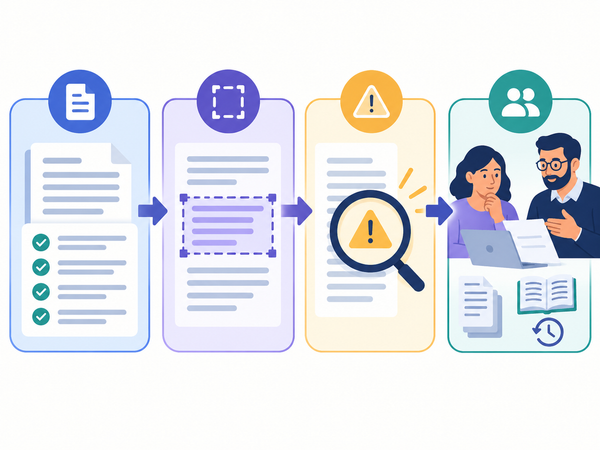
An AI visibility audit examines whether your website can be discovered, accessed, understood, and potentially cited by AI-powered search experiences such as Google AI Overviews, ChatGPT Search, Microsoft Copilot, and Perplexity.
The process starts with technical access, but it does not end there. Your pages also need to answer relevant questions, explain who your business is, support important claims with evidence, and give readers information worth using. You can start with HumanizeAI's free AI readiness check to identify potential website issues, then use the 26-point checklist below to investigate the findings and prioritize improvements.
The important distinction: AI readiness is not the same as AI visibility. A website can pass technical and content checks without appearing in a generated answer. Conversely, seeing your brand mentioned once does not prove consistent visibility across different questions or platforms.
This guide gives you a repeatable audit process, a practical scorecard, a worked example, and a measurement plan.
What Is an AI Visibility Audit?
An AI visibility audit is a structured assessment of the conditions that affect how a website can participate in AI-assisted discovery.
It examines four connected areas:
- Technical accessibility: Can relevant crawlers reach and read important pages?
- Content readiness: Does the content answer real questions accurately and usefully?
- Entity clarity: Can readers and search systems understand the business, products, and people behind the website?
- Authority and corroboration: Are important claims supported by credible, verifiable evidence?
A complete audit also measures whether your website is actually appearing in AI-generated search experiences.
These are related, but different, tasks.
Google explicitly states that its AI features rely on the same foundational SEO best practices used for traditional Search. There are no additional technical requirements for appearing in AI Overviews or AI Mode beyond the existing Search requirements.
Source: Google Search Central — AI Features and Your Website.
For a broader explanation of the discipline, see HumanizeAI's guide to answer engine optimization.
Before You Start: Choose the Pages Worth Auditing
Do not begin by scanning every URL on your domain.
Start with a manageable group of pages that matter to your business.
For example, a B2B SaaS company could examine its homepage, two product pages, three important educational articles, one comparison page, and its About page.
For each page, record:
- URL and page purpose
- Target audience and primary reader question
- Indexing status
- Intended search or AI discovery opportunity
- Current content owner
- Last substantive content review
- Known technical or editorial issues
Create a simple worksheet with these columns:
These rows are illustrative, not findings from a real website.
Use four statuses throughout the audit:
- PASS: The check meets its stated condition.
- PARTIAL: Some requirements are met, but there is a meaningful gap.
- FAIL: A specific problem has been verified.
- NOT TESTED: There is insufficient evidence to reach a conclusion.
Do not turn every unknown into a failure.
1. Technical AI Search Audit: Can Crawlers Reach and Read Your Pages?
Technical access is the first place to investigate because content cannot participate normally in an index-based search experience if the relevant search systems cannot discover or access it.
But different AI platforms use different retrieval methods and crawler controls. A single robots.txt setting does not govern every AI product.
Technical checklist: 8 checks
These are diagnostic checks, not a proprietary AI ranking formula.
The crawler distinction most websites miss
OpenAI documents separate crawlers with different purposes:
Allowing OAI-SearchBot while disallowing GPTBot is a documented configuration choice. Blocking a training crawler does not automatically mean your site must opt out of every AI search feature.
Source: OpenAI — Overview of OpenAI Crawlers.
For Google AI Overviews and AI Mode, Googlebot access and normal Search eligibility are the central considerations. Google-Extended serves a different purpose and should not be treated as the control for appearing in Google Search's AI features.
Check whether your content exists outside a visual rendering
Open a priority page and compare what a visitor sees with what appears in its initial HTML source.
If the product description, pricing explanation, or core answer only appears after a complicated client-side interaction, investigate whether your intended crawlers and indexing systems can access that information.
A JavaScript-powered website is not automatically invisible to search engines. The problem is whether the important content is reliably available to the systems that need it.
Test actual rendering before prescribing a technical change.
Should you add an llms.txt file?
An llms.txt file is an optional text-based document intended to help compatible tools find important website resources.
It is not required for Google AI Overviews, AI Mode, or general Google Search visibility.
Google's official generative AI guidance states that Google Search does not use llms.txt files or special AI markup for ranking or eligibility.
HumanizeAI's readiness scan checks for the presence of an llms.txt file, but that diagnostic item should not be interpreted as an official Google requirement or as proof that adding the file will generate citations.
Source: Google — Optimizing for Generative AI Features.
Technical audit takeaway: Fix verified access, indexing, rendering, and navigation problems before investing in speculative AI-specific optimizations.
2. Content Audit: Can Your Pages Answer the Questions People Ask?
A technically accessible page can still fail to satisfy the reader's question.
For example, a software company might have a perfectly indexed page titled "Automated Reporting" that spends hundreds of words discussing efficiency without explaining what reports the software produces.
That is a content problem, not a crawler problem.
Content checklist: 8 checks
A passing content audit is not a requirement to insert a particular number of headings, FAQs, keywords, or paragraphs.
The objective is to make information useful and easy to understand.
Example: Turning a generic answer into a useful one
Weak content:
Our platform offers innovative AI-powered solutions that streamline workflows and enhance business productivity.
The sentence offers almost no information a buyer can evaluate.
Stronger illustrative version:
The platform collects project updates into a shared dashboard, highlights overdue tasks, and lets managers export a weekly progress report.
The second version explains what the software does. It can be checked against the actual product.
For a real business, publish that version only if those capabilities are accurate.
This is the difference between replacing generic language and adding useful information.
Evaluate whether a passage deserves to be cited
Ask yourself:
- Does it make a clear, factual point?
- Can the claim be verified?
- Does it contain a specific example or an original explanation?
- Does it answer a real question?
- Would a reader understand it without misleading context?
- Is there a reason to reference this page rather than a more authoritative source?
For a deeper look at the issue, see what makes a page citable to AI.
A clear passage can be useful to AI-assisted retrieval, but no passage format guarantees a citation. Search relevance, retrieval methods, source selection, and platform behavior are not entirely under the publisher's control.
When the problem is an existing article with weak structure or missing topic coverage, HumanizeAI's AI Content Optimizer can help identify potential editorial improvements. Its recommendations should still be checked against the article's intended audience and actual evidence.
3. Entity Audit: Is Your Business Easy to Identify?
Imagine someone asking an AI assistant:
"Which company makes this software, and how is it different from the alternatives?"
If the website alternates between several brand names, hides its company information, and uses inconsistent product descriptions, it makes that question harder to answer accurately.
An entity audit checks whether people, organizations, products, and services are described clearly and consistently.
It is not a measurement of a universal "entity authority score."
Entity checklist: 5 checks
What should your About page explain?
A useful About page should make it easy to understand:
- What the organization does
- Which products or services it offers
- Who is responsible for the organization
- Who the products or services are intended for
- How customers can contact the business
- Which qualifications, partnerships, or claims can be verified
Not every company needs to publish the same information. Privacy, legal obligations, business type, and relevance matter.
The principle is transparency, not exposing unnecessary personal details.
Does schema markup improve AI visibility?
Structured data helps search systems interpret eligible page information when implemented correctly.
For example, appropriate Organization, Product, or Article structured data can reinforce information already displayed to readers.
However, Google does not require special schema markup for its generative AI features, and adding structured data does not guarantee inclusion or citation.
Follow the official Google structured data guidelines, and only mark up information that genuinely applies to the page.
Entity audit takeaway: Make the organization and its offerings understandable before attempting to amplify its online presence.
4. Authority Audit: Can Readers Independently Verify Your Claims?
Authority is not the number of websites that mention a brand.
A company can appear in dozens of irrelevant directories while providing no evidence for its most important claims.
A useful authority audit examines the quality, relevance, accuracy, and independence of the evidence surrounding the business.
Authority checklist: 5 checks
A practical example of evidence quality
Consider two claims on a software company's website.
Claim A:
Our software delivers industry-leading accuracy and transforms customer operations.
Claim B:
In a documented internal evaluation, the team tested the software against a defined set of tasks. The report describes the dataset, evaluation criteria, observed results, and limitations.
Claim B is more useful because readers can assess what was actually tested.
That does not make the reported performance independent or automatically reliable. The methodology, data, conflicts of interest, and reproducibility still matter.
For businesses without proprietary research, a carefully sourced technical explanation or a documented implementation example may be more valuable than an unsupported superiority claim.
Why artificial authority building is risky
Buying irrelevant placements, manufacturing endorsements, or creating misleading third-party mentions does not make information more trustworthy.
Google's guidance for generative AI search explicitly discourages pursuing inauthentic mentions as a shortcut.
The better approach is to create information worth referencing, establish genuine professional relationships, and accurately document what the organization knows or has accomplished.
How to Run a Free AI Readiness Check on Your Website
You can perform many checks manually, but a preliminary scan makes it easier to identify which pages deserve attention first.
HumanizeAI offers a Free AI Readiness Report that reviews a sample of publicly available website pages.
Step 1: Open the AI Readiness Tool
Visit HumanizeAI's free website readiness checker.
The service requires a free account and states that no credit card is needed.
Step 2: Enter Your Website
Provide your website address and start the assessment.
According to the tool's published description, the scan reviews the homepage, up to nine linked pages, up to three blog posts, and selected supporting files.
It is a sample-based assessment, not a guaranteed complete audit of every URL.
Step 3: Review the Four Readiness Areas
The report also presents homepage speed information separately using Google performance data.
Step 4: Review Findings, Not Just Scores
A readiness score is a diagnostic starting point.
Prioritize the underlying findings:
- What was tested?
- Which page triggered the issue?
- Is the finding correct?
- Does it affect an important page?
- How much work is needed to fix it?
- Who owns the fix?
HumanizeAI describes its four readiness scores as provisional because the assessment is continuing to evolve.
An increase in a readiness score means the diagnostic assessment changed. It does not, by itself, demonstrate more AI citations.
Step 5: Check What the Report Does Not Measure
The free report does not currently query AI platforms to show whether they mention or cite your business.
It therefore cannot establish your actual brand visibility across ChatGPT, Gemini, Perplexity, or every AI search experience.
For that, you need separate visibility observations, platform reporting, or appropriate monitoring tools.
HumanizeAI's guide to the best AI search visibility tools explains the difference between dedicated monitoring tools and content optimization platforms.
Recommended workflow: Use the readiness scan to identify possible website problems, verify important issues manually, make targeted improvements, and measure visibility separately.
AI Visibility Audit Example: Turning Findings Into Fixes
Consider a fictional B2B SaaS company called NorthstarFlow.
It sells project coordination software to operations teams.
The marketing team wants its website to be useful when potential customers research project management and reporting solutions through traditional search and AI assistants.
The following findings are hypothetical examples, not results from an actual audit.
What should the team fix first?
Start with the rendering issue.
There is little value in polishing a page that important retrieval systems cannot reliably access.
Next, improve the product explanation and verify the company's identity and evidence.
Then strengthen the internal linking between the product page and the relevant educational resources.
The team does not need to publish twenty new blog posts to address these findings.
It needs to resolve the gaps identified on existing pages.
How should the team verify the changes?
For the technical issue, compare the page's initial HTML before and after deployment.
For the content update, have someone unfamiliar with the product answer three questions using only the page:
- What does the product do?
- Who is it designed for?
- What evidence supports its main benefits?
For the entity update, check whether the organization information is consistent across the website and relevant official profiles.
For the internal linking update, crawl the site again to confirm the intended connections are accessible.
These tests confirm that the fixes were implemented. They do not yet establish improved AI visibility.
Which AI Visibility Problems Should You Fix First?
A useful audit ends with a prioritized worklist, not a vague recommendation to improve everything.
Use the following order as a practical starting point.
Use business importance, confidence in the diagnosis, implementation effort, and potential impact to assign final priorities.
For example, a verified indexing problem on a revenue-critical product page deserves attention before an optional llms.txt experiment.
A reusable audit scorecard
Use the 26 checks as an operational worksheet.
This is an editorial scorecard, not an official Google, OpenAI, Bing, or HumanizeAI scoring standard.
Do not average the results into a percentage that implies a measured probability of appearing in AI answers.
A single critical blocker can matter more than several minor passing checks.
How to Measure Whether Your AI Visibility Improvements Worked
After resolving the most important issues, establish whether your website's actual visibility changes.
Measurement should cover three different outcomes:
- Website readiness: Have verified technical, content, and trust issues been resolved?
- Search discovery: Are relevant pages receiving search impressions, clicks, and engagement?
- AI citations and mentions: Are supported AI experiences displaying references to your website or business?
Do not combine them into one metric.
1. Use Google Search Console
Google Search Console can help you examine indexing, page performance, search queries, impressions, clicks, and average position.
Google also provides a Generative AI Performance Report for eligible data from AI Overviews and AI Mode. Google states that this reporting was rolled out globally on August 31, 2026.
The dedicated report focuses on impressions, including page, country, device, and time dimensions. If the report is unavailable, insufficient eligible impression data may be one reason.
These impressions are also included within the broader Search performance data, so avoid double-counting them.
Source: Google Search Console — Generative AI Performance Report.
2. Check Bing Webmaster Tools AI Performance
Bing Webmaster Tools offers AI Performance reporting for supported Microsoft AI search experiences.
Depending on available data, you can examine:
- Total citation activity
- Pages cited in AI-generated answers
- Citation trends
- Grounding queries
- Related page-level activity
A visible citation is not the same as a click or a conventional search ranking.
Bing also notes that its reporting represents supported, aggregated activity rather than a complete log of every possible AI answer.
Source: Bing Webmaster Tools — AI Performance.
3. Track Relevant AI Answers Carefully
Choose a small set of questions that real prospects ask.
For example:
- What tools can help a small operations team manage project reporting?
- Which project management platforms support automated status reports?
- How should a growing SaaS team compare project coordination tools?
Record the platform, question wording, date, location or market where available, brand mentions, and visible source citations.
Separate:
Brand mention: The business name appears in the generated response.
Source citation: The answer visibly references a page or source.
Referral visit: A user actually clicks through to your website.
One result from one prompt does not represent the full market.
For substantial monitoring, keep the query set and collection method consistent, and report the limitations of the sample.
4. Compare Performance Over Time
Record a baseline before implementing changes.
After publication and indexing, compare complete, reasonably comparable reporting periods. A 28-day window may be suitable for established pages with enough data; sparse datasets may need 56 or 84 days.
Monitor:
Keep track of algorithm updates, seasonality, new competitor content, and other site changes.
A before-and-after comparison shows what changed. It does not automatically prove which specific edit caused the difference.
Common AI Visibility Audit Mistakes
Treating AI readiness as proof of AI citations
A readiness report checks characteristics that may support discovery and content usefulness.
It cannot prove that a specific model will select your website as a source.
HumanizeAI's article on why citability is not a checklist examines why even strong organic visibility and structured content do not guarantee selection in an AI answer.
Blocking the wrong crawler
Search crawlers and training crawlers can serve different functions.
Review the official documentation for each platform before changing access settings. Do not assume that enabling or disabling one crawler has the same effect everywhere.
Using schema as a substitute for useful content
Structured data can clarify eligible page information. It cannot make vague content accurate, establish unsupported claims, or guarantee AI search visibility.
Publishing a separate article for every keyword variation
A GEO audit checklist and a generative engine optimization audit checklist may satisfy the same underlying reader task.
Creating near-identical pages for each wording can produce unnecessary duplication.
Assign each URL a clear purpose and create separate pages only when readers genuinely need a different resource.
Buying mentions instead of improving evidence
Relevant editorial references can help readers discover a business and verify its claims.
Artificial mentions, irrelevant listings, and fabricated endorsements do not provide the same value.
Measuring only a readiness score
Technical and content readiness is one part of the process.
Measure actual search exposure, citation activity, brand mentions, and useful website visits separately.
Frequently Asked Questions
What is an AI visibility audit?
An AI visibility audit evaluates whether a website is technically accessible, contains useful answers, clearly identifies its business and content sources, and provides credible evidence. A complete audit also checks whether the website actually appears in supported AI search and citation reporting.
How do I audit my website for ChatGPT Search?
Start by reviewing your site's technical accessibility and relevant OpenAI crawler settings, particularly OAI-SearchBot. Check whether key pages are publicly accessible, contain readable information, and answer questions your audience asks. Then assess real ChatGPT Search results where feasible, recording visible references and methodological limitations.
Can I run an AI visibility audit for free?
Yes. Many checks use free resources such as Search Console, Bing Webmaster Tools, source-code inspection, official crawler documentation, and manual content reviews. HumanizeAI also offers a free AI readiness assessment for a preliminary review of selected public pages.
Is a GEO audit different from an SEO audit?
They overlap substantially. A traditional SEO audit covers crawlability, indexing, website structure, content quality, and search performance. A GEO or AI visibility audit also considers platform-specific access policies, entity clarity, verifiable content, and observed citations or brand mentions across supported AI experiences. The same website may benefit from one integrated audit rather than two unrelated processes.
Does robots.txt affect AI search visibility?
It can. Robots.txt governs access for compliant crawlers, but each platform may use different crawler identities and retrieval methods. Check official documentation rather than assuming one rule controls all AI products.
Is llms.txt required for AI search?
No universal requirement exists. Google explicitly states that llms.txt and other special AI text files are not required or used for visibility in Google Search, including its generative AI features. Other tools may choose to use such files, but their presence is not evidence of improved search performance.
Does structured data guarantee AI citations?
No. Relevant, accurate structured data can help systems interpret page information, but Google does not require special schema markup for AI Overviews or AI Mode. Citations remain dependent on factors outside the control of markup alone.
How do I know whether AI platforms cite my website?
Use platform-specific reporting where available, such as Google Search Console's Generative AI Performance Report and Bing Webmaster Tools AI Performance. You can also examine visible references from a consistent sample of AI search questions. Keep brand mentions, citations, impressions, and referral traffic separate.
How often should I repeat an AI visibility audit?
Repeat the most important technical checks after major site changes, such as a redesign, migration, CMS update, or modification to crawler access rules. For an established website, a periodic quarterly review can be a practical starting schedule. Adjust the frequency to the site's rate of change and business importance.
What is the difference between AI readiness and AI visibility?
AI readiness describes whether a website has characteristics that support access, understanding, useful answers, and verifiable information.
AI visibility describes whether the business or website is actually appearing in AI-generated search experiences.
Readiness can be audited through website diagnostics. Visibility requires observation or measurement of the relevant AI search surfaces.
Final Action: Turn Your Audit Into a Prioritized Improvement Plan
The purpose of an AI visibility audit is not to collect another score.
It is to make better decisions about your website.
Start with your most important pages. Check technical access. Review the questions those pages answer. Verify business information and material claims. Then prioritize the problems that affect real users and important search journeys.
Use the 26-point checklist to record what passes, what fails, and what remains untested.
If you want a quick starting assessment, run HumanizeAI's Free AI Readiness Check to review potential crawlability, credibility, citability, and readability issues.
Investigate the findings, fix the important problems, and measure actual search and AI visibility over time.
A better website audit should produce a clear next action, not just a better-looking number.