What Makes a Page Citable to AI? The 7 Structural Markers That Determine Whether ChatGPT, Gemini, and Perplexity Cite Your Content

Quick Summary
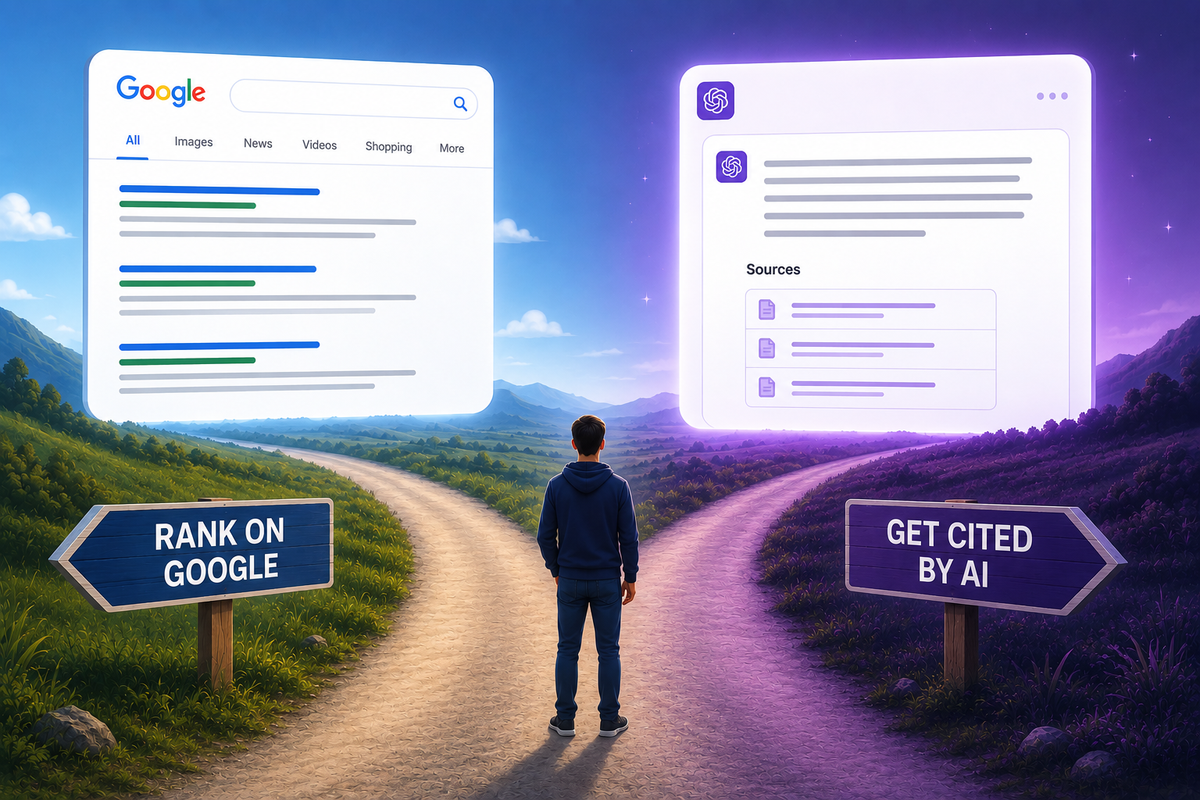
Lets, be clear - Ranking at the top of Google does not mean AI engines will cite your content. AI citation selection happens inside a Retrieval-Augmented Generation (RAG) pipeline that evaluates pages differently than a search ranking algorithm does. Seven structural and content markers determine whether an AI system extracts and attributes your page as a source, from our research. This article explains what those markers are, why each one matters mechanically, and what you can do to build them into every piece of content you publish.
What You'll Learn
- Why Google ranking and AI citation are separate outcomes, and why optimizing for one does not guarantee the other
- How AI systems actually select sources through the RAG pipeline
- The 7 specific markers of a citable page, with concrete examples of what each looks like in practice
- How this framework shaped the architecture of the HumanizeAI AI Writer
- A self-diagnostic you can run on any page in 10 minutes
The TL;DR
What makes a page citable to AI engines like ChatGPT, Gemini, and Perplexity?
Seven markers consistently appear on pages AI systems cite and are absent from pages they skip: a direct answer in the first 150 words, evidence-backed specificity, a real named author, a question-hierarchy heading structure, an FAQ section with standalone answers, parsable HTML that AI crawlers can read, and original contribution that makes the page distinctively worth citing rather than generically correct.
These markers are not SEO best practices rephrased. They are structural requirements imposed by how AI systems retrieve and extract content. A page can rank in the top three on Google and fail on five of these markers - and it will not get cited. A page can rank at position eight and pass all seven - and it will.
The research backs this up. According to a peer-reviewed study by Aggarwal et al. published at ACM SIGKDD 2024 ("GEO: Generative Engine Optimization"), lower-ranked pages around position five saw citation lift of over 100% from structural content improvements, while pages already at position one saw only modest gains. The mechanism is not ranking - it is extractability.
The Breakdown
Why Ranking and Citation Are Not the Same Thing
Most content teams are optimizing for the wrong outcome. They write to rank. They build backlinks to rank. They optimize titles and meta descriptions to rank. And ranking still matters -- but it is not what determines whether an AI engine cites your page.
Google's ranking algorithm asks one question: is this page authoritative and relevant? An AI engine's citation process asks a different question: can I pull a clean, accurate, attributable answer from this page right now, without misrepresenting the source?
Those are different questions. They have different answers. And they require different content decisions.
Here is the practical consequence: according to Semrush's 2026 content correlation study, a page can hold position one in traditional search and be largely invisible to AI citation selection because its content is structured for crawlers, not for extraction. The characteristics that earn a top ranking -- keyword density, backlink quantity, domain authority -- do not predict whether an AI system will extract a specific passage and attribute it to your site.
Understanding why requires understanding how AI systems actually select sources.
How Do AI Systems Actually Select Sources? The RAG Pipeline Explained
When you ask ChatGPT, Perplexity, or Google AI Overviews a question, the system does not instantly generate an answer from internal knowledge. For most queries, it runs a process called Retrieval-Augmented Generation, or RAG.
RAG has four stages, and each one creates a filter your content must pass:
Stage 1 -- Retrieval. The AI system sends a query (or multiple related queries, what Google calls "query fan-out") to its retrieval index. The index is a curated subset of the web -- not the full web, and not identical to Google's search index. Pages that are invisible to this retrieval layer, because of robots.txt blocks, JavaScript rendering, or poor crawlability, never reach Stage 2.
Stage 2 -- Ranking. Candidate pages are ranked by the AI system's own relevance and trust signals. This is where domain authority and topical relevance matter -- but they are not the only signals. The system is also weighing how directly a page answers the query, how recently it was updated, and whether it carries trust markers like a named author and cited sources.
Stage 3 -- Extraction. The AI system reads the highest-ranked candidate pages and attempts to extract specific passages to use in its response. This is the stage most content teams do not optimize for. A page that passes Stages 1 and 2 can still fail at Stage 3 if the relevant answer is buried in paragraph six, locked inside a JavaScript accordion, or written in promotional copy that an AI system cannot cleanly attribute.
Stage 4 -- Attribution. The AI system selects which extracted passages to include and which sources to credit in the response. Pages get cited here. Most pages that made it through Stages 1, 2, and 3 do not make it to Stage 4 -- they get extracted and synthesized into composite answers with no individual attribution.
The implication is direct: getting cited is harder than ranking. Ranking gets you to Stage 2. Citability gets you to Stage 4.
The 7 Markers of a Page That Gets Cited
These seven markers are not a content checklist. They are structural requirements at each stage of the RAG pipeline. Passing all seven does not guarantee a citation. Failing any one of them significantly reduces the probability of one.
Marker 1: Does the Page Lead With the Direct Answer?
AI systems weight early-page content more heavily when selecting extraction candidates. The Princeton KDD 2024 research Aggarwal et al., "GEO: Generative Engine Optimization" confirms this pattern: extraction rates drop significantly for content where the core answer appears after substantive setup paragraphs.
What this looks like in practice: The first 150 words give a complete, standalone response to the question the page targets. Not a teaser. Not context-setting. The answer itself.
What fails: "In this article, we'll explore the many ways that [topic] has become increasingly important for modern marketers." This is a warmup sentence. It contains no extractable information and trains the system to skip ahead -- or skip entirely.
How to fix it: Write the Executive Answer of every piece before writing anything else. Force the core response into the first paragraph. You can layer in context, background, and examples after the answer is on the page.
The H.E.A.R.T. writing framework we apply at HumanizeAI operationalizes this as the "Answer First" principle: every article opens with a direct BLUF (Bottom Line Up Front) within the first 150 words. That's not just a writing preference - it's a citation requirement.
Marker 2: Is the Content Specific and Evidence-Backed?
Generic content loses citation share. AI synthesis collapses generic sources into composite answers that don't attribute any single source. The defense against this is specificity: data points, named examples, specific timeframes, named methodologies.
According to Aggarwal et al. (KDD 2024), adding statistics to existing content produced a +41% lift in citation rates. Adding inline source attribution produced up to +115% lift for mid-ranked pages. These are the two highest-impact single changes documented in peer-reviewed AI citation research.
What this looks like in practice: "63% of B2B software buyers now begin their purchasing research in an AI chatbot, according to G2's April 2026 Answer Economy report" is citable. "Most buyers are using AI tools in their research process" is not.
What fails: Broad assertions - "studies show," "experts agree," "research indicates" - with no named source, date, or link. AI systems are trained on a web that cites sources. Unsourced claims read as unverifiable and get passed over for attribution.
The [VERIFY] discipline: Every claim in content we produce at HumanizeAI that cannot be immediately verified with a named, dated, linked source gets flagged with [VERIFY] and held until resolved. An unsourced claim is not published. This is not a style preference - it is a citability requirement. A claim that cannot be attributed cannot be cited.
Marker 3: Does the Page Have a Real Named Author With Visible Credentials?
AI systems applying E-E-A-T signals look for evidence that a real, qualified person produced the content -- not just because Google's guidelines say so, but because attribution requires someone to attribute to. A page with no author byline creates a citation problem for the AI system: it cannot confidently say who produced the information.
According to Semrush's 2026 correlation study, E-E-A-T signals (which include named authorship, credentials, and first-person experience signals) showed a +30.64% correlation with citation selection. This is the second-strongest positive factor in the research.
What this looks like in practice: A real name in the byline, a visible author bio with relevant credentials, a link to a consistent author page with attribution history. The author is clearly identified as a person who would have direct experience with the topic.
What fails: "By the HumanizeAI Team." "Written by our editorial staff." Anonymous content - even well-written, well-sourced anonymous content carries a weaker trust signal and is harder for an AI system to attribute confidently.
The founding principle: The founder is the best content asset a company has. First-person content with real operating experience - specific results, named decisions, documented processes - outperforms ghostwritten brand content on every AI citation dimension. Your name and your experience are a trust signal in their own right.
Marker 4: Are the Headings Written as Real Questions?
AI engines match query intent to heading structure when scanning a page for a relevant extraction point. A heading written as "AI Humanization Process" does not match a query phrased as "How do I make AI content sound more human?" A heading written as "How Do I Make AI-Generated Content Sound Human?" matches exactly.
The Semrush 2026 study found Q&A format showed a +25.45% correlation with citation selection. The FLIP framework from Seer Interactive's 2026 AI visibility research confirms that AI retrieval systems respond specifically to queries triggered by in-depth informational needs -- and those queries are almost always phrased as questions, not topic labels.
What this looks like in practice: Every H2 and H3 on a citable page is written the way a real person would type a query into ChatGPT. "What Is AEO and How Does It Differ from GEO?" not "AEO vs GEO Overview."
What fails: Topic-label headings. "Introduction," "Background," "Methodology," "Conclusion," "Key Points." These are organizational labels for the writer -- not signals for an AI extraction system.
How to fix it: Take every heading in every existing piece of content and convert it to a question. This single change, applied across an existing content library, is one of the highest-return retroactive fixes available.
Marker 5: Does the Page Have a Dedicated FAQ Section With Standalone Answers?
FAQ sections are the highest-yield format for AI citation. Each Q/A pair is a pre-packaged, extractable unit. A question-answer pair that a person would ask an AI engine, answered completely and self-containedly, is exactly what an AI extraction system is looking for.
The Semrush 2026 research found structured data elements (which include FAQPage schema) showed a +21.60% correlation with citation selection. Q&A format showed +25.45%. These two findings compound: a FAQ section with properly implemented FAQPage schema is the highest-density citation target format on a page.
What this looks like in practice: A dedicated FAQ section with minimum five questions, each written in real search/prompt language ("What is the difference between AEO and SEO?"), each answered completely in 2-4 sentences with no reference to the surrounding article ("As mentioned above..."), and each answer meaningful on its own if lifted and cited with zero context.
What fails: FAQ sections where answers end with "Contact us to learn more." FAQ sections where the questions are company-generated puff ("Why is [Brand] the best choice?"). FAQ sections where the answer is "It depends" without explaining what it depends on.
The schema requirement: FAQPage JSON-LD schema must accompany the FAQ section. Every FAQ section on every HumanizeAI article ships with a FAQPage schema block for Jessica to implement. The content team writes it - implementation does not happen separately because questions and answers written in schema format catch clarity issues the prose version masks.
Marker 6: Can AI Actually Parse the Page? (Technical Citability)
This is the marker that eliminates pages before they reach any content evaluation. If AI crawlers cannot read the page, nothing else matters.
Google Search Central's May 2026 guide on AI-optimized content confirms AI Overviews and AI Mode use retrieval-augmented generation against the existing search index -- meaning pages with crawlability problems are excluded at the retrieval layer, before any citation decision is made. For ChatGPT, Perplexity, and Claude's web-search mode, the same principle applies: if the search/retrieval crawler (OAI-SearchBot, Claude-SearchBot, PerplexityBot) is blocked by robots.txt or cannot parse the content from the HTML, the page does not exist in the citation process.
What this looks like in practice: All critical content - service descriptions, FAQ answers, specifications, author bios, citations - lives in clean HTML, visible without JavaScript execution. No content behind "read more" clicks, no specs in image files, no FAQ answers in embedded PDFs. Schema markup at three levels: Organization (site-wide), Article (page-level), FAQPage (block-level).
What fails: Pages where FAQ content is in a JavaScript accordion. Author bios that only render after a script runs. Pricing tables screenshotted as images. Any page where the view-source content is substantially different from the rendered-browser content.
How to check it: Right-click any page and select "View Page Source." If the content you care about - your answers, your evidence, your credentials is not visible in that raw HTML view, it is invisible to AI crawlers.
Marker 7: Does the Page Contribute Something Original?
This is the hardest marker to define and the most important one for long-term citability. Generic content that follows every other marker correctly still loses citation share to content that is specific and distinctive. AI synthesis collapses generic sources into composite answers that attribute no individual source. The only defense is content nobody else could have written.
The Princeton KDD 2024 research named this "information gain" - the degree to which a piece of content adds something that was not in the existing set of sources. High information gain drives citation. Low information gain produces synthesis without attribution.
What contributes original citation value:
- Proprietary data from your own research or survey
- A named framework or methodology that others can reference
- First-hand operating experience documented as a case study or observation
- A specific outcome or result with real numbers attached
- A defined taxonomy or vocabulary the field doesn't yet have
What does not: A comprehensive summary of what other sources have already published. A guide that reorganizes existing information without adding a new angle. A "complete guide" that is complete only in the sense of covering the category -- not in the sense of contributing to it.
The Bland Tax: The Princeton research named something worth building strategy around. Generic content that passes every technical check correctly - FAQ sections, structured data, clean headings, statistics from other sources - still loses citation share to content that has something distinctive to say. Being technically correct and structurally compliant earns you a seat at the table. Having something worth quoting is what earns the citation.
How This Framework Shaped the HumanizeAI AI Content Creator
When we built the Content Creator at HumanizeAI, we structured it around these seven markers explicitly - not because they are a content trend, but because they define what "well-written" means in an AI-citation context. A piece of content that does not lead with the answer, does not name its sources, and does not contain an FAQ section is not just missing some formatting niceties - it is unlikely to be cited. And content that is not cited is not building the AI visibility asset its author intended.
The Content Creator's three-step flow (Setup, Outline, Write & Score) integrates the seven markers as structural requirements, not optional enhancements. The Setup step captures the author and entity signals. The Outline step enforces question-formatted headings, which are very much needed today. The Write & Score step applies our internal scoring mechanism which we call the Content Authority Score (CAS). The Content Authority Score (CAS) rubric is a 100-point, 8-dimension scoring system built directly from these citation markers and the research underlying them.
The CAS allows us to score every article prior to publishing at HumanizeAI, which allows us to optimize. And we do this not as a box-checking exercise - as a hard gate for certain portions. A piece that scores below 75 or fails any of the three required gates (Originality, Factual Integrity, Humanization) does not publish. The rubric makes the seven markers measurable, not just advisable. Our goal is to pulish high quality content that allows our clients to share their knowledge instead of just AI slop.
We built the CAS for our own content operation first. The AI Content Creator applies it automatically because we believe the same standard that makes an article worth publishing is also what makes it worth citing. Those two things should not be different standards.
Founder Observation
The moment I understood that ranking and citation are separate games came from a single experiment.
After acquiring HumanizeAI, I ran a search audit on the site - 47 issues across technical, content, and trust-signal dimensions. But the more interesting data came from a different test. I started running the prompts our customers would ask ChatGPT: "best AI content humanizer," "how to make AI text sound human," "AI writing tools for content marketers."
HumanizeAI ranked in the top five on Google for several of these terms. It appeared nowhere in the AI answers.
I spent 25 years in enterprise SaaS, including VP of Global Sales at companies like Okta and HashiCorp. I have run hundreds of demos where the question was: "why should I choose you instead of the alternative?" The answer that works is never "because we rank higher." It's always specific evidence of specific outcomes for specific people.
That's the same question an AI engine asks when it decides what to cite. The content team building for Google rankings is answering a different question than the AI system is asking. Once I saw that clearly, the rebuild of the content strategy and the AI Writer both followed naturally.
Research & Supporting Evidence
The seven markers in this article are grounded in three independent research sources, not editorial judgment:
1. Aggarwal et al., "GEO: Generative Engine Optimization," ACM SIGKDD 2024 The only peer-reviewed academic study on AI citation optimization. Researchers from Princeton University, IIT Delhi, and Georgia Tech ran 10,000 queries through generative AI systems and measured nine specific content modifications against their citation impact. Top findings: Statistics Addition (+41%), Source Citation (+115% for mid-ranked pages), Quotation Addition (consistent positive). The most underreported finding: lower-ranked pages saw far larger citation lift from GEO optimization than top-ranked pages -- because the ceiling for already-cited pages is lower. [Link: https://collaborate.princeton.edu/en/publications/geo-generative-engine-optimization/]
2. Semrush, "How We Built a Content Optimization Tool for AI Search," January 2026 Semrush's correlation study analyzing thousands of AI-cited vs. non-cited pages for content quality signals. Top positive correlations: Clarity and summarization (+32.83%), E-E-A-T signals (+30.64%), Q&A format (+25.45%), Section structure (+22.91%), Structured data elements (+21.60%). One key negative: promotional tone (-26.19%). [Link: https://www.semrush.com/blog/content-optimization-ai-search-study/]
3. Google Search Central, "Optimizing Your Website for Generative AI Features on Google Search," May 2026 Google's first official technical guidance on AI Overviews and AI Mode content selection. Confirms the use of RAG and query fan-out. States that the same crawlability and quality signals driving traditional search results govern AI surface selection. [Link: https://developers.google.com/search/docs/fundamentals/ai-optimization-guide]
4. G2, "The Answer Economy: How AI Search Is Rewiring B2B Software Buying," April 2026 Based on a survey of 1,076 B2B decision-makers. Key finding: 51% of B2B software buyers now begin purchasing research in an AI chatbot, up 72% year over year. AI search referral converts at 4.4x to 23x the rate of organic, per corroborating data from Semrush and Seer Interactive. [VERIFY: Confirm G2 report direct URL for inline link -- search "G2 Answer Economy report 2026"]
Mini Case Study
The FAQ Section That Started Appearing in Perplexity Answers
A content marketing manager at a B2B SaaS company - let's call the company Clearfield (illustrative composite; not a real client) - ran the Chapter 2 gut-check audit from the HumanizeAI AI Visibility Playbook. Result: their brand appeared in zero of twelve AI answers for their target category queries, even though they ranked in the top four on Google for three of the same terms.
The diagnosis was Marker 5 failure. Their content had no FAQ sections. Their headings were topic labels, not questions. Their most important product page led with a hero image description and brand tagline before any substantive content appeared.
The fix took two days: they added a five-question FAQ section to their three highest-traffic pages, rewrote headings as questions, and published FAQPage schema for each. They also moved the direct answer to the query their page targeted into the first 100 words of each page.
Thirty days later, re-running the same twelve audit queries: their brand appeared in four of the twelve responses, and one Perplexity answer cited their FAQ section directly. Their organic rankings had not changed.
The mechanism was exactly the RAG pipeline description above: the pages were already in the retrieval index. They were already passing the ranking filter. They were failing at the extraction stage. The FAQ changes made them extractable - and extraction led to attribution.
Key Takeaways
- Ranking is not citation. A page can rank at position one on Google and never appear in an AI-generated answer. The two outcomes require different content decisions.
- The RAG pipeline has four stages. Retrieval, Ranking, Extraction, Attribution. Most content teams optimize for Stage 2 (Ranking). Citation happens at Stage 4 (Attribution). Getting there requires passing Stage 3 (Extraction), which most content fails.
- Seven markers predict citability. Answer in the first 150 words, specific and sourced evidence, named author with credentials, question-formatted headings, FAQ with standalone answers, clean parsable HTML, and original contribution that is distinctively yours.
- FAQ sections are the highest-yield format. Each Q/A pair is a pre-packaged extraction unit. FAQPage schema makes the Q/A relationship explicit. This combination produces the strongest single-format citability improvement available.
- Lower-ranked pages benefit more from GEO optimization than higher-ranked ones. The Princeton KDD 2024 research found citation lifts of over 100% for mid-ranked pages. You do not need to rank first to get cited.
- Generic content loses citation share. AI synthesis collapses generic sources into composite answers without attribution. Original contribution – your data, your experience, your named framework – is the only defense against the Bland Tax.
- Technical citability is the prerequisite. If AI crawlers cannot parse your page, no content improvements matter. Check your robots.txt, view-source your key pages, and implement FAQPage schema before optimizing content.
Frequently Asked Questions
Q: Do I have to rank on Google for AI to cite my content? A: No. AI citation and Google ranking are separate outcomes. AI systems build retrieval indexes that overlap with but are not identical to Google's search index. Research from Aggarwal et al. (Princeton KDD 2024) found that pages around position five showed far larger citation lift from content improvements than pages already at position one. Ranking helps with retrievability, but it does not determine whether an AI engine extracts and attributes your content. A page at position eight with strong citation markers will often outperform a page at position one with weak ones.
Q: What is the single most important change to make a page more citable? A: Adding a direct answer in the first 150 words, combined with a dedicated FAQ section, produces the most consistent citation improvement based on available research. These two changes address the two most common failure points in the RAG extraction stage: the answer is buried too deep to extract confidently, and there is no pre-packaged Q/A unit to pull. The Semrush 2026 study found Q&A format and section clarity are the two highest-positive-correlation content signals for AI citation selection.
Q: Does FAQPage schema actually help, or is it just technical overhead? A: FAQPage schema makes the relationship between a question and its answer explicit in machine-readable format. This is not just SEO metadata - it is a direct signal to AI extraction systems about which text is the question and which text is the answer. The Semrush 2026 correlation research found structured data elements showed a +21.60% correlation with citation selection. Combined with Q&A format (+25.45%), these two signals compound. FAQPage schema is one of the highest-ROI technical implementations for AI citability.
Q: How often does AI-cited content drive actual traffic? A: Often less than you expect, and that is not entirely a problem. Research from Seer Interactive (2026) found that position-one CTR dropped 58% on queries where an AI Overview appears. But AI citation also creates measurable brand recall, branded search lift, and consideration-stage influence that show up in downstream metrics rather than direct referral sessions. Visitors who arrive from an LLM citation convert at 3x to 23x the rate of traditional organic visitors, per corroborating data from Semrush and Webflow. The citation itself is the asset, even when it does not produce a click.
Q: Can I improve my AI citability without creating new content? A: Yes. Three of the seven markers are retroactive fixes on existing pages: moving the direct answer to the first 150 words, converting topic-label headings to questions, and adding FAQ sections with FAQPage schema. These changes on existing pages that already have retrieval-layer visibility can produce measurable citation improvements within 30 to 60 days. New content is necessary for question gaps, but existing pages with the right structural fixes can move faster.
Q: How do I know if my content is actually getting cited? A: Run a systematic prompt audit: build a set of 15-25 real buyer questions in your category, run them through ChatGPT, Perplexity, and Gemini in private windows, and document which brands and source URLs appear in the responses. Track GA4 for LLM referral traffic (sessions sourced from chatgpt.com, perplexity.ai, and similar domains). Re-run the same prompt set monthly and compare. This is Stage 1 of HumanizeAI's GEO Visibility Framework: the Prompt Audit. The baseline you set today is what all future improvement is measured against.
Q: What makes content original enough to earn citations instead of just getting synthesized without attribution? A: Original contribution that no other source could provide: your own survey or study data, a named and documented proprietary framework, first-person operating experience with specific outcomes, or a defined taxonomy or vocabulary the field does not yet have. Generic summaries of publicly available information get synthesized into composite AI answers without attribution. The research term for this is "information gain" - the degree to which your content adds something new to the existing source set. High information gain drives citation. Low information gain drives synthesis without credit.
Is Your Content Built to Be Cited - or Just to Rank?
The seven markers in this article are the same criteria the HumanizeAI AI Writer applies automatically when you build content in the platform. Every article comes out with answer-first structure, question-formatted headings, a citable FAQ section, and a Content Authority Score that tells you exactly how close it is to citation-ready before you publish.
Stop guessing whether your content will show up in AI answers. Build it to be cited from the first draft.
Start Writing Citation-Ready Content → See Plans and Pricing →
Free plan available · No credit card required
Additional Resources
- AEO and GEO Guide - The AI Search Playbook - The full HumanizeAI playbook on Answer Engine Optimization and Generative Engine Optimization. Start here for the complete strategic framework.
- How to Humanize AI Text for Marketing – AI content that sounds human is also content that reads as authored by a real person – a required citation marker. This guide covers the production process.
- The Signs of AI Writing with a Prompt for Your LLM - Wikipedia lists 35 key tells on why your AI generated text has not trust and authority. This is an overview of all of them and a prompt to use to remove them for your generated text.
- Wikipedia Guide To The Signs of AI Writing: Using It Could Backfire - Wikipedia's AI-writing guide is accurate. The mistake is using a detection checklist as a style guide. Here's what it can't measure, why scrubbing tells makes content worse, and what to check instead.
About the Author
Steve Palomares has spent 25+ years building software companies. Now owner of HumanizeAI, he writes about AI content strategy for marketing, AEO, GEO and growing software businesses with AI. Based in North Texas.