Why Does ZeroGPT Say I Used AI When I Didn’t?

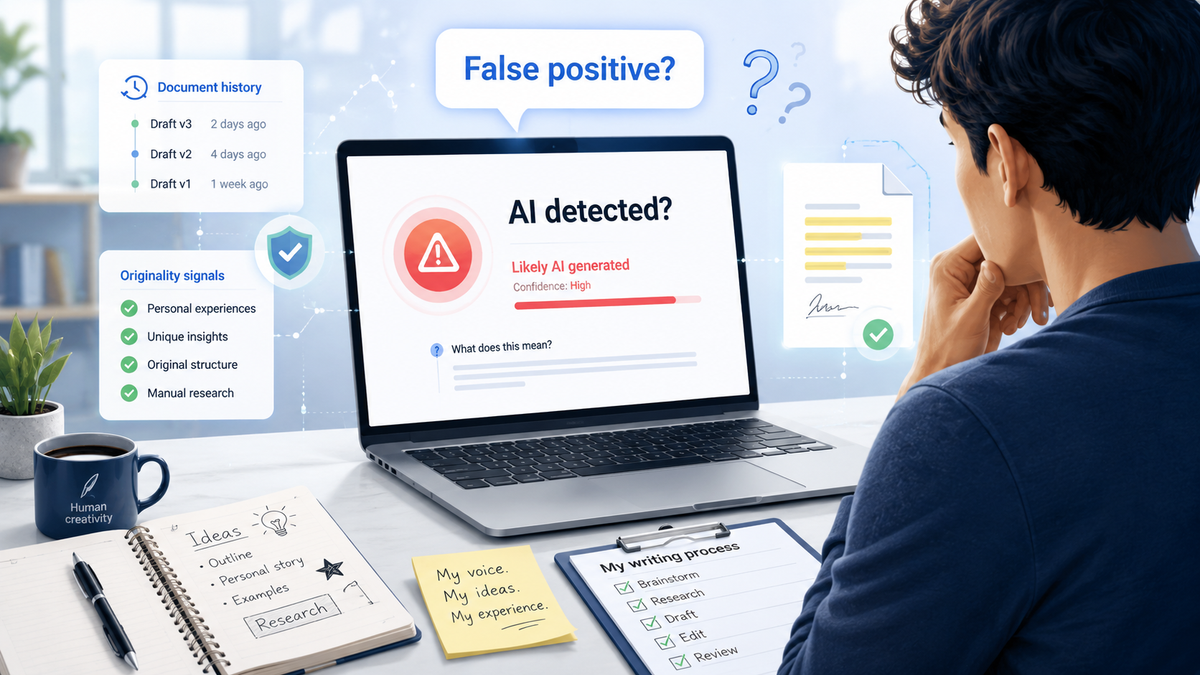
ZeroGPT may say you used AI even when you wrote the text yourself because its result is a classification—not direct evidence of how the document was created. Human and AI writing patterns can overlap, and text detectors can produce false positives. Before rewriting anything, preserve your drafts, notes, sources, and version history, then review the result in context.
A high score can be upsetting, especially when your grade, work, publication, or reputation is involved. But it should begin a review process, not automatically settle the question of authorship. Universities and researchers have repeatedly warned that AI-detection results can be wrong and should not be treated as conclusive evidence on their own.
Can ZeroGPT Be Wrong?
Yes. ZeroGPT can classify human-written text as AI-generated, just as an AI detector can fail to identify text that was generated by an AI system.
ZeroGPT says it uses a multistage methodology intended to reduce false positives and reports accuracy above 98% in its internal evaluations. That is the company’s own assessment, however, and it should not be interpreted as a guarantee for every document, writing style, language, subject, or real-world situation.
Independent research has found that AI-text detectors can produce both false positives and false negatives. One research preprint that evaluated ZeroGPT alongside other detection approaches reported significant limitations in distinguishing human and AI-generated essays. Other studies have found that detector performance can change across models, datasets, domains, and writing conditions.
The responsible conclusion is not that ZeroGPT is always wrong. It is that a ZeroGPT result should be considered one piece of evidence with known limitations.
Why Can Human-Written Text Be Flagged as AI?
There is rarely one provable reason for a false positive. ZeroGPT’s private classification system is not fully available for outside inspection, so claims that one specific word, sentence length, or transition “triggered” the result should be treated cautiously.
Several broader factors can explain why authentic writing receives an unexpected classification.
The detector is classifying the final text—not watching you write it
A text detector normally evaluates the document it receives. It does not automatically have access to:
- Your outline.
- Your research notes.
- Earlier drafts.
- Your document revision history.
- Your typing process.
- Conversations with an instructor or editor.
- Your understanding of the subject.
It therefore makes an inference from the submitted text rather than observing authorship directly.
That is why documentation of your process can be more useful than repeatedly uploading the same passage to different detectors.
Human and AI writing patterns can overlap
Generative models learn from human-created language. Clear, formal, structured writing is not exclusive to AI, and AI-generated writing can imitate many characteristics associated with human writing.
This creates unavoidable overlap between the two categories. Research into text detection has shown that systems may perform well under one test condition and poorly when the model, subject, style, or dataset changes.
A polished paragraph is not proof of AI use. Neither is a particular transition, vocabulary choice, or sentence structure.
For a broader comparison, see AI vs. human writing. Or also see this article about the patterns Wikipedia catalogs as AI-writing tells.
Formal or non-native English writing may be misclassified
A peer-reviewed study led by Stanford researchers found that several GPT detectors disproportionately misclassified writing by non-native English writers. The study raised fairness concerns about using detector results in evaluative and educational settings.
That research did not establish one universal false-positive rate for every detector or every student. It does show why language background, writing style, and context matter when someone interprets an AI score.
AI-assisted editing changes the authorship picture
There is an important difference between:
- Writing every sentence yourself.
- Using a spelling checker.
- Accepting AI-generated rewrites.
- Asking an AI tool to restructure paragraphs.
- Generating a draft and editing it manually.
A document may be largely based on your ideas but still contain AI-generated phrasing if you accepted generative rewrite suggestions. Whether that use is permitted depends on the relevant school, employer, client, publisher, or platform policy.
Before describing a result as a false positive, identify exactly which tools were used and what they changed.
Limited context can make a result harder to interpret
A short paragraph gives any classifier less information than a full document. However, you should not assume that adding more text will automatically fix the result or make it accurate.
Check ZeroGPT’s current input guidance, evaluate the full document where appropriate, and avoid drawing serious conclusions from an isolated sentence.
What Does a ZeroGPT Percentage Actually Mean?
A ZeroGPT percentage is the tool’s output about the submitted text. It should not automatically be read as:
- The percentage of words written by AI.
- The probability that the writer cheated.
- Proof that ChatGPT was used.
- Proof that a particular AI model created the passage.
- Proof that the writer is being dishonest.
The precise interpretation should follow ZeroGPT’s current documentation. More broadly, institutional guidance commonly treats detector reports as signals requiring review rather than conclusive evidence.
The University of Melbourne, for example, tells students that an AI-writing detection report alone is not sufficient evidence for an allegation and notes that students may instead be asked to explain their argument, sources, drafts, or notes.
For more detail about what these tools can and cannot establish, read Can ChatGPT be detected?.
What Should You Do If ZeroGPT Flags Your Work?
Do not panic, delete your drafts, or immediately rewrite every sentence. Start by documenting how the work was created.
1. Preserve your evidence
Keep:
- Early drafts.
- Outlines.
- Research notes.
- Document version history.
- Source lists.
- Citation records.
- Comments from instructors or editors.
- Files showing when the work was created.
- Any permitted AI-use disclosure.
Do not modify or recreate evidence after a dispute begins.
2. Identify what was actually flagged
Record:
- The exact document version.
- The date and time of the check.
- The passage ZeroGPT highlighted.
- The score or classification displayed.
- The amount of text submitted.
- Any settings used.
- A screenshot of the result.
This information helps distinguish a document-wide concern from one isolated passage.
3. Separate human writing from AI assistance
Write down which statement accurately describes the document:
Be precise. Saying “I wrote it” may not fully describe the process if an AI system generated or substantially rewrote some of the wording.
4. Review the applicable policy
Check the current rules for:
- Brainstorming.
- Outlining.
- Grammar assistance.
- Paraphrasing.
- Generative rewriting.
- Translation.
- Citation.
- Disclosure.
- Submitting AI-generated language.
Acceptable use differs across institutions and assignments. HumanizeAI’s own acceptable-use policy prohibits submitting AI-generated or AI-assisted work as original academic work where that use is prohibited.
5. Request human review when the consequences are serious
When a score affects a grade, disciplinary action, employment, publication, or reputation, ask for the result to be evaluated alongside:
- Your drafts and revision history.
- Your previous writing.
- Your ability to explain the argument.
- Your sources.
- The relevant policy.
- The exact passage flagged.
- Any declared AI assistance.
MIT teaching guidance warns that detector errors can lead to false accusations, while several institutions recommend dialogue, process evidence, and human judgment instead of relying on software alone.
ZeroGPT False-Positive Response Checklist
Use this checklist before changing your document:
[ ] I saved the original document and did not overwrite it.
[ ] I preserved drafts, notes, sources, and version history.
[ ] I recorded the exact passage and score ZeroGPT displayed.
[ ] I identified every AI, grammar, translation, or rewriting tool used.
[ ] I separated fully human-written sections from AI-assisted sections.
[ ] I checked the relevant school, workplace, client, or publishing policy.
[ ] I verified quotations, facts, references, and citations.
[ ] I can explain how I developed the argument and reached the conclusion.
[ ] I avoided treating a second detector as definitive proof.
[ ] I requested human review if the result has serious consequences.
[ ] I revised unclear writing for quality—not merely to chase a lower score.
[ ] I disclosed AI assistance wherever disclosure is required.
The checklist does not prove authorship by itself. It helps organize the evidence and questions a fair review should consider.
Should You Rewrite Human-Written Work to Change the Score?
Not automatically.
If the text genuinely reflects your work and is clear, accurate, original, and appropriate for the assignment, rewriting it only to satisfy an opaque detector may make the writing worse or distort your meaning.
Instead, review it for normal editorial reasons:
- Is the argument clear?
- Are examples specific?
- Are sources attributed?
- Are any claims unsupported?
- Is the structure repetitive?
- Does the wording reflect your real voice?
- Can you explain every part of the document?
Individual words commonly associated with AI are not proof that a passage was generated. Many appear naturally in formal and professional writing. See this discussion of common AI words and phrases for context, but do not treat it as a prohibited-word list.
When Can an AI Humanizer Be Appropriate?
An AI humanizer may be appropriate when you genuinely used AI to create or rewrite a draft and now need to improve its clarity, flow, readability, sentence variation, or tone.
HumanizeAI’s AI Humanizer is designed to revise AI-assisted or mechanical writing by improving elements such as structure, flow, and naturalness. The output still requires human review for factual accuracy, originality, meaning, citations, and policy compliance.
It is not the correct solution when:
- You need to prove that you authored an existing document.
- AI use was prohibited and you are trying to conceal it.
- The original human-written text is already accurate and clear.
- You want a guaranteed ZeroGPT score.
- You need evidence for an academic-integrity appeal.
- You have not checked whether AI assistance is permitted.
Using a humanizer cannot prove human authorship, and no responsible tool should guarantee a particular result from a third-party detector.
For an editing-first workflow, see how to humanize AI text responsibly and whether humanizing AI content is ethical.
Up Next: How AI systems actually evaluate writing - The 7 Pillars to Citable Content
Frequently Asked Questions
Can ZeroGPT be wrong about human writing?
Yes. A false positive occurs when human-written material is classified as AI-generated. Research and institutional guidance show that AI detectors have limitations and should not be treated as conclusive evidence by themselves.
Why does ZeroGPT say my writing is 100% AI?
The result indicates that ZeroGPT strongly classified the submitted text as AI-related under its system. It does not independently prove that every word was produced by AI or that misconduct occurred. Check the tool’s current explanation of its scoring and evaluate the result with drafts, context, policy, and human review.
Can an AI detector prove that someone used ChatGPT?
Not by itself. A text classifier can identify patterns it associates with generated writing, but establishing who wrote a document and how it was produced requires broader evidence. Independent research has documented both false-positive and false-negative problems.
Should I check the text with several AI detectors?
A comparison may show that systems disagree, but agreement does not transform the result into proof. Detectors use different models, datasets, and thresholds. Preserve the outputs, but prioritize drafts, revision history, sources, policies, and human review.
Can grammar correction make writing look AI-generated?
Basic spelling or punctuation correction does not mean an AI system authored the document. Generative rewriting is different: when a tool replaces or restructures sentences, the final wording may be AI-assisted. Record what the tool changed and follow the relevant disclosure rules.
Final Answer
ZeroGPT may say you used AI because the patterns in your text matched patterns its classifier associates with generated writing. That result can be useful as a prompt for review, but it is not direct proof of authorship.
Preserve your writing-process evidence, identify any AI assistance accurately, review the applicable rules, and request human evaluation when the consequences matter. Improve the writing where it genuinely needs improvement—but do not rewrite authentic work merely to chase a detector score.