How to Humanize AI Marketing Content Without Losing Brand Voice

AI can produce a landing-page draft, campaign email, blog section, or social post in seconds. The problem is that the copy can sound polished enough to publish while still feeling generic enough to belong to almost any brand.
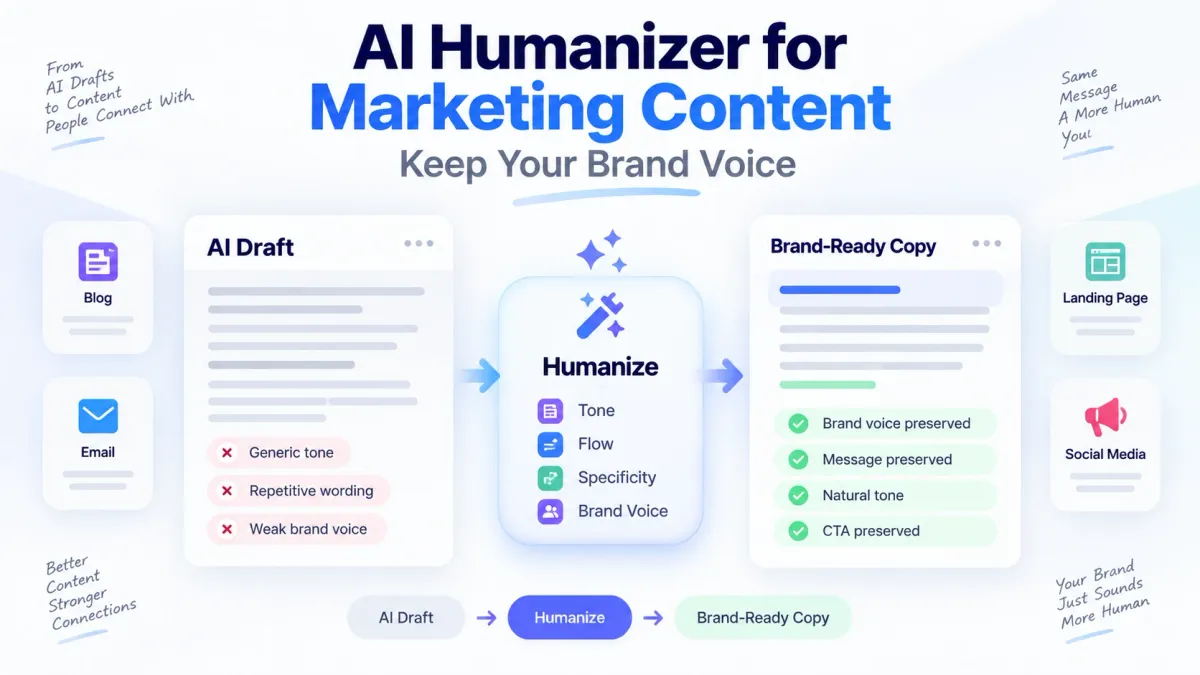
Humanizing AI marketing content is not about rewriting everything. The goal is to preserve the strategy, product facts, audience, offer, and call to action while improving the tone, rhythm, specificity, and flow of the draft.
For marketers, that distinction matters. A rewrite is only useful if the content still communicates the same message after it sounds more natural.
Quick Answer
To humanize AI marketing content, first lock the facts, positioning, offer, CTA, and brand terminology that should not change. Then improve robotic phrasing, sentence rhythm, vague benefits, transitions, and tone without altering the original message.
A final human review should confirm that the copy still sounds like the brand, represents the product accurately, and guides the reader toward the intended next step.
Key Takeaways
- Humanization should preserve product facts, positioning, offers, and CTA intent.
- Define the brand voice before rewriting so the output has a clear stylistic target.
- Do not confuse humanization with paraphrasing or SEO optimization; they solve different problems.
- Landing pages, emails, blogs, social posts, and product descriptions require different editing decisions.
- Compare the humanized draft with the original to catch meaning drift or altered claims.
- Human review is still necessary before publishing marketing copy.
Why AI-Generated Marketing Content Often Sounds Generic
AI-generated marketing copy often has the right structure but weak differentiation.
A draft may mention the product, identify a benefit, include a call to action, and still sound as though almost any competitor could publish it.
Common problems include:
Vague Benefits
AI drafts frequently use benefits such as:
- save time
- improve efficiency
- streamline your workflow
- achieve better results
- unlock your potential
These phrases are not automatically wrong. The problem is that they say very little unless they are connected to something specific.
“Save time on content production” is broad.
“Turn an approved content brief into a first draft without rebuilding the structure from scratch” gives the reader a clearer idea of what the benefit actually means.
Generic Adjectives
Words such as “powerful,” “innovative,” “seamless,” and “revolutionary” can make copy sound promotional without explaining why the product is useful.
Specificity is usually stronger than another adjective.
Predictable Sentence Structure
AI drafts can fall into a repeated pattern:
statement → explanation → benefit → transition → next benefit.
When every paragraph follows the same rhythm, even accurate copy can feel mechanical.
Weak Brand Voice
If the prompt does not define the brand voice clearly, the model usually defaults to broadly professional language.
That may be acceptable for a first draft, but it is rarely distinctive enough for final marketing content.
Copy That Could Belong to Any Brand
A useful test is simple:
Could you replace your company name with a competitor's name without changing the paragraph?
If the answer is yes, the copy probably needs more specificity.
What Should Stay the Same When You Humanize Marketing Copy?
Humanization should change the presentation of the message, not the commercial truth behind it.
Before editing, separate the elements that must remain stable from the elements you want to improve.
For example, if a landing page says a product has three pricing plans, humanization should not change the number of plans.
If the CTA is “Start Free,” the rewrite should not quietly turn that into “Book a Demo.”
If the product is positioned for agencies, the rewrite should not broaden the audience to “everyone.”
The safest approach is to identify those fixed elements before the copy enters the rewriting stage.
How to Humanize AI Marketing Content Step by Step
Step 1 — Define the Brand Voice Before Rewriting
Do not ask a tool to “make this sound more human” without defining what “human” means for the brand.
A useful voice brief can include:
- formal vs. conversational
- concise vs. explanatory
- confident vs. understated
- technical vs. accessible
- vocabulary the brand regularly uses
- phrases the brand avoids
- preferred sentence length
- use of humor
- level of sales pressure
For example:
Write in a direct, professional tone. Use short paragraphs and plain English. Avoid exaggerated claims and generic phrases such as “revolutionary” or “game-changing.” Explain benefits with concrete examples.
That gives the rewrite a much clearer target.
Step 2 — Lock the Facts, Offer, and CTA
Before humanizing the draft, list the elements that should not change.
These may include:
- product name
- feature names
- pricing
- availability
- important product claims
- campaign offer
- CTA text or destination
- target audience
- required terminology
- campaign objective
- important keywords
Think of this as the “do not rewrite incorrectly” list.
It is especially useful when several people or tools touch the same piece of content.
Step 3 — Remove Generic AI Marketing Language
AI-assisted marketing copy often becomes generic when it relies on familiar promotional patterns.
For example:
Generic draft
Unlock the power of our revolutionary solution and take your content strategy to the next level with a seamless experience designed for modern marketers.
The sentence contains a lot of marketing language but very little information.
A clearer version might be:
Turn AI-assisted drafts into clearer marketing copy while keeping your original message, product details, and call to action intact.
The second version is not better because it sounds less “AI.” It is better because the reader can understand what the product actually does.
Do not build an arbitrary blacklist of forbidden words. Instead, ask whether each phrase communicates something specific.
Step 4 — Add Specificity
Specificity makes marketing copy more useful.
Compare:
Generic
Our platform helps teams improve their content workflow.
More specific
A marketing team can draft an article with AI, humanize the language, review the brand voice, optimize the final page, and publish without restarting the content process at each stage.
No invented statistics are necessary. The example simply explains the workflow more clearly.
Useful ways to add specificity include:
- naming the content format
- explaining the actual task
- defining what changes
- defining what stays the same
- describing the next step
- including a realistic example
Step 5 — Adjust Rhythm and Tone
Natural marketing copy rarely uses the same sentence length throughout.
Mix short statements with slightly longer explanations.
Avoid forcing every sentence into an identical pattern.
Also review transitions. AI-generated copy often overuses explicit connectors such as “Additionally,” “Furthermore,” and “Moreover.”
Sometimes the strongest transition is simply moving naturally to the next point.
Read the copy aloud. If every sentence lands with the same rhythm, change the structure.
Step 6 — Review the Humanized Draft Against the Original
After rewriting, compare the two versions.
Ask:
- Did the meaning change?
- Did a product fact disappear?
- Did the tool introduce a claim that was not in the original?
- Did the CTA become weaker or stronger?
- Did the positioning change?
- Does the tone still match the brand?
- Is the final version genuinely clearer?
This step matters because a smoother sentence is not automatically a more accurate sentence.
Step 7 — Perform Final Marketing and Editorial QA
The humanized draft is still a draft.
Before publishing, review:
- factual accuracy
- brand consistency
- product terminology
- CTA
- formatting
- links
- search intent when relevant
- legal or compliance-sensitive claims
- duplicated ideas
- unsupported claims
Marketing teams should treat humanization as part of editorial production, not as the final approval step.
How Humanization Changes by Marketing Format
Different marketing assets have different jobs, so the humanization process should change with the format.
Blog Content
Blog content needs more than a natural tone.
A strong blog should also include:
- useful explanations
- clear answers
- relevant examples
- logical heading structure
- an expert point of view
- readable paragraphs
If the entire article needs a broader editing process, follow the full guide on how to humanize AI text.
For deeper stylistic techniques, see the guide on how to make AI writing more human.
Landing Page Copy
Landing pages are more commercially sensitive.
Preserve:
- positioning
- value proposition
- offer
- CTA
- product facts
Improve:
- vague benefits
- repetitive claims
- generic adjectives
- awkward transitions
- unnecessary explanation
The humanized version should still move the reader toward the same decision.
Email Marketing
For email copy, focus on:
- a natural opening
- a clear reason for the message
- conversational transitions
- concise paragraphs
- CTA preservation
Do not let humanization introduce urgency, scarcity, or claims that were not present in the original campaign.
Social Media Content
Social content usually needs tighter pacing.
Review:
- opening line
- sentence length
- platform-appropriate tone
- recognizable brand voice
- excessive formality
- generic motivational phrasing
Humanization should make the post feel more deliberate, not simply more casual.
Product Descriptions
Product descriptions require careful meaning preservation.
Keep:
- specifications
- features
- dimensions
- compatibility
- materials
- important differentiators
Improve:
- repetitive wording
- vague adjectives
- awkward phrasing
- generic benefit statements
Never let stylistic rewriting alter a specification.
Before and After: Humanizing AI Marketing Copy
The examples below are illustrative. They are not customer case studies or measured performance results.
Example 1: Landing Page
AI Draft
Unlock the full potential of your content workflow with our powerful AI solution designed to streamline your processes and enhance efficiency.
Humanized Version
Move AI-assisted content from draft to publish without rewriting the entire piece by hand. Refine the language, review the message, and keep the workflow moving.
What Changed
The humanized version removes broad promotional language and explains the workflow more concretely. The commercial intent remains, but the wording is more specific.
Example 2: Marketing Email
AI Draft
We are excited to introduce our innovative platform that empowers marketing teams to create better content faster and achieve outstanding results.
Humanized Version
If your team already uses AI for first drafts, the next challenge is making those drafts sound like your brand. Our workflow helps you refine the language before the content reaches your audience.
What Changed
The rewrite replaces unsupported outcome language with a concrete problem and a clearer use case.
Example 3: Blog Introduction
AI Draft
In today's rapidly evolving digital landscape, artificial intelligence has revolutionized the way marketers create and distribute content.
Humanized Version
AI can get a marketing draft on the page quickly. The harder part is turning that draft into something specific enough to sound like your brand instead of everyone else's.
What Changed
The rewrite removes a generic opening and moves directly to the problem the reader came to solve.
Where an AI Humanizer Fits Into the Marketing Workflow
Marketing teams can humanize content manually. The tradeoff is time, especially when AI-assisted drafts are being produced across several formats or campaigns.
A dedicated AI Humanizer for marketing content can handle the first structural editing pass by improving tone, sentence variation, structure, and readability while preserving the original intent. HumanizeAI's current product page describes Basic, Advanced, and Ultra rewriting modes and says the tool supports text created with ChatGPT, Gemini, Claude, and other AI tools.
For marketing teams, the useful division of work is:
Tool: language, rhythm, structure, flow.
Marketer: positioning, evidence, brand voice, product truth, CTA, and final approval.
That keeps the tool in the right role.
Humanizing Marketing Content vs. Optimizing It
Humanization and content optimization are related, but they are not the same process.
Humanization focuses on how the writing sounds and flows.
It deals with:
- tone
- rhythm
- repetition
- sentence structure
- naturalness
- readability
Content optimization focuses more broadly on whether the page covers the topic and search intent effectively.
That may include:
- headings
- missing subtopics
- entities
- search intent
- keyword coverage
- FAQs
- content structure
- competitor gaps
HumanizeAI's current AI Content Optimizer analyzes content against live search competitors and surfaces structural, keyword, entity, heading, FAQ, and readability opportunities.
A practical sequence is:
Humanize the draft → review the brand message → optimize the page where needed.
Do not use content optimization as a substitute for brand editing, and do not use humanization as a substitute for search strategy.
What an AI Humanizer Cannot Do for Your Marketing
An AI humanizer can help improve the language of a draft. It cannot take responsibility for the marketing strategy behind it.
It cannot automatically:
- verify product facts
- create genuine customer experience
- confirm legal or compliance claims
- guarantee conversions
- guarantee search rankings
- guarantee engagement
- define your positioning
- decide your brand strategy
- verify whether every claim is defensible
- replace final editorial judgment
That is why human review remains part of the workflow.
The more commercially sensitive the page is, the more important that review becomes.
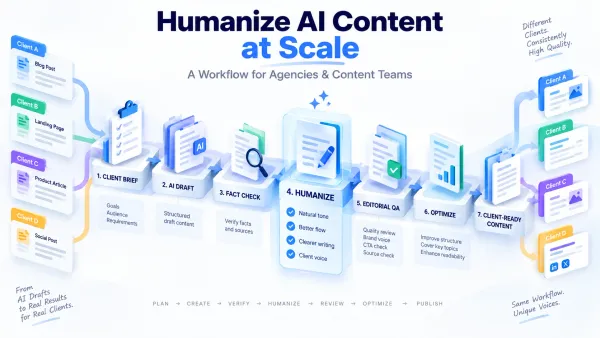
Recommended AI Marketing Content Workflow
A practical workflow looks like this:
1. Brief
Define the audience, goal, product, CTA, search intent, and brand voice.
2. AI Draft
Use the brief to generate a useful starting point rather than a generic first pass.
3. Fact Check
Verify product facts, prices, feature names, statistics, sources, and claims.
4. Humanize
Improve tone, structure, rhythm, specificity, and flow.
5. Brand Review
Make sure the draft sounds like the company and still communicates the intended positioning.
6. SEO / Content Optimization
For search-driven pages, review topic coverage, structure, internal links, search intent, and missing information.
7. Final QA
Check copy, links, formatting, claims, CTA, and consistency.
8. Publish
Only publish once the final version is accurate and useful—not merely more polished than the original AI draft.
Frequently Asked Questions
What is the best way to humanize AI marketing content?
Start by identifying the facts, positioning, offer, CTA, and brand terminology that must remain unchanged. Then improve robotic wording, sentence rhythm, specificity, tone, and flow before completing a final human review.
Can an AI humanizer preserve brand voice?
An AI humanizer can help align a draft with a defined tone and improve how the writing flows, but brand voice should still be reviewed by someone who understands the company's positioning and editorial standards. The clearer the brand guidelines are before rewriting, the better the editing process can be directed.
Can I humanize AI-generated blog content?
Yes. For blog content, focus on clarity, useful examples, natural introductions, sentence variation, and a clear point of view. Humanization should improve the writing without changing factual claims or search intent.
Should I humanize landing page copy?
Humanization can be useful when AI-drafted landing page copy sounds generic or overly polished. Preserve the value proposition, product facts, offer, and CTA while improving vague benefits, rhythm, and tone.
Does humanizing marketing content help SEO?
Humanization can improve readability, clarity, specificity, and overall content quality, but it does not guarantee rankings. SEO performance depends on a broader set of factors, including search intent, topic coverage, technical accessibility, authority, and the usefulness of the final page.
Is an AI humanizer the same as a paraphrasing tool?
No. Paraphrasing primarily changes how existing text is worded. Humanization focuses more broadly on tone, sentence variation, rhythm, flow, and naturalness while preserving the underlying message.
Can marketing teams humanize content at scale?
Yes, but scale makes process discipline more important. Teams should define brand rules, preserve factual information, use a consistent review workflow, and keep human approval in place rather than relying on automated rewriting alone.
Final Takeaway
The goal of humanizing AI marketing content is not to make every sentence sound dramatically different.
It is to make the draft sound specific to the brand.
Preserve the facts. Preserve the offer. Preserve the CTA.
Then improve the tone, rhythm, specificity, and flow.
For teams that produce AI-assisted marketing content regularly, a dedicated humanizer can speed up that editing stage. But the final responsibility still belongs to the marketer: making sure the copy is accurate, useful, on-brand, and ready for a real audience.
Sources / References
- HumanizeAI AI Humanizer — current product functionality, rewriting modes, supported AI-platform content, and meaning-preservation positioning.
- HumanizeAI AI Content Optimizer — current content-optimization functionality and workflow.