How to Use AI for Writing (Without Sounding Like AI)
AI can draft fast. It can't tell you if the draft is any good. Here's a step-by-step way to use AI for writing, plus the actual scoring system HumanizeAI runs to check whether content is worth publishing.


Updated September 27, 2026 · 11 min read
The TL;DR
AI writing tools are genuinely useful for speed: drafting, outlining, restructuring, and clearing writer's block. They are not useful for judgment, verified facts, or real experience, because a language model has none of those things on its own. The gap between a fast AI draft and content worth publishing is entirely in what a human adds afterward: sourced evidence, a real example, a clear point of view, and a direct answer up front. At HumanizeAI, every piece we optimize runs through a writing process while it's being drafted and a scoring system before it publishes, built specifically to close that gap instead of hoping an editor catches it.
What You'll Learn
- How AI writing actually works, and where it's strong versus where it falls short
- A step-by-step process for using AI to draft blog posts, marketing copy, and long-form content
- How HumanizeAI's writing process shapes each step so the result doesn't read as generic
- How HumanizeAI's scoring system checks a finished piece before it publishes
- What HumanizeAI's Canonical Content Index is, why it's different from a style check, and what its current status actually is
- Whether AI-written content is safe for SEO, backed by real, dated research
The Breakdown
What is AI writing, and what does it actually do well?
AI writing tools are language models trained on large amounts of text, predicting the most likely next word based on the surrounding context. They don't understand meaning the way a person does. They have no opinions, no firsthand experience, and no awareness of whether a claim is true. What they're genuinely good at is pattern completion: producing fluent, structured, confident-sounding text very quickly.
That makes AI strong at a specific set of tasks: drafting a first pass, organizing a long piece into logical sections, expanding a rough idea into full paragraphs, cleaning up grammar, and generating outlines or headline options. It's weak at the things that make content worth reading: original insight, deep subject-matter judgment, verified facts, and an emotional read on an audience. Those weaknesses aren't a bug to route around. They're the actual reason human review exists in any serious content process, ours included, and they're also the reason a page built to actually humanize AI text has to add real substance, not just smooth out the sentences.
How do I actually use AI to write something worth publishing?
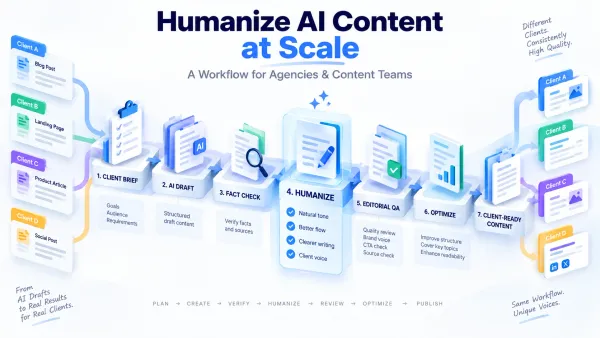
Here's the process we use, step by step. Each step is built into how the draft gets written in the first place, not applied as a separate pass afterward.
- Define who you're writing for before you write anything. Name the specific reader and what they need from this piece. Content written for a generic audience reads generic, no matter how good the AI output is.
- Write a detailed prompt, not a vague one. Include the topic, the audience, the tone, and the required structure. Vague prompts produce vague, interchangeable drafts.
- Generate an outline first, and edit it before expanding anything. This is where you catch missing angles and reorder sections for a logical flow, before you've sunk time into full paragraphs.
- Draft one section at a time, not the whole piece in one shot. Section-by-section generation stays focused and produces more specific writing than a single long prompt does.
- Add sourced evidence to every factual claim. Every statistic or finding needs a named source, a date, and a live link, or it gets cut. "Studies show" is never acceptable on its own.
- Add one real, specific, firsthand example. A generic example that could belong to any company doesn't count. If you don't have a real one, say so rather than inventing one.
- Move the direct answer to the first 150-200 words. Readers and AI engines both extract value from the opening, not from a slow build-up.
- Add named citations and internal links before you call it done. A byline, outbound links to credible sources, and internal links to related content, woven through the piece rather than bolted on at the end.
That's the full loop. Steps 1, 3, and 4 are about using AI efficiently. Steps 5 through 8 are about the human work that turns a fast draft into something worth publishing, and they're the steps that get skipped when AI content underperforms.
Where does this process break down most often?
Almost always at steps 5 and 6. It's easy to generate a fluent paragraph and move on. It's slower to track down a real, dated source for every claim, and slower still to sit with a draft long enough to add something only you would know. Those two steps are also, not coincidentally, the two that a subtraction-only editing pass, one that just removes AI-sounding phrases, does nothing to fix. You can strip every stock phrase out of a paragraph and it will still be unsourced and generic if steps 5 and 6 never happened.
How does HumanizeAI check whether a finished piece is actually good?
We run every piece we optimize through a scoring system called the Content Authority Score, CAS for short.
CAS has two layers. The first is three pass/fail gates that run before anything gets scored: Originality (does it avoid reproducing more than 5% of any single source), Factual Integrity (is every claim sourced or flagged for verification, with zero unresolved gaps), and Humanization (does it read as genuinely human rather than raw model output). Any failed gate means the piece isn't ready, regardless of how it scores on everything else.
The second layer is eight scored dimensions across things like Answer Structure, Citability, Experience, Authority Signals, and Clarity. Two of these map directly to the steps above. Experience checks for the concrete, firsthand example from step 6, and includes a hard rule against fabricating one just to score well. Citability checks whether the sourced claims from step 5 are attributed clearly enough that another writer, or an AI system, could verify and cite them. A piece needs 75 or above, with all three gates passed, before it's considered publishable.
Is there anything CAS still can't catch?
Yes, and this is the honest part. CAS can confirm a piece has sources, an example, and a clean structure. It can't yet answer a harder question: would anyone actually choose to cite this piece over what's already ranking for the same topic? A piece can pass every CAS gate, sourced, structured, humanized, and still just restate what a dozen other articles already say.
We're actively building a layer to answer that question: the Canonical Content Index, CCI for short. It's designed to score whether a piece contributes something genuinely new rather than repeating consensus, weighted across five things that move the score most:
- Original Contribution — does the piece add something that wasn't in the existing top results: new data, a firsthand account, a conclusion drawn from real experience, a new definition or taxonomy?
- Information Gain — does a reader learn something here they couldn't have assembled from three other pages already ranking for the same query?
- Evidence Depth — are claims backed by named sources, real methodology, or firsthand observation, not just assertion?
- Framework or Asset Creation — does the piece introduce a named, structured way of thinking about a problem that others would reference when discussing the topic?
- Quotability and Extractability — is there a specific sentence, statistic, or insight a writer or AI system could lift and attribute to this source specifically, one that would still make sense with zero surrounding context?
This is part of our current build, not a shipped feature, and we want to say that plainly rather than let the name imply more than it currently does. When it ships, it becomes the difference between "this passed the checks" and "this is worth citing," a distinction CAS alone can't make today.
Is AI-written content safe for SEO?
Yes, based on both Google's own stated guidance and independent research, as long as it's genuinely useful. Google has said directly that using AI doesn't give content any special advantage or penalty on its own. Content that's original, helpful, and demonstrates real expertise can perform well regardless of how it was produced, and automation used specifically to manipulate rankings is what actually violates their spam policies, not automation itself (Google Search Central, "Google Search's guidance about AI-generated content").
Independent data backs this up. Ahrefs studied 600,000 pages across 100,000 keywords and found a correlation of 0.011 between the percentage of AI-generated content on a page and its Google ranking position, effectively no relationship at all (Ahrefs, "AI-Generated Content Does Not Hurt Your Google Rankings," July 2025). The same study found 86.5% of top-ranking pages already contain some AI-generated content. The problem was never AI. It's thin, unsourced, generic content, whether a person or a model wrote it.
There's a related, newer question worth a brief mention here: ranking on Google and getting cited inside an AI-generated answer are not the same thing. A page can rank well and never get pulled into an AI Overview or a ChatGPT answer, because AI citation depends on different signals, structure, sourcing, and trust, than traditional ranking does. That's a deeper topic than this guide covers, and it deserves its own full breakdown rather than a paragraph here.
Founder Observation
The difference between AI content that works and AI content that doesn't has never been the tool. It's the brief. When I was scaling sales teams at Okta and HashiCorp, we didn't get better results by hiring more people, we got better results by building better processes. The same is true here. Hand an AI model a vague topic and you get a vague article. Hand it a detailed brief, target persona, required sources, structure, tone, and you get a draft that's most of the way there before a human touches it. The human's job stops being writing from scratch and becomes editing, verifying, and adding the real experience only they have. That's a completely different workflow than "type a topic, publish the output," and it's the workflow this entire guide is built around.
Research & Supporting Evidence
- Google Search Central, "Google Search's guidance about AI-generated content" (2023, still current guidance) — Google states that AI-produced content gets no special ranking benefit or penalty on its own; quality, helpfulness, and E-E-A-T are what matter, and manipulative automation, not AI use itself, is what violates spam policy.
- Ahrefs, "AI-Generated Content Does Not Hurt Your Google Rankings" (July 2025) — a study of 600,000 pages across 100,000 keywords found a correlation of 0.011 between AI content percentage and ranking position, effectively no relationship, and that 86.5% of top-ranking pages already contain some AI-generated content.
- G2, "The Answer Economy: How AI Search Is Rewiring B2B Software Buying" (April 2026) — 51% of B2B software buyers now begin purchasing research in an AI chatbot rather than traditional search, underscoring why citability, not just rankability, increasingly matters for content strategy.
Mini Case Study
The clearest proof of this process isn't a client story, it's what happened when we ran it on our own content. One HumanizeAI blog article scored 29 out of 100 on CAS before this process was applied: no named sources for a claim-heavy piece, no firsthand example, a generic structure that could have belonged to any site covering the topic. After running exactly the steps above, sourcing every claim, adding a specific firsthand observation, restructuring for a direct answer up front, the same article scored 93 out of 100, moving from a Gate 2 (Factual Integrity) fail to a clean pass on all three gates.
Nothing about the underlying facts changed in that rewrite. What changed was whether a claim had a name, a date, and a link attached to it, and whether the piece said something only a specific person with specific experience could say. That's the entire argument of this guide, demonstrated on our own work rather than asserted about someone else's.
Key Takeaways
- AI is fast at drafting, outlining, and restructuring. It has no judgment, no verified facts, and no real experience on its own.
- The step-by-step process in this guide comes down to: define the reader, prompt clearly, outline first, draft section by section, then add sourced evidence, a real example, an upfront answer, and trust signals.
- CAS is the scoring system that checks whether a finished piece actually did that work: three pass/fail gates plus eight scored dimensions, with 75 and all gates passed as the publish threshold.
- Running this exact process on HumanizeAI's own content took one article from 29/100 to 93/100 on CAS, without changing the underlying facts, only how they were sourced and supported.
- CCI, the Canonical Content Index, is the next layer being built, checking whether a piece is worth citing across five weighted factors: Original Contribution, Information Gain, Evidence Depth, Framework or Asset Creation, and Quotability and Extractability. It's in active development, not a shipped feature yet.
- Google does not penalize AI-assisted content on its own. Ahrefs' research (July 2025) and Google's own stated guidance both confirm quality and sourcing matter, not the production method.
FAQ
How do I use AI for writing without it sounding generic? Follow AI drafting with deliberate human additions: sourced evidence for every claim, at least one real firsthand example, a direct answer moved to the first 150-200 words, and named citations. Removing AI-sounding phrases alone doesn't fix generic content, because the problem is usually missing substance, not surface style.
Does Google penalize AI-written content? No. Google's own guidance states that AI-produced content receives no special ranking boost or penalty on its own, and an Ahrefs study of 600,000 pages found essentially no correlation (0.011) between AI content percentage and ranking position. Thin or unsourced content underperforms regardless of who or what wrote it.
What is HumanizeAI's CAS score? CAS, the Content Authority Score, is HumanizeAI's scoring system for content quality. It runs three pass/fail gates (Originality, Factual Integrity, Humanization) and scores eight dimensions across 100 points, including Experience and Citability. A publishable piece needs 75 or above with all three gates passed.
What is the CCI and is it available now? CCI, the Canonical Content Index, is a system HumanizeAI is actively building to score whether a piece would actually get cited over what's already published on a topic, weighted across Original Contribution, Information Gain, Evidence Depth, Framework or Asset Creation, and Quotability and Extractability. It's in development, not a live feature yet, but it will form the basis on how we guard your content, to ensure once it ranks and is cited by AI, that is stays there.
Can beginners use AI for writing effectively? Yes. The step-by-step process, define the audience, prompt clearly, outline first, draft section by section, then add evidence and a real example, works regardless of experience level. The skill that takes practice is the human half: sourcing claims and adding genuine firsthand detail, not the AI prompting itself.
Does this process actually work, or is it theoretical? It's been run on HumanizeAI's own content. One internal article moved from a 29/100 CAS score, failing the Factual Integrity gate, to 93/100 and a clean pass on all three gates after applying exactly the steps in this guide, with no change to the underlying facts.
Ready to Put This Process on Autopilot Instead of Doing It by Hand?
Every step in this guide is what our own AI Article Agent runs automatically before a draft ever reaches you.
If you've read this far and thought "that's a lot to check manually for every article," that's the actual reason we built the AI Article Agent: source-checking, structure, and a firsthand-example prompt, built into the drafting step itself instead of a separate editing pass you have to remember to do.
See How the AI Article Agent Works → See HumanizeAI pricing
Additional Resources
- How to Humanize AI Text: The Complete Guide for Marketers — pillar page
- HumanizeAI AI Article Agent — the tool that runs this exact process automatically
- Does Humanizing AI Text Cause It To Be Penalized By Google?
- Wikipedia's Signs of AI Writing: The Full List, Plus a Copy-Paste Prompt You Can Turn Into a Skill
- Understand the Best AI Paraphrasing Tools
About the Author
Steve Palomares has spent 25+ years building software companies. Now founder and CEO of HumanizeAI, he writes about AI content strategy for marketing, AEO, GEO and growing software businesses with AI. Based in North Texas. Read more about Steve.