AI Humanizer for SEO Content: How to Improve AI Drafts Without Breaking SEO


AI humanizers can improve SEO content when they are used as an editing layer, not as a shortcut to rankings. A good humanizer can make an AI-assisted draft less repetitive, improve sentence rhythm and readability, and reduce robotic phrasing while preserving the original meaning.
What it cannot do is make weak content rank. It cannot replace keyword research, search-intent analysis, fact-checking, original examples, internal linking, subject matter expertise, or editorial judgment.
Google's current guidance does not prohibit AI-assisted content. Instead, Google emphasizes accuracy, quality, relevance, originality, and people-first value, while warning that generating large amounts of low-value content can violate its scaled content abuse policies.
For SEO teams, that distinction matters.
The goal is not to make content “look human” to an algorithm. The goal is to make an AI-assisted draft better for the person who actually has to read it.
If you already have a draft that needs that editing pass, you can try our AI humanizer for SEO content before completing the final SEO and editorial review.
Quick Summary
An AI humanizer for SEO content is useful when an AI-generated draft has the right information but sounds generic, repetitive, overly formal, or mechanically structured.
Use one to improve:
- sentence flow and variation
- repetitive phrasing
- robotic transitions
- readability
- tone
- naturalness
Do not expect one to fix:
- incorrect facts
- weak search intent
- missing expertise
- poor keyword targeting
- thin topical coverage
- bad internal linking
- unsupported claims
- lack of original information
That is the core difference between humanizing SEO content and simply rewriting text.
What Is an AI Humanizer for SEO Content?
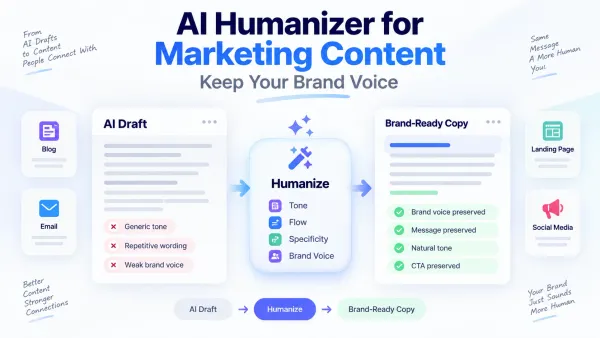
An AI humanizer for SEO content is a rewriting tool used to improve the naturalness, flow, tone, and sentence structure of AI-assisted content without intentionally changing its core meaning or SEO purpose.
HumanizeAI's current AI Humanizer, for example, is designed around tone, structure, flow, readability, meaning preservation, and reducing repetitive AI-style patterns. It supports text generated with systems such as ChatGPT, Gemini, and Claude.
That makes humanization different from several adjacent tasks.
A humanizer can support the editing process, but it should not be treated as a replacement for the other four.
If you want the broader distinction between rewriting and humanization, our guide to the best AI humanizer tools goes deeper into how these tools differ in practice.
Does Google Penalize AI-Generated or Humanized SEO Content?
Google does not say that content is automatically penalized because AI helped create it.
Google's Search Central guidance says that appropriate use of AI and automation is not against its guidelines. What can become a problem is using automation to produce large amounts of content primarily to manipulate search rankings or publishing pages that add little or no value for users.
Google's people-first guidance also encourages publishers to ask whether a page demonstrates real expertise, provides enough information for the reader to achieve their goal, and leaves the reader with a satisfying experience.
That means this is the wrong SEO question:
“Can I humanize this so Google won't know it came from AI?”
A better question is:
“Does this editing step make the page clearer, more useful, more specific, and more credible?”
There is also no strong evidence that the percentage of AI-generated text alone determines rankings. Ahrefs analyzed 600,000 ranking pages across 100,000 keywords and reported a correlation of just 0.011 between estimated AI-content percentage and Google ranking position—effectively no relationship in that dataset. Ahrefs also cautions that AI detectors are probabilistic and can produce false positives.
So the SEO case for humanization is not “Google hates AI.”
The case is that raw AI drafts often still need editing.
Why Raw AI Drafts Often Need Human Editing
AI can generate a useful first draft quickly. But speed is not the same as publication quality.
A typical AI-assisted SEO draft can have several recognizable weaknesses:
Repetitive sentence patterns
Several paragraphs may use almost identical sentence lengths, transitions, or openings.
The information may technically be correct, but the page starts to feel formulaic.
Generic claims
AI-generated drafts often produce sentences such as:
“Businesses can leverage this strategy to enhance their online presence and drive meaningful results.”
The sentence sounds polished, but it communicates almost nothing.
Specific writing would explain which businesses, which strategy, what changes, and what result is being measured.
Excessive transitions
Phrases such as “Additionally,” “Furthermore,” “Moreover,” and “In today's digital landscape” can appear far more frequently than a human editor would normally tolerate.
Surface-level completeness
AI can produce a section for every expected subtopic without contributing anything that competitors have not already said.
That is particularly important for SEO because Google explicitly warns against primarily summarizing other sources without adding substantial value.
False confidence
A draft can state uncertain information with complete confidence.
Humanization will not fix that.
The claim must be verified before the prose is polished.
For a broader workflow, see our guide on how to humanize AI text.
What Should an AI Humanizer Preserve for SEO?
This is where SEO humanization becomes more complicated than normal rewriting.
Making a paragraph “sound nicer” is not enough. The rewrite needs to preserve the parts of the draft that have strategic value.
1. Search intent
If a section was written to answer:
“How does an AI humanizer affect SEO?”
the rewrite should not drift into a generic explanation of AI writing tools.
Natural language is useless if the answer becomes less relevant.
2. Important terminology
Exact-match keywords do not need to appear in every paragraph, but important entities and terminology should not disappear simply because the tool prefers synonyms.
If your article is about AI humanizers for SEO content, replacing every instance with vague alternatives like “writing transformation software” would make the content less precise.
3. Factual meaning
A humanizer should not change:
“Google does not automatically penalize AI-generated content.”
into:
“Google rewards humanized AI content.”
Those are completely different claims.
The second is not supported by Google's guidance.
4. Links and citations
If your draft contains important internal links, references, statistics, product names, or source citations, check them after rewriting.
Do not assume they survived correctly.
5. Technical accuracy
This becomes especially important in topics such as medicine, finance, software, law, and technical SEO.
Natural prose with an incorrect explanation is still incorrect.
Before and After: Humanizing an SEO Paragraph
Consider this raw AI-style paragraph:
Before
Search engine optimization is an essential digital marketing strategy that enables businesses to improve their online visibility. By implementing effective SEO techniques, businesses can improve rankings, increase organic traffic, and achieve sustainable online growth.
There is nothing grammatically wrong with it.
The problem is that it could appear on thousands of websites.
A stronger edited version might be:
After
SEO helps a page become easier for search engines to understand and easier for the right audience to discover. But rankings do not improve because a writer added a few keywords. The page still has to match the searcher's intent, answer the question better than competing results, and give readers a reason to trust the information.
Notice what changed.
The second version has more sentence variation and fewer generic claims, but more importantly, it says something.
That distinction matters.
Humanization should not be measured by how dramatically the wording changes. It should be measured by whether the draft becomes easier to read without becoming less accurate or less useful.
Humanization vs. SEO Optimization
One of the biggest mistakes content teams make is treating these as the same process.
They are not.
SEO optimization asks questions such as:
- What is the dominant search intent?
- Which entities need to be covered?
- What questions are competitors answering?
- What information is missing from the SERP?
- Which page should receive internal links?
- Does the page satisfy the query?
- Is this keyword already targeted by another URL?
Humanization asks a narrower question:
Can this already-researched draft communicate its ideas in a clearer and more natural way?
If you need help with the optimization layer itself, compare dedicated content optimization tools rather than expecting a humanizer to perform both jobs.
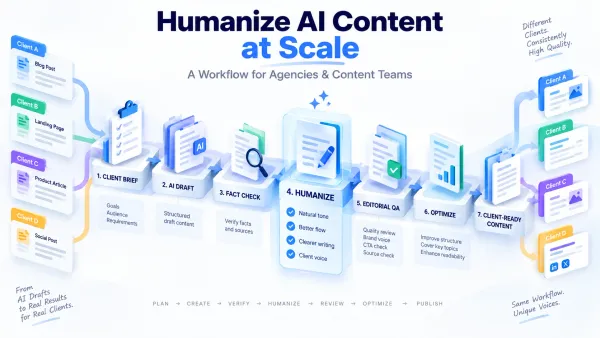
Where Should Humanization Fit in an SEO Workflow?
The safest workflow is not:
AI → Humanizer → Publish
It should look more like this:
1. Research search intent
Understand what the searcher is actually trying to accomplish.
2. Research the topic
Use authoritative sources, competitor analysis, subject-matter expertise, and original data where available.
3. Create the draft
AI can help structure or accelerate the first draft.
Google explicitly acknowledges that generative AI can be useful for research and adding structure to original content.
4. Verify factual claims
Check statistics, dates, quotations, product capabilities, regulations, studies, and named sources.
5. Add information competitors cannot reproduce
This may include:
- original examples
- screenshots
- proprietary data
- expert commentary
- real product testing
- methodology
- firsthand observations
6. Optimize for search intent
Review headings, entities, topic coverage, internal links, and page architecture.
7. Humanize the sections that need it
Use the humanizer to improve robotic phrasing, repetition, cadence, and flow.
8. Compare the rewrite with the original
Make sure no important fact, keyword, link, quotation, or nuance disappeared.
9. Complete a human editorial review
Read the page as a reader rather than as an SEO checklist.
10. Publish and measure
Use Search Console and analytics data to see whether users actually find and engage with the page.
For ChatGPT-specific drafts, see our workflow for how to humanize ChatGPT content.
The SEO Humanization Checklist
Before publishing a humanized article, check four layers.
Then ask one final question:
Did the humanizer merely make the text different, or did it make the page better?
Different is easy.
Better is the goal.
What Competitor Pages Get Right—and Where SEO Teams Should Be Careful
Current pages ranking around this topic generally emphasize three benefits: preserving keyword intent, improving readability, and speeding up the editorial workflow. RewriteNext, for example, explicitly positions its SEO humanizer around keyword-intent preservation and a faster editing process. LumiHumanizer similarly frames humanization as a quality-control layer rather than something that should replace SEO planning.
Those are reasonable use cases.
But some competing pages go considerably further.
HumanizeThisAI currently markets its SEO offering using claims such as being “Google Penalty-Proof,” helping pages “rank higher,” meeting E-E-A-T standards, and avoiding algorithmic penalties. Those are the company's own marketing claims; they should not be confused with Google's published guidance.
Google does not publish a rule saying that running a draft through a humanizer makes it penalty-proof or creates E-E-A-T.
Google instead emphasizes people-first usefulness, accuracy, quality, relevance, and meaningful value.
That distinction is important for SEO teams choosing a humanization workflow.
A credible tool should help you edit.
It should not encourage you to outsource SEO judgment to the rewrite button.
What an AI Humanizer Cannot Add for You
Firsthand experience
A model can rewrite:
“In our experience, this strategy improves conversions.”
But if nobody on the team actually had that experience, smoother wording does not make the statement true.
Original research
A humanizer cannot create legitimate survey results, testing data, customer results, or benchmark studies.
Expertise
It can improve how an expert explanation is written.
It cannot create the underlying expertise.
Reliable citations
If the original source is wrong or fabricated, the rewrite still has a bad source.
Search strategy
A tool cannot automatically decide which URL should own a keyword or whether a new article will cannibalize an existing page.
Information gain
If the input merely summarizes the same five competitor pages everyone else summarized, a stylistic rewrite does not create a unique reason for the page to exist.
This is why the question do AI humanizers actually work needs a more nuanced answer than “yes” or “no.”
They work for the editing problems they are designed to address.
They do not solve every problem in the content.
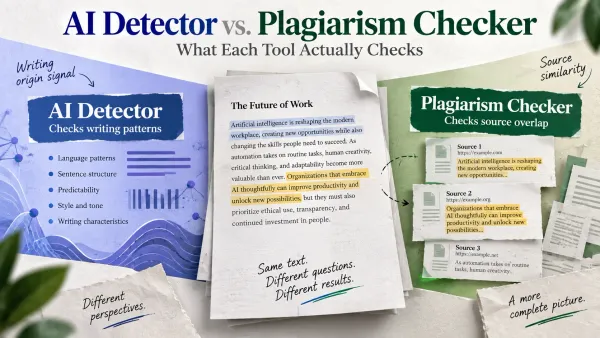
Should SEO Writers Try to Pass AI Detectors?
AI-detection scores should not be the primary KPI for SEO content.
The reason is straightforward: Google has not said that a page needs to pass an AI detector to rank. Its public guidance focuses on content quality and spam behavior rather than requiring human authorship.
AI detection itself is also probabilistic.
Ahrefs explicitly notes that AI detectors can produce false positives because they operate as statistical models rather than definitive authorship tests.
That does not make detectors useless.
They can help identify sections that feel highly patterned or formulaic. But the editorial response should be:
“Why does this section read mechanically?”
not simply:
“How do I lower the score?”
For a broader comparison of machine-generated and edited prose, see AI vs. human writing.
How to Use HumanizeAI on an SEO Draft
HumanizeAI's current AI Humanizer is designed to improve tone, structure, readability, sentence variation, and naturalness while aiming to preserve the original meaning. The product currently offers multiple rewriting modes and supports AI-assisted text from systems including ChatGPT, Gemini, and Claude.
For SEO content, use it selectively.
Start with a finished SEO draft
Do the research and optimization first.
Do not humanize an incomplete outline and assume the result will become a finished SEO article.
Process the prose that needs editing
Typical candidates include:
- introductions
- generic explanations
- repetitive body paragraphs
- stiff transitions
- AI-heavy conclusions
Be more cautious with:
- quotations
- legal wording
- definitions
- statistics
- highly technical instructions
- metadata
- structured data
- branded terminology
Compare both versions
Check whether the rewritten version preserved:
- factual meaning
- target terminology
- relevant entities
- internal links
- citations
- intent
Edit manually afterward
A final human review is still required.
HumanizeAI's own product page tells users to review the humanized output after processing; that step is particularly important for SEO publishing.
If your goal is simply to make an existing AI draft less mechanical, you can humanize your AI-generated content and then run the checklist above before publishing.
When Is a Humanizer Most Useful for SEO Teams?
An AI humanizer tends to add the most value when the underlying draft is already strategically sound.
Good candidate:
- intent is correct
- research is complete
- claims have been checked
- headings are useful
- content contains original value
- prose still sounds repetitive or synthetic
Bad candidate:
- no keyword research
- generic AI outline
- unsupported statistics
- no expert input
- copied competitor structure
- weak sources
- wrong intent
Humanizing the second draft simply produces better-written thin content.
That is not a meaningful SEO strategy.
What About AI Search and AI Overviews?
The same principle applies to Google's generative search features.
Google's 2026 guidance says that traditional SEO best practices remain relevant to AI Overviews and AI Mode because these experiences are rooted in Google's existing Search ranking and quality systems. Google specifically recommends continuing to focus on useful content, crawlability, indexability, structured information, and established SEO fundamentals rather than assuming there is a separate secret optimization process.
So humanizing a page does not guarantee that ChatGPT, Google AI Overviews, Gemini, or another answer engine will cite it.
What can help is making information:
- clear
- specific
- factually supported
- easy to extract
- logically structured
- genuinely useful
For the broader strategy, see our guide to Google AI search optimization.
A Better Way to Measure Humanization Quality
Instead of asking whether a tool “beats AI detection,” score the output on five dimensions.
Meaning preservation
Did the facts and conclusions remain the same?
Specificity preservation
Did meaningful terminology survive, or did the rewrite turn precise language into generic synonyms?
Readability improvement
Is the page genuinely easier to read?
Voice fit
Would you publish this under your brand without feeling that it still sounds generic?
Editorial effort saved
Did the tool reduce the amount of manual rewriting required?
This framework gives SEO teams a much more useful evaluation standard than a single detector percentage.
It also makes comparing free vs. paid AI humanizers more practical: evaluate them on workflow quality and editing efficiency, not simply on whether they produce a lower AI score.
Key Takeaways
An AI humanizer can be useful for SEO content, but its job is narrower than many marketing claims suggest.
Google does not require publishers to disguise AI involvement. Its guidance focuses on helpfulness, accuracy, relevance, originality, and whether automation is being used to create low-value content at scale.
A strong SEO workflow therefore uses humanization after strategy and verification—not instead of them.
The humanizer improves the draft's delivery.
The editor is still responsible for its substance.
Frequently Asked Questions
What is the best AI humanizer for SEO content?
The best option is the one that improves readability and naturalness without changing factual meaning, important terminology, or search intent. Evaluate the before-and-after output rather than choosing based only on detector scores or ranking promises.
HumanizeAI is designed around tone, flow, structure, readability, and meaning preservation, and includes SEO professionals among its intended users.
Can an AI humanizer improve Google rankings?
Not directly in any guaranteed way.
A humanizer may improve the quality of a draft by making it clearer and less repetitive, but rankings depend on many factors beyond prose style. Google's guidance does not state that humanized content receives a ranking boost.
Does Google penalize AI-written SEO content?
Not simply because AI was used.
Google says appropriate AI use is allowed. Problems arise when automation is used to manipulate rankings or produce low-value content at scale.
Should I humanize content before or after SEO optimization?
Usually after the main research and optimization work.
Establish the search intent, structure, factual content, important entities, and keyword strategy first. Then humanize the prose and verify that those elements survived.
Can humanization remove important SEO keywords?
Any rewriting process can potentially alter terminology.
That is why SEO writers should compare the output with the original and check important keywords, entities, headings, links, and branded terms manually.
Is a humanizer the same as a paraphrasing tool?
No.
Paraphrasing primarily changes how something is worded. Humanization is intended to improve broader patterns such as rhythm, sentence variation, tone, and flow.
Should SEO writers care about AI detector scores?
They can be used as one diagnostic signal, but not as the primary measure of content quality. AI detectors are probabilistic, and Google's published guidance does not make passing AI detection a requirement for ranking.
Ready to Humanize an SEO Draft?
If your SEO strategy, research, and facts are already in place but the draft still sounds repetitive or overly mechanical, HumanizeAI can handle the humanization pass.
Try the HumanizeAI AI Humanizer, then review the result for meaning, keywords, sources, internal links, and brand voice before publishing.