Signs of AI Writing in Marketing Copy: 15 Patterns and How to Fix Each One
Most AI-assisted marketing copy fails on reader trust, not grammar. Here are 15 patterns that show up across landing pages, emails, social posts and blogs, with an original before-and-after example and one-line fix for each.

By Steve Palomares, owner of HumanizeAI.com (Paloma Digital LLC) | 25+ years in B2B SaaS go-to-market roles at Okta, HashiCorp and Drata | Last updated: November 24, 2026
Key TakeawaysReader trust, not grammar, is where AI drafts break down. Unedited chatbot copy relies on abstract openers, inflated verbs and generic proof that make a brand sound interchangeable.One pattern alone is never proof. A single sign of AI writing can show up in human-written copy too; what erodes credibility is when several stack inside one landing page, email or post.Social checklists miss channel context. Viral lists such as "27 signs of AI writing" catalog stray phrases without showing how to fix a hero headline, a nurture sequence or a LinkedIn hook.The real fix is always specificity. Swapping synonyms leaves empty claims intact; replacing vague adjectives with a named customer problem, a real number and a clear next step fixes both voice and conversion.
What you'll learn in this guide:
- How to spot the 15 most common signs of AI writing across landing pages, marketing emails, social posts and B2B blogs
- Why buyers disengage when marketing copy feels templated, backed by 2024 to 2026 consumer and search research
- An original before-and-after example and a one-line fix for every pattern
- A 5-minute editorial review checklist built around the H.E.A.R.T. framework
What are the clearest signs of AI writing in marketing copy?
The clearest signs of AI writing in marketing copy are not typos or broken grammar. They are structural habits: abstract "evolving landscape" openers, stacked rule-of-three adjectives, "not just X, it's Y" pivots, inflated verbs like "leverage" and "elevate," and claims backed by zero named evidence.
When buyers read those patterns across your site, emails and social feed, the brand sounds interchangeable. In a Gartner consumer survey published in March 2026, 50% of U.S. consumers said they prefer brands that avoid generative AI in customer-facing messages, ads and content, and 68% said they frequently wonder whether what they see online is real.
One sign of AI writing by itself proves nothing. Popular social roundups like "27 signs of AI writing" often treat single words or punctuation marks as giveaways. What actually hurts marketing performance is a cluster of vague patterns replacing real product detail. If you want the encyclopedic reference list first, read our breakdown of Wikipedia's signs of AI writing. This guide focuses on the 15 patterns that show up in commercial copy, plus how to fix each one for clarity, brand voice and reader trust. For the broader editing workflow behind these fixes, see our guide on how to humanize AI text.
Key distinction: encyclopedic tells do not match commercial copy. A neutral encyclopedia rejects a confident opinion; a landing page needs one. Edit marketing copy for specificity and buyer relevance, not neutrality.
How do signs of AI writing show up across marketing channels?
Different marketing channels break in different ways when teams publish lightly edited AI drafts. Landing pages lose urgency in the hero, emails sound like automated customer support, social posts blur into identical hooks, and blog guides pad definitions before answering the query.
| Channel | Most common signs of AI writing | What buyers notice first | Primary fix |
|---|---|---|---|
| Landing pages | Landscape openers, negative parallelism, inflated verbs, vague proof | Hero copy could fit any competitor in the category | Name the buyer, the workflow bottleneck and one verifiable outcome |
| Marketing emails | Artificial warmth, placeholder phrasing, hedging, soft closers | Message reads like a cold template rather than a person | Open with context, state one point and ask for one clear action |
| Social posts | Rule-of-three lists, uniform cadence, staccato mic-drop closers | Feed posts feel rhythmic, preachy and repetitive | Vary sentence length and anchor the post in one concrete observation |
| B2B blog content | Heading restatements, stiff "serves as" phrasing, boilerplate conclusions, stray Markdown | Long sections repeat the prompt without answering the reader's question | Lead with the direct answer, cite named sources and preview rendered output |
Fixing the channel mismatch starts with recognizing each pattern on the page. Below are the 15 patterns I see most often across B2B marketing drafts, organized by where they do the most damage.
Which signs of AI writing hurt landing page conversions first?
Landing pages have seconds to explain who the product is for and why it matters. These four signs of AI writing burn that above-the-fold space on throat-clearing and decorative claims.
1. The "Rapidly Evolving Landscape" Throat-Clearer
AI models default to macro-level scene setting before they mention what your product does. That forces a busy buyer to read two empty sentences before reaching the offer.
Example (written by us):
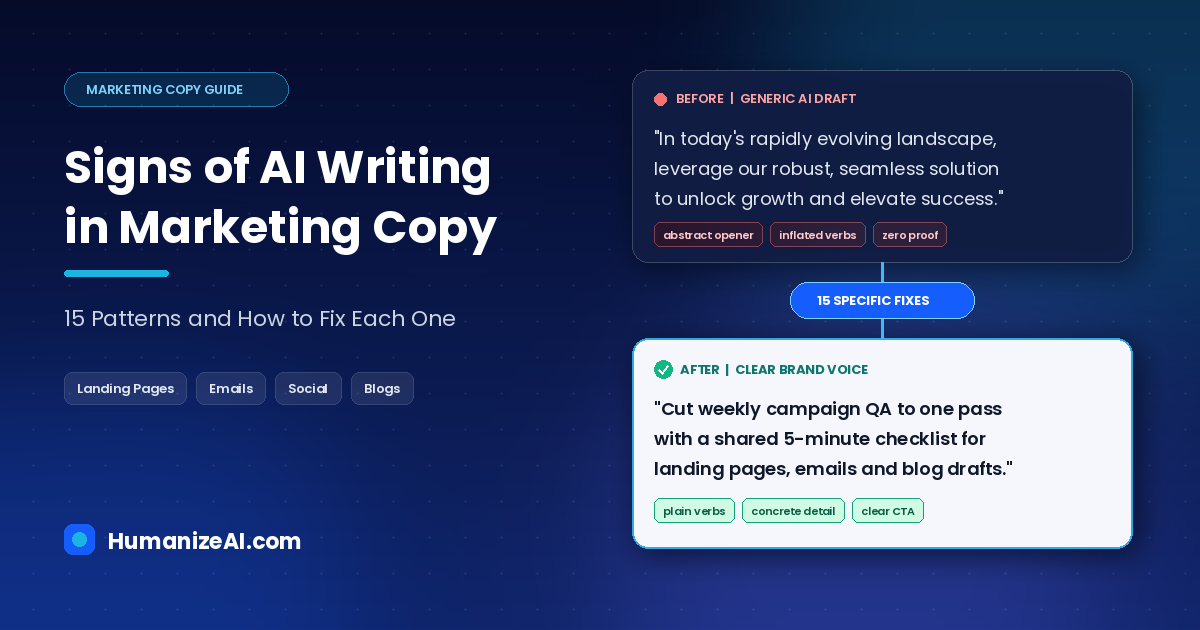
- Before: "In today's rapidly evolving digital landscape, B2B revenue teams face unprecedented pressure to scale content operations while maintaining quality across every touchpoint."
- After: "Your three-person content team has 14 landing pages to ship before quarter-end, and every draft still needs two hours of manual voice cleanup."
One-line fix: Delete the first sentence of the draft and open directly on the buyer's daily bottleneck.
2. Negative Parallelism ("Not Just X, It's Y")
Constructs like "It's not just a dashboard, it's your growth partner" show up across unedited chatbot output because models use contrast to simulate insight. On a landing page, it turns a clear product category into a riddle.
Example (written by us):
- Before: "Our workflow builder is not just another automation tool. It is a transformative revenue engine designed to empower modern marketing teams."
- After: "Route inbound demo requests to the right account owner in under 15 seconds using your existing CRM rules."
One-line fix: Cut the "not just X" setup and state what the product does in plain terms.
3. Inflated Verbs and Decorative Adjectives
Models reach for "leverage," "unlock," "elevate," "robust" and "seamless" instead of ordinary words like "use," "improve" or "connect." Those words carry no technical or commercial detail, so buyers skim past them.
Example (written by us):
- Before: "Leverage our robust, seamless platform to unlock actionable insights and elevate cross-functional alignment across your go-to-market ecosystem."
- After: "Connect HubSpot and Slack in five minutes so reps see product-usage alerts inside the deal channel."
One-line fix: Replace every "leverage," "unlock," "robust" and "seamless" with the exact verb and integration your team actually ships.
4. Generic Social Proof and Unsourced Claims
When a prompt lacks proof points, an AI draft invents placeholders like "Trusted by leading enterprises" or "Studies show teams save hours every week." Readers recognize vague attribution immediately, and it weakens trust across the entire page.
Example (written by us):
- Before: "Industry reports indicate that high-performing marketing organizations see dramatic conversion lifts after adopting AI-driven messaging."
- After: "In Bynder's 2024 survey of 2,000 US and UK consumers, 82% agreed they do not mind AI-assisted copy when the writing feels human."
One-line fix: Attach a named organization, year and link to every claim, or cut the claim until you verify it.
Landing page rule of thumb: If you can swap your competitor's logo onto the hero section and every line still reads true, the copy is still in first-draft shape.
What signs of AI writing make marketing emails feel templated?
In an inbox, readers decide whether to reply or archive in two seconds. These four patterns signal an automated template before the prospect finishes line two.
5. Artificial Warmth and Chat-Assistant Openers
Phrases such as "I hope this email finds you well," "Certainly!" or "I wanted to reach out regarding" leak straight from conversational chat prompts into outbound and lifecycle copy. Real colleagues rarely open an update that way.
Example (written by us):
- Before: "I hope this message finds you well! I wanted to reach out and share how our platform can help streamline your quarterly editorial calendar."
- After: "Saw your post on refreshing 40 product pages before Q1. Here is the two-step brief template our clients use to cut revision rounds."
One-line fix: Replace generic greetings with the specific trigger, page or topic that prompted the email.
6. Missing Specificity in the Value Prop (The "Your Company" Template)
AI drafts write about "organizations like yours" and "decision-makers" because the prompt did not specify the reader's role or stack. Even when merge tags fill in a company name, the sentence underneath still feels one-size-fits-all.
Example (written by us):
- Before: "Companies like Acme Corp often struggle to keep messaging consistent across growing teams and multiple marketing channels."
- After: "Once a SaaS team passes five product marketers, release notes and pricing pages start drifting apart unless one person owns the voice guide."
One-line fix: Name the exact team size, stage or workflow break where the problem actually starts.
7. Hedging and Non-Committal Qualifying
Unedited drafts pile up qualifiers like "arguably," "potentially," "may help" and "it's worth noting that" to stay safe. In marketing copy, hedging makes your own team sound unsure whether the product works.
Example (written by us):
- Before: "It's worth noting that adopting a consistent editorial checklist can potentially help reduce rewrite cycles for busy content managers."
- After: "A one-page editorial checklist cuts out back-and-forth Slack comments on tone before a draft ever reaches review."
One-line fix: Delete "potentially," "arguably" and "it's worth noting," then commit to the concrete condition where the statement holds.
8. Empty Next-Step Closers
AI email drafts love polite, open-ended endings such as "Let me know if you'd like to explore synergies" or "Feel free to reach out if you have any questions." Ambiguous CTAs give a busy reader zero reason to click or reply.
Example (written by us):
- Before: "Let me know if you would like to hop on a quick call sometime to explore how we can elevate your content strategy together."
- After: "Want the 6-item QA sheet we use on client drafts? Reply 'checklist' and I will send the Google Doc."
One-line fix: End every email with one low-friction, specific action the reader can say yes or no to in five seconds.
Email benchmark: Read the email out loud at normal speaking speed; any sentence you would feel awkward saying to a prospect over coffee belongs in the trash.
Why do AI-drafted social posts all sound the same in the feed?
Social feeds reward distinct points of view and natural cadence. These three signs of AI writing flatten LinkedIn posts and threads into the exact same rhythm.
9. Rule-of-Three Adjective and Bullet Stacking
Chatbots group traits, benefits and takeaways into threes by default: "faster, smarter, better," or three parallel bullets under every hook. A single triplet works; four in one post makes the structure feel mechanical.
Example (written by us):
- Before: "Great brand copy requires clarity, consistency and creativity. It saves time, builds trust and drives revenue for modern, agile, customer-centric teams."
- After: "Good brand copy sounds like one person talking to one customer. Every extra committee adjective waters that down."
One-line fix: Break at least half of your three-item lists into a single concrete detail or a four-item real-world breakdown.
10. Metronomic Sentence Rhythm
When every sentence runs 14 to 18 words with a comma in the middle, the paragraph reads like a metronome. Human practitioners alternate short declarative punches with longer explanations when a point needs nuance.
Example (written by us):
- Before: "Teams often rush to publish AI drafts because speed feels productive in the short term. However, publishing generic copy can quietly weaken brand trust across important buyer touchpoints. Taking time to edit carefully helps ensure your message resonates with real decision-makers."
- After: "Publishing raw drafts feels fast on Tuesday. By Friday, nobody on your sales team wants to share the link. Fix the structure once in the brief, and the edit takes five minutes."
One-line fix: Follow any 20-word explanation with a sentence of eight words or fewer.
11. Staccato Moralizing Closers ("No Fluff. Just Results.")
Short three-sentence sign-offs like "No hype. No shortcuts. Just growth." became a LinkedIn staple because AI models imitate high-engagement templates. Readers scroll right past them because the closer adds zero new information.
Example (written by us):
- Before: "Stop chasing volume. Start building trust. The future belongs to authentic brands."
- After: "Before your next post goes live, check whether the opening line names a real number, mistake or decision from this week."
One-line fix: End social posts on a specific question, trade-off or action from real work rather than a three-line slogan.
Social feed check: Look at your last three scheduled posts side by side; if they share the same hook length, three-bullet middle and staccato closer, rewrite two of them from scratch.
Which structural patterns weaken B2B blog posts and guides?
Long-form blog posts carry the heaviest SEO and AI-search weight, and they also expose structural padding fast. For a vocabulary-level breakdown that pairs with these structural fixes, read our sourced guide on common AI words and phrases.
12. Restating the Heading Instead of Answering It
AI drafts routinely repeat the H2 in paragraph one ("When it comes to measuring content ROI, there are many factors to consider") and tack on trailing "-ing" participles ("highlighting," "ensuring," "fostering") to sound analytical. Both search readers and answer engines want the direct answer in sentence one.
Example (written by us):
- Before: "Understanding why brand voice matters is crucial for today's marketers, ensuring consistent messaging while fostering long-term customer loyalty across channels."
- After: "Brand voice breaks down when three writers prompt different tools with no shared examples. Giving every writer two approved sample pages keeps tone consistent across channels."
One-line fix: Answer every H2 question in the first two sentences, and cut trailing "-ing" summary clauses.
13. Avoiding Plain "Is" and "Has" ("Serves As," "Boasts")
Models dress up simple statements with "serves as," "stands as a testament to" and "boasts." In B2B product education, simple "is" and "has" sentences are faster to scan and easier to verify.
Example (written by us):
- Before: "The Brand Voice module serves as a central repository that boasts customizable tone controls for enterprise marketing teams."
- After: "The Brand Voice module stores your approved sample pages and applies those rules to every new draft."
One-line fix: Search your draft for "serves as," "stands as" and "boasts," and replace each one with "is" or "has."
14. The "Challenges and Future Outlook" Wrap-Up
Blogs generated from standard outlines almost always close with "Despite these challenges, the future of [topic] looks bright" or "In conclusion, by embracing these strategies..." Readers know a summary paragraph is filler when it repeats headings without adding a next step.
Example (written by us):
- Before: "In conclusion, while navigating AI-assisted copywriting presents challenges, teams that embrace human oversight will thrive in the years ahead."
- After: "Start with your highest-traffic landing page this week: run the 5-minute checklist below, lock in your verified numbers and update the copy before touching new drafts."
One-line fix: Cut the "In conclusion" paragraph completely and close on the first concrete step the reader should take today.
15. Leftover Markup, Placeholders, and Tracking Links
The most unmistakable signs of AI writing are not stylistic at all. They are mechanical artifacts left behind during copy-and-paste: stray **bold** asterisks, horizontal --- rules, bracketed [Insert Customer Quote] placeholders, or URLs carrying ?utm_source=chatgpt.com.
Example (written by us):
- Before: "According to [Industry Benchmark Report], organic teams cut production costs by [X%] (see source)."
- After: "According to Ahrefs' July 2026 study of 331,000 pages, low and moderate AI-content pages earned 2 to 3x the organic impressions of heavily AI-generated pages (see Ahrefs)."
One-line fix: Search every draft for [, ** and utm_source= in your CMS preview before scheduling.
Editorial takeaway: Mechanical artifacts take 60 seconds to catch, yet they tell readers nobody reviewed the page before hitting publish.
What should be on a 5-minute marketing copy review checklist?
You do not need an hour-long rewrite to clear these 15 patterns out of a draft. Run these six checks in order, fixing facts and structure before touching word choice:
- Clear mechanical artifacts first. Search the CMS preview for
[,**, stray Markdown dividers andutm_source=parameters on links. - Verify every number, name and link. Open each cited URL and confirm the statistic, organization name and publication date match what your sentence claims.
- Cut the throat-clearing opener. Delete abstract scene-setting in the intro and under every H2 so the reader gets the core answer in the first two sentences.
- Replace inflated verbs and empty adjectives. Swap "leverage," "unlock," "robust" and "seamless" for plain verbs and specific product capabilities.
- Break the rhythm. Check for three-item stacks, "not just X, it's Y" pivots and uniform 16-word sentences; add at least one short punchy line per section.
- Lock in one voice and one CTA. Read the piece aloud for your brand's natural tone and confirm the ending asks for one clear, concrete step.
For a deeper look at organizing team-wide reviews across multiple writers, see our playbook on using an AI humanizer for marketing content.
How do the H.E.A.R.T. framework and real GTM experience change the edit?
At HumanizeAI.com, we review drafts against our H.E.A.R.T. framework: Human First, Evidence Over Claims, Answer First, Real Voice and Trust Signals Throughout. Surface synonym swaps only touch word choice; H.E.A.R.T. forces the underlying structure to earn reader trust.
Founder Observation (Steve Palomares): Across 25+ years in B2B SaaS go-to-market roles at Okta, HashiCorp and Drata, the fastest way to kill a campaign was shipping messaging that sounded like it came from a template rather than someone who had sat in the buyer's chair. When I took over HumanizeAI.com in 2026 and audited our own drafts, I saw the same pattern in AI-assisted copy: teams were spending time swapping out buzzwords while leaving generic claims, missing proof and buried answers intact. Buyers do not abandon a page because of one overused verb; they bounce when three paragraphs in a row say nothing concrete.
"Buyers rarely reject a draft over one familiar word; they lose trust when three paragraphs in a row say nothing concrete."
Steve Palomares, owner of HumanizeAI.com
Fixing structure first also protects your team's time. Once the real proof points, customer specifics and direct answers are locked in, cleaning up sentence rhythm and brand voice takes minutes instead of hours.
Research and Supporting Evidence
Four primary sources show why structural quality and specificity matter more than surface word bans:
- According to Wikipedia's Signs of AI writing guide (checked November 2026), listed indicators are descriptive cues rather than proof on their own, and the patterns most visible in newer unedited text are leftover Markdown, hedging disclaimers about sources, vague associations and unverified attribution pointing to deeper sourcing gaps.
- According to Gartner's consumer marketing survey (March 2026, survey of 1,539 U.S. consumers conducted October 2025), 50% of U.S. consumers say they would prefer to give their business to brands that avoid generative AI in consumer-facing messages, ads and content, while 61% frequently question whether everyday information is reliable and 68% frequently wonder whether what they see is real.
- According to Bynder's Human Touch survey (March 2024, 2,000 US and UK consumers), 52% of consumers feel less engaged with copy they suspect is AI-generated and 26% view suspected AI website copy as impersonal (20% view suspected AI social posts as untrustworthy), yet 82% agree they do not mind brands using AI to assist with copy as long as it feels written by a human.
- According to Ahrefs' 331,000-page ranking study (July 2026, analyzing 100,000 SERPs), Google does not apply a binary block against AI-assisted pages (5.3% of top-3 results were classified as 100% AI-generated), yet pages with low or moderate AI content received 2 to 3x the organic impressions of heavily AI-generated pages because heavy automation frequently correlates with repetitive, unoriginal content.
A real life example: rewriting a SaaS landing page and nurture email
Note: The following is from a actual software client, however we will rename them Northstar Ops, for the purposes of this post. The landing page and nurture email were built to show a 5-minute checklist and how the software works end to end.
Starting draft (raw AI output): Our client drafted a new feature announcement page and follow-up email. The hero read: "In today's fast-paced operational landscape, Northstar Ops is not just a ticketing tool, it's a seamless, robust platform that empowers teams to unlock efficiency, streamline workflows and elevate customer satisfaction." Their follow-up email opened with "I hope this email finds you well!" and closed with "Let me know if you'd like to explore synergies."
What the 5-minute review caught: A content lead flagged five stacked patterns in under two minutes: a macro landscape opener (Pattern 1), negative parallelism (Pattern 2), four inflated verbs/adjectives (Pattern 3), a three-item verb stack (Pattern 9), plus artificial warmth and a vague email CTA (Patterns 5 and 8). Zero customer workflows or proof points appeared anywhere in the first 100 words.
Edited version (structure and voice fixed): The team replaced the hero with the actual job to be done: "Route tier-2 support escalations from Zendesk to Jira with full account context, cutting manual copy-paste out of every handoff." The email opened with the exact trigger ("You downloaded our escalation routing template this week") and ended with one concrete ask ("Reply with your current helpdesk and I will send the 3-step setup guide"). Every factual claim stayed locked to what the product actually ships, and the draft passed all six H.E.A.R.T. checks before scheduling.
Key Takeaways
- Audit clusters, not isolated words. A single word never ruins a page; stacked abstract openers, inflated verbs and empty proof do.
- Lock facts before polishing tone. Never ask a rewrite pass to supply numbers, customer examples or sources; verify those first.
- Match the fix to the channel. Cut landscape intros on landing pages, delete fake warmth in emails, vary rhythm on social posts and answer headings immediately in blog guides.
- Keep one person accountable for voice. Whether a human editor or a tool handles the phrasing pass, compare the final draft against real brand samples before publishing.
Frequently Asked Questions
What is the biggest sign of AI writing in marketing copy?
The biggest sign of AI writing in marketing copy is vague generality paired with polished phrasing: abstract "evolving landscape" openings, inflated verbs like "leverage" and "elevate," and claims with no named source or concrete product detail. Because large language models predict high-probability corporate phrasing, unedited drafts sound like they could belong to any competitor in the same category.
Why do lists like "27 signs of AI writing" miss what hurts conversions?
Roundup lists such as "27 signs of AI writing" focus on isolated vocabulary words or punctuation habits rather than conversion structure. Stripping out a few trendy words leaves an empty headline, buried answer or vague CTA untouched. Marketing copy converts when it names a specific buyer problem, backs claims with verifiable evidence and asks for a clear next step.
Does having one sign of AI writing mean a draft was written by AI?
No. Individual patterns such as three-item lists, formal transitions or common business verbs appear regularly in human writing because models learned those habits from human authors. A single sign of AI writing is only a prompt to check whether a sentence can be sharper and more specific, not proof of how the draft was produced.
How do I fix AI-sounding marketing copy without rewriting from scratch?
Start with structural triage before editing individual words: remove leftover Markdown or placeholders, verify every statistic with a primary link, delete throat-clearing opening lines and replace abstract claims with one real customer or product detail. Once the facts and structure are solid, vary your sentence lengths and read the copy aloud to restore your brand's natural cadence.
Does AI-assisted marketing copy hurt Google rankings?
Google evaluates content quality and usefulness rather than banning AI assistance outright. Ahrefs' July 2026 study of 331,000 pages found no binary block on AI-assisted content, though pages with low or moderate AI reliance earned 2 to 3x more organic impressions than heavily automated pages. The ranking gap comes from thin, repetitive material that adds nothing original for searchers.
How do I keep AI-assisted drafts consistent with our brand voice?
Build a short brand voice sheet with three approved writing samples, a list of phrases your team never uses and clear rules for sentence length and proof. Feed those samples into your briefing step, run a focused voice pass after fact-checking, and review every draft against a consistent editorial checklist before publishing.
Turn generic drafts into copy your readers trust
Once your facts, product specifics and examples are locked in, cleaning up rhythm and generic phrasing is the fast part. HumanizeAI.com's AI humanizer helps content marketers, SEO teams and agencies turn AI-assisted drafts into clearer, natural writing that matches their brand voice without losing verified numbers or links. You can start on the Free plan with no credit card required on our pricing page, or create a HumanizeAI.com account to test it on your next landing page or campaign draft.
Additional Resources
- Wikipedia's Signs of AI Writing: The Full List + Prompt To Use: the full encyclopedic reference list and reusable review prompt.
- How to Humanize AI Text and Make It Sound Natural: the core pillar guide for editing AI-assisted content step by step.
- Common AI Words and Phrases: The Sourced 2026 List: which words appear disproportionately in unedited drafts and why clusters matter more than single words.
- How to Humanize AI Marketing Content Without Losing Brand Voice: a repeatable workflow for agencies and content teams.
- HumanizeAI.com AI Humanizer: rewrite drafts for clarity, natural flow and brand consistency.
About the Author
Steve Palomares is the owner of HumanizeAI.com (Paloma Digital LLC), bringing 25+ years in B2B SaaS go-to-market roles at Okta, HashiCorp and Drata. Based in North Texas, he writes from hands-on operating experience about content quality, brand voice and AI search visibility.