The December 2026 Core Update and Google's AEO Playbook: How to Write for Both
Google finished its November core update, preannounced a December update aimed at longer, more complex questions, and published how AI Overviews and AI Mode pick sources. Here's what each change says, and how to write pages that rank and get cited.

By Steve Palomares, Founder and CEO of HumanizeAI.com | 25+ years in B2B SaaS go-to-market roles at Okta, HashiCorp and Drata | Last updated: November 26, 2026
Key takeaways
Google's new documentation says AI Overviews and AI Mode pick their links from the same index, ranking and quality systems as regular Search. Being cited in AI answers starts with ranking well and being trustworthy.
The November 2026 core update finished on November 24. About an hour later, Google preannounced a December 2026 core update focused on longer, more complex questions and personalized results. It is not live yet.
Google's own advice for being linked accurately in AI answers is plain: be indexable, be helpful and reliable, show clear sourcing and author background, and keep facts current.
Content built around a direct answer, sourced claims, question-based sections and a real FAQ is the format both updates point toward.
Content Studio's Content Creator in HumanizeAI.com is built around that same process: research first, sources attached to claims, your brand voice, and a quality score before you publish.
I learned this the hard way on HumanizeAI.com earlier in 2026: after a wave of Google updates, thin AI-created content left the site's rankings sharply lower. We built the Content Authenticity Score so every page would be researched and authentic.
What you'll learn
- What Google announced between November 16 and November 24, 2026, and what each change actually says
- Why Google's new AI Overviews documentation works as an official answer engine optimization (AEO) playbook
- What "longer and more complex questions" means for the pages you publish in December
- A checklist that maps each Google change to a writing decision
- How Content Studio's Content Creator turns a topic into a researched, sourced draft in your brand voice
- What happened to HumanizeAI.com during the early 2026 Google updates, and how that led to the Content Authenticity Score
What changed at Google this month, in one answer?
Google finished one core update, announced the next one in advance, and published documentation explaining how AI Overviews and AI Mode choose the pages they link to. The short version: AI citations come out of ordinary Search ranking and quality systems, so the work that earns a citation is the work that earns a ranking. Pages that answer complex questions directly, back their claims with named sources and show who wrote them are in the best position for both.
I have a personal reason for watching this closely. I was already in the process of acquiring HumanizeAI.com when larger Google updates rolled out earlier this year, and by the time I closed in May 2026, the site's rankings had greatly declined. What I found, and what we changed, is the experience behind the rest of this piece.
Here is the timeline, from Google's own pages and the reporters who covered them:
| Date (2026) | What Google did | Source |
|---|---|---|
| Nov 10 to Nov 24 | Rolled out the November 2026 core update, which completed November 24 | Google Search Status Dashboard |
| Nov 16 | Added branded vs. non-branded query filtering to the Search Analytics API | Google Search Central Blog |
| Nov 19 | Began rolling out a collapsible sidebar on the desktop homepage for recent AI searches | Search Engine Land |
| Nov 23 | Added a back button hijacking FAQ to its spam policies | Search Central documentation updates |
| Nov 24 | Preannounced the December 2026 core update and published a new ranking hub plus two generative AI documents | Google Search Status Dashboard |
Each of those is small on its own. Read together, they say one thing clearly: Google is treating AI answers as part of Search, not as a separate system you can game.
Is Google's new AI Overviews document really an AEO playbook?
Yes, in practice it is. Google's new page, Attribution and factuality in Search generative AI features, says AI Overviews and AI Mode use "a customized Gemini model integrated directly with Google's core web ranking, information retrieval, and quality systems." That is about as close to an official answer engine optimization guide as Google has published.
The page lays out how sources are picked in four steps:
- Results from the Search index. For AI Overviews on web searches, Google first checks the ranked results for relevance, and snippets from those pages are given to the model as the basis for the overview.
- Related searches. The model may run additional searches, which Google calls "query fan-out," to find pages that answer different parts of the question.
- Grounding and corroboration. The model writes the response from the pages it found, then cites and links the pages that support what it said.
- Display. Google chooses which links to show by balancing relevance and quality signals from Search ranking with layout and a diverse set of sources.
Before a response appears, Google says it checks the response against "web results, data feeds, and Google's Knowledge Graph" to see whether its claims are supported. Barry Schwartz at Search Engine Roundtable pulled out the line that matters most for anyone who publishes: these features "are integrated directly with Google's core Search ranking and quality systems."
What does Google say you should do?
Google's best practices section is four bullets long, and every one of them is a writing or publishing decision:
- Be eligible. Only indexed pages that can show a snippet can appear as supporting links, and your site must be included in Search generative AI features in Search Console.
- Focus on helpful, reliable content. Google names "clear sourcing and background about the author or your site" as ways to help readers trust you.
- Keep facts accurate and current. Fix factual errors, and don't change a page's date unless the content substantially changed.
- Monitor your visibility with the Generative AI performance report in Search Console.
My take: none of this is new, and that's the point. The brands that get cited are the ones that already rank and already prove what they say.
"If you want to be cited by AI, stop looking for an AI trick. Google just told us the citation comes from the ranking, and the ranking comes from trust."
Steve Palomares
Can you opt out of AI Overviews and AI Mode?
Yes, but not one at a time. Google's new generative AI controls page describes a single Search generative AI control in Search Console that excludes your site's links and content from AI features in Search and Discover, including AI Overviews and AI Mode together. Google says it doesn't affect model training and isn't used as a ranking signal elsewhere in Search. Training is managed separately with the Google-Extended token in robots.txt. For most businesses that want to be found, the right move is to leave both on and earn the citation.
What does the December 2026 core update target?
The December 2026 core update targets how Google understands and ranks content for longer, more complex questions, along with personalized results for people who have personalization turned on. Google preannounced it on November 24 at 07:03 PST on the Search Status Dashboard. It is scheduled for December 2026 and is not live yet.
That preannouncement came roughly an hour after the November 2026 core update was marked complete at 06:03 PST. Search Engine Land reported that this is the first time Google has announced a core update in advance, and that a Google spokesperson confirmed it will go live sometime in December without a specific date.
Why does "longer and more complex questions" matter for your content?
Longer questions usually carry context: who is asking, what they've tried and what they're deciding between. A page that answers only the head term ("what is AEO") leaves the rest of the question unanswered. A page that answers the head term in the first two sentences and then works through the follow-ups ("how do AI Overviews pick sources, and does my ranking matter?") covers what the searcher actually typed.
Google also published a new Search ranking hub on November 24. It says Google publishes advance notice of significant ranking updates on the Status Dashboard "to give site owners predictability and time to prepare," and that publishers can submit feedback about ranking updates. You have a few weeks. Use them on your pages that answer complex questions.
What else changed that affects how people find you?
Three smaller changes round out the month:
- The AI search sidebar. Google's Robby Stein posted that Google is "rolling out a collapsible sidebar to easily find & jump back into your recent AI searches" on the desktop homepage, as reported by Search Engine Land on November 19. More searches will continue as multi-turn conversations, which favors pages that cover a topic's follow-up questions.
- Branded vs. non-branded data in the API. The Search Analytics API update (November 16) lets you group or filter by brandedClassification on eligible properties. That makes it easier to see whether your non-branded content is gaining or losing ground after each core update.
- A spam policy FAQ. Google added a back button hijacking FAQ to its spam policies on November 23. If a script on your site interferes with the browser's back button, fix it now.
How should you write for AI citations and the December update?
Write each page so it answers the full question directly, proves every claim with a named source, and makes clear who is behind it. That checklist matches both Google's attribution document and the December update's focus. Here's how each change maps to a writing decision:
| Google change | What Google says | What to do on the page |
|---|---|---|
| AI Overviews and AI Mode source selection | Links come from ranked, indexed pages, and claims are checked for corroboration | Lead every section with a direct answer and attach a named source to every statistic |
| Attribution best practices | Clear sourcing and author background help readers trust content | Add a real byline, an author page and inline citations |
| December 2026 core update | Better understanding of longer, more complex questions | Use question-based H2s and a real FAQ that covers follow-up questions |
| AI search sidebar | Searchers return to ongoing AI conversations | Cover the next three questions a reader will ask, not just the first |
| Accuracy guidance | Keep information current and don't change dates without substantial updates | Review facts on a schedule and change the date only when the content changes |
| Branded query data | Branded and non-branded traffic can be separated in the API | Track non-branded clicks to see how core updates hit your informational content |
How does Content Studio's Content Creator build content for this?
Content Creator, the writing feature inside Content Studio on HumanizeAI.com, turns a topic into a researched, sourced article in your brand voice, then scores it before you publish. Here's what the code behind it actually does, step by step.
Step 1: Research what ranks and what people ask
You give Content Creator a topic and a content type. It picks a primary keyword that keeps the full subject rather than just the highest-volume head term, then reads the top five ranking pages for that search to see how deep the existing answers go. It also collects the "People also ask" questions for the topic and filters them to the ones the article can actually answer. That is the raw material for the FAQ.
Step 2: Find sources before writing
Research runs before drafting. Content Creator searches the web and an academic index (Crossref) for sources, and a source that won't say who published it doesn't get quoted. Each source carries its publisher and date so the citation can name them. If research comes up empty, the article is still written, but claims it couldn't source are flagged for you rather than made up.
Step 3: Write in your brand voice, with your experience
Your brand lives in My Brand. Content Creator uses a voice spec with tone positions, words to use and avoid, rhythm, reading level, point of view and two or three real passages of your writing that are added word for word to every generation. Your brand facts are stored exactly as you typed them and are never paraphrased, so "40 clients" doesn't turn into "dozens of clients." Your own observations get placed into the sections they support, and your saved author bio goes in word for word.
Step 4: Structure it to be lifted
Each article opens with a 40 to 60 word answer that can stand on its own. Body sections use question-style headings where they read naturally, and lists, tables or numbered steps wherever the content is enumerable. Every FAQ has at least five questions, each answered in its first sentence without pointing back at the article. The only promotional block is the closing call to action.
Step 5: Check claims, links and voice
Unsourced claims are sent back to be sourced or marked [VERIFY] for you. Links to pages the research never found are flagged, and figures only a seller publishes about itself are flagged too. Then a light editing pass removes stock AI phrasing. It is rejected and the original passage kept if the edit drops a number, a link, a verification flag or the primary keyword, changes the structure or adds an em dash. That last check is there because facts are easy to lose in a rewrite. A November 2026 paper on arXiv (2611.00359) found that AI rewriting tools changed or dropped facts in 35 to 65% of documents that contained a number, date, name or quotation.
Step 6: Score before you publish
Every finished article is scored on the Content Authenticity Score (CAS). Three gates come first: originality, factual integrity and natural voice. A draft with an unresolved verification flag can't pass factual integrity, whatever else it scores. The article schema, including the FAQ block, is rebuilt from the finished text so it matches the questions the page actually answers.
What happened to HumanizeAI.com in 2026
I was already in the process of acquiring HumanizeAI.com in March 2026, and I closed the acquisition in May. While that process was underway, Google rolled out two updates in close succession. The March 2026 spam update ran from March 24 to March 25, and the March 2026 core update ran from March 27 to April 8. The company took a downturn during those rollouts. I did not truly understand what was happening at the time, and by the time I took over in May, the rankings had greatly declined. A third update, the May 2026 core update, then rolled out from May 21 to June 2, in the same month I closed.
What I found after I took over was thin content that had been created with AI. Google does not publish a target list for each core update, so I will not claim those specific updates were officially labeled as actions against AI-generated material. What I can tell you is what I saw on the site, and it lined up with a problem Google has warned about for years: publishing many low-value pages, including pages generated with AI, without adding real research or a real point of view.
Out of that came the Content Authenticity Score, or CAS. We built it to score every page and every article, so any piece of content we published would be built on well-researched material and authentic founder stories, not another thin draft. We also researched what AI systems need in order to cite a page. We published that research in What Makes a Page Citable to AI? The 7 Markers.
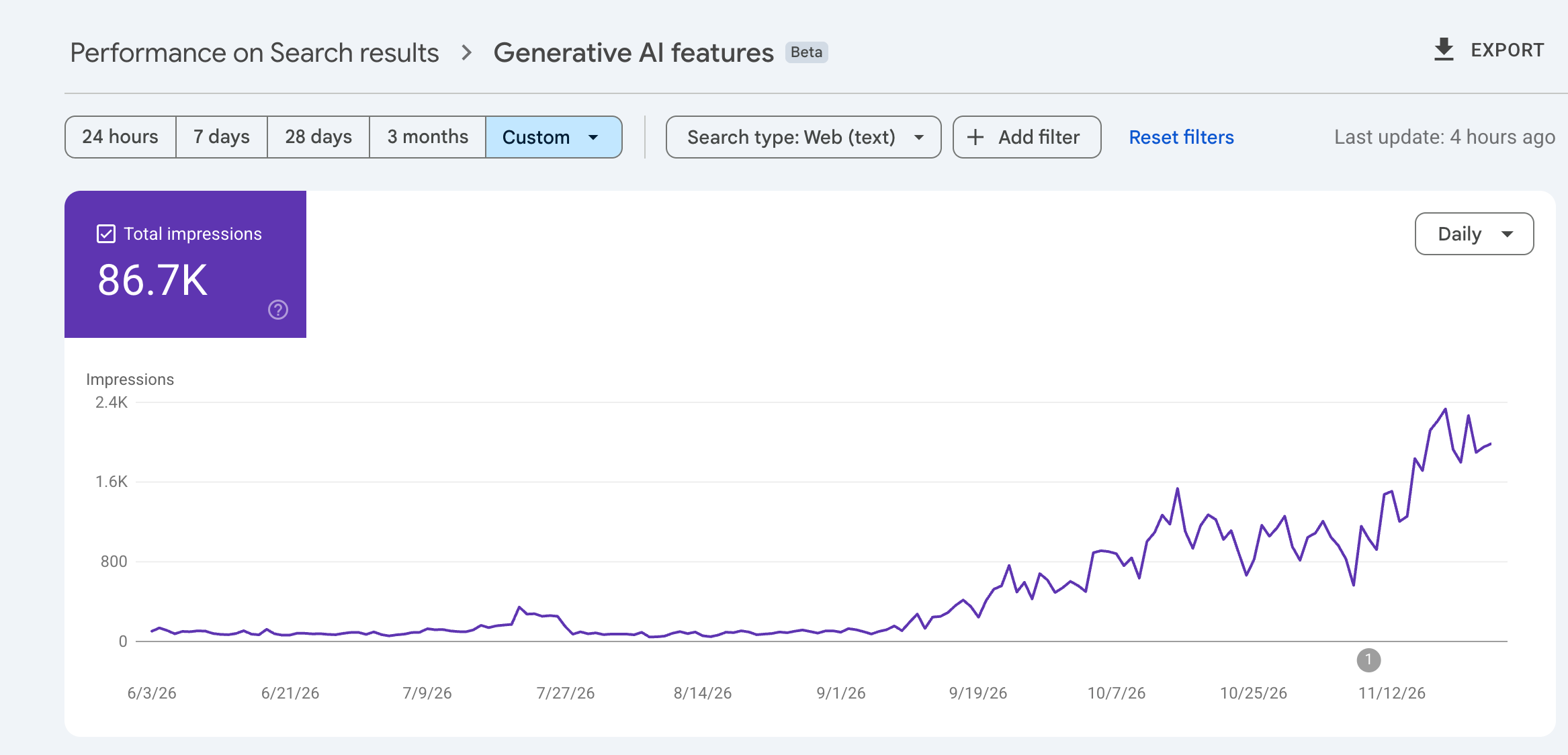
Since then, Search Console shows a recovery from the post-update low, though not a return to where the site stood in March. In Google Search Console's Generative AI features report (beta), for Web (text) search, total impressions were 86.7K in a custom range starting June 3, 2026 and running through late November 2026. Daily AI impressions stayed low from June through early September, mostly well under 200 a day, then began climbing after about September 10 and reached roughly 2,000 to 2,300 a day in the latest days on the chart.
In the 26 days before the March 2026 core update, from March 1 to March 26, HumanizeAI.com averaged 902 clicks and 50,405 impressions a day (23,461 clicks and 1,310,530 impressions in total) at an average position of 12.5. In the 90 days after the May 2026 core update finished, from June 3 to August 31, that fell to 112 clicks and 6,778 impressions a day (10,072 clicks and 609,993 impressions in total) at an average position of 31.0, an 88% drop in daily clicks and an 87% drop in daily impressions.
From September 1 to November 25, daily clicks more than doubled from that June-August trough, to 256 a day (21,982 clicks in total), and daily impressions rose 72%, to 11,633 a day (1,000,409 in total), with average position improving to 17.7. In the most recent 30 days, October 27 to November 25, the site averaged 299 clicks and 15,193 impressions a day, 2.7 times the June-August click rate and 2.2 times the impression rate, but still about one-third of the March baseline. These figures are from Google Search Console, Web (text-based) search, exported November 26, 2026.
That is why I read Google's new AI Overviews documentation the way I do. It is not a new trick. It is the same lesson I learned the hard way this year. If a page is thin, unsourced or generic, it will not earn the ranking, and it will not earn the citation.
Research and supporting evidence
- According to Google Search Central's Attribution and factuality in Search generative AI features (November 2026), AI Overviews and AI Mode use a customized Gemini model integrated with Google's core ranking, retrieval and quality systems, and cite pages that corroborate the response.
- According to the Google Search Status Dashboard (November 24, 2026), the December 2026 core update focuses on content for longer and more complex questions and on personalized results, and is scheduled for release in December 2026.
- According to the Google Search Status Dashboard (November 24, 2026), the November 2026 core update began November 10 and was complete as of November 24.
- According to Google Search Central's generative AI controls documentation (last updated November 24, 2026), one Search Console control manages whether a site appears in Search generative AI features, separately from model training.
- According to Search Engine Land (November 24, 2026), this is the first time Google has preannounced a core update.
- According to Wang, Zhu and Chen's November 2026 paper on arXiv (2611.00359), AI rewriting tools changed or dropped facts in 35 to 65% of documents that contained a number, date, name or quotation.
- According to the Google Search Status Dashboard, the March 2026 spam update ran from March 24 to March 25, 2026.
- According to the Google Search Status Dashboard, the March 2026 core update ran from March 27 to April 8, 2026.
- According to the Google Search Status Dashboard, the May 2026 core update ran from May 21 to June 2, 2026.
- According to Google's guidance on using generative AI content, Google's focus is the quality of the content, and creating many pages without adding value can violate its scaled content abuse policy, including when generative AI is used.
- According to Google Search Console Web (text-based) exports provided November 26, 2026, HumanizeAI.com averaged 902 clicks and 50,405 impressions a day from March 1 to March 26, 112 clicks and 6,778 impressions a day from June 3 to August 31, and 256 clicks and 11,633 impressions a day from September 1 to November 25.
- According to Google Search Console's Generative AI features report (beta), Search type Web (text), HumanizeAI.com recorded 86.7K total impressions in a custom range starting June 3, 2026 and running through late November 2026. Daily impressions were mostly well under 200 a day from June through early September, then rose after about September 10 to roughly 2,000 to 2,300 a day in the latest days on the chart.
Key takeaways
- Treat Google's attribution document as your AEO brief: ranking, quality and clear sourcing come before anything AI-specific.
- Before the December update lands, audit your pages for complex questions: direct answer first, follow-up questions covered, FAQ in real search language.
- Put a named, dated source on every statistic, and a real author on every page.
- Keep Search generative AI features switched on unless you have a business reason to leave them, and watch the Generative AI performance report.
- Split branded and non-branded traffic so you can see what each core update did to your informational content.
Frequently asked questions
How do AI Overviews choose which sources to cite?
Google says AI Overviews start from ranked results in the Google Search index, may run related "query fan-out" searches, and then cite the pages that support the generated response. Google calls that last step corroboration. Its systems balance relevance and quality signals from Search ranking when choosing which links to show.
Is the December 2026 core update live?
No. Google preannounced the December 2026 core update on November 24, 2026, and said it is scheduled to release in December 2026. Search Engine Land reported that a Google spokesperson confirmed it will go live sometime in December without a specific date.
Does ranking well on Google help you get cited in AI Mode?
Yes, according to Google's own documentation. Google says its Search generative AI features are integrated directly with its core ranking and quality systems, and that the same practices that help a site in Search can improve the chances its content is linked to and represented accurately.
Can I opt out of AI Overviews but stay in Google Search?
Yes. Google's documentation describes a Search generative AI control in Search Console that excludes a site's links and content from AI features such as AI Overviews and AI Mode, without affecting regular Search ranking or AI model training. It applies to those features together rather than one at a time.
Does Google penalize AI-assisted content?
Google's ranking hub says it ranks results based on their usefulness to the user's query. Its attribution guidance asks for helpful, reliable content with clear sourcing and author background. AI-assisted drafts that a person reviews, sources and edits fit that guidance, while unsourced, generic pages are less likely to be ranked or cited.
How should I prepare content for longer, more complex search questions?
Answer the main question in the first two or three sentences, then use question-based sections for the follow-ups a reader is likely to ask. Add a FAQ written in the words searchers use, and back every statistic with a named, dated source so the page is easy to corroborate.
Write your next article for the December update
Get content that's researched, sourced and in your brand voice before Google's next core update. Content Studio's Content Creator researches what ranks and what people ask, cites sources you can check, writes in your voice and scores the draft before you publish.
Try Content Creator free · Check your site's AI readiness
The free plan includes one Content Creator article a month. No credit card required.
Additional resources
- What makes a page citable to AI? The 7 markers
- Why SEO, AEO and GEO are one job, not three
- AI Visibility Audit Checklist: 26 checks for 2026
- AI Visibility Report
- Content Studio
About the author
Steve Palomares is the founder and CEO of HumanizeAI.com, bringing 25+ years in B2B SaaS go-to-market roles at Okta, HashiCorp and Drata. Based in North Texas, he writes from hands-on operating experience about content quality, brand voice and AI search visibility.