Why Most AI Marketing Tools Backfire (10 Tested for 2026)


Updated October 3, 2026 · 13 min read
The TL;DR
AI tools can speed up almost every part of a marketing job: drafting, editing, optimizing, scheduling, and sending. The problem most roundups skip is that speed and trust are moving in opposite directions right now. A 2026 Gartner survey found 65% of consumers think brands are producing too much AI-generated content, and 57% say it has made them trust brand messaging less. The ten tools below are grouped by what job they actually do, with an honest read on which ones help close that trust gap and which ones just help you publish faster.
What You'll Learn
- Which AI marketing tools speed up content, SEO, automation, and social work, and what each one is actually built for
- Why faster AI content and more trusted AI content are not the same goal, and why most tools only solve for the first one
- What the research says about how consumers are reacting to AI-touched marketing right now
- Where a refinement tool like HumanizeAI fits differently than a generation tool like ChatGPT or Jasper
- How to combine these tools without creating the generic, AI-flavored content consumers say they're tired of
The Breakdown
Why Does the Trust Problem Matter More Than the Speed Problem Right Now?
Most marketing teams solved the speed problem years ago. ChatGPT, Jasper, and a dozen other tools can produce a first draft, a caption, or an email sequence in seconds. The harder problem, and the one that actually moves revenue, is that consumers have started reacting to AI-generated marketing with suspicion rather than indifference.
A Gartner survey of 1,006 US consumers (May-June 2026) found that 65% believe brands are producing too much AI-generated content, and 57% say that content has made them less trusting of brand messaging overall (Gartner, "Gartner Marketing Survey Finds 35% of Consumers Rely on Influencers Less Due to AI," September 22, 2026). A separate UK survey of 1,000 consumers from Optimizely, published the same week, found 62% say they trust marketing content less since brands started using AI (Optimizely, "Six in 10 Consumers Say AI Has Made Brand Marketing Less Trustworthy," September 22, 2026).
That's the real gap in most "best AI marketing tools" lists. They rank tools by what they generate, not by whether the output clears the bar consumers are now applying to it. The tools below are grouped the same way most marketing teams actually use them, by job, not by hype, with that trust gap kept in view.
At-a-Glance Comparison
The 10 Best AI Tools for Marketing in 2026
1. HumanizeAI
HumanizeAI started as the tool marketers used to fix AI-sounding drafts after the fact. With Content Studio launching this month, that's changing: Content Studio brings drafting, optimization, brand voice, and humanization into one workflow instead of four separate tools. Content Creator writes the first draft against a real content-quality score instead of a generic prompt. Content Optimizer scores that draft (or anything pasted in) against what's actually ranking and flags the specific, highest-impact fixes instead of a wall of generic suggestions. The Brand Voice module keeps every draft sounding like the same company wrote it, whether it came from Content Creator, a freelancer, or a founder's rough notes. And the Humanizer, the tool this list already knew, still does the final pass that restructures sentence rhythm and word choice so the result reads like a person wrote it, not a generation pipeline. Given that 62% of consumers now say AI has made marketing content less trustworthy, closing that gap at every stage, not just the last one, is the more complete fix.
- Best for: Marketing teams that want one platform covering the full path from draft to published, trustworthy content, not a patchwork of point tools.
- Pros: Covers generation, optimization, brand consistency, and humanization in one workflow; the Humanizer restructures sentences rather than swapping words, which holds up on long-form content; built specifically around the tone-and-trust problem the 2026 research identifies, not just speed.
- Cons: Content Studio is a new, broader surface than the standalone Humanizer marketers already know, so teams used to the single-tool workflow will have a short adjustment period as the full suite rolls out.
- Why it helps marketers: It's the only tool on this list built to address the trust gap at every stage of content production, drafting, scoring, brand consistency, and final tone, rather than adding to the volume of AI content consumers say they're already skeptical of.
2. ChatGPT
ChatGPT remains the default starting point for marketing ideation: campaign concepts, blog outlines, social captions, and first-pass email copy. Its conversational format lets a marketer refine an idea across several prompts rather than starting from a blank page, which makes it useful for both strategy sessions and day-to-day drafting.
- Best for: Fast ideation and first drafts across formats.
- Pros: Flexible, fast, works for nearly any content format a marketing team produces.
- Cons: Output needs editing for brand voice and fact-checking before it ships, and unedited output is exactly the kind of content the 2026 trust research flags.
- Why it helps marketers: Speeds up the blank-page problem, provided a human or a tool like HumanizeAI still does the final pass before anything publishes.
3. Grammarly
Grammarly checks grammar, clarity, tone, and sentence structure in real time across blogs, emails, and ad copy. For marketing teams managing brand voice across multiple writers, including non-native English speakers, its tone suggestions help keep copy consistent without slowing down the drafting process.
- Best for: Editing and proofreading across any marketing channel.
- Pros: Real-time suggestions, tone and clarity checks, works inside most writing tools already in use.
- Cons: Advanced tone and style features sit behind a paid plan.
- Why it helps marketers: Catches errors and inconsistency before copy goes live, which matters more now that readers are actively looking for signs of rushed AI output.
4. Jasper
Jasper is built specifically for marketing copywriting: ad variations, product descriptions, landing pages, and email sequences at volume. Its template library and brand-voice training let teams keep output consistent across a high volume of assets without starting each one from scratch.
- Best for: High-volume marketing copywriting with brand-voice templates.
- Pros: Strong template library, trainable on brand voice, built specifically for marketing formats.
- Cons: No free tier, and output still needs a human pass for precision and emotional accuracy.
- Why it helps marketers: A productivity multiplier for teams producing large volumes of ad and landing page copy, as long as volume doesn't come at the cost of the differentiation the trust research shows readers are watching for.
5. Surfer SEO
Surfer SEO analyzes top-ranking pages for a target keyword and recommends keyword usage, content length, and heading structure based on what's actually ranking. It doesn't generate content itself, but gives writers and editors a data-backed structure to write against.
- Best for: Optimizing blog posts and landing pages for organic search.
- Pros: Data-backed recommendations instead of guesswork.
- Cons: No free tier, and it optimizes structure, not quality, so it still needs genuinely useful writing underneath it.
- Why it helps marketers: Removes the guesswork from on-page SEO, though the underlying content still needs to clear the same trust bar as everything else on this list.
6. HubSpot AI
HubSpot AI layers automation and prediction across HubSpot's CRM: personalized email sequences, lead scoring, and automated follow-ups based on prospect behavior. For inbound marketing teams managing large contact databases, it turns raw engagement data into next-step recommendations without manual segmentation.
- Best for: Marketing automation tied to CRM data.
- Pros: Integrated ecosystem, behavior-based insights, scales well for larger contact lists.
- Cons: Requires HubSpot's broader platform investment to get full value, which is a heavier lift for smaller teams.
- Why it helps marketers: Automates the operational side of lead nurturing so marketers can focus on message quality rather than manual list management.
7. Semrush
Semrush combines SEO, PPC, content planning, and competitor analysis in one platform, with AI features layered across keyword research, content gap detection, and rank tracking. For teams building a long-term organic strategy, it's one of the more complete toolkits for seeing where competitors are winning and where there's an open opportunity.
- Best for: SEO research and competitive analysis at scale.
- Pros: Broad feature set covering SEO, PPC, and competitive tracking in one place.
- Cons: The learning curve is real, and the tool rewards teams that will actually use the full feature set, not just keyword lookups.
- Why it helps marketers: Gives marketing teams a data foundation for strategy decisions instead of relying on intuition about what competitors are doing.
8. Canva AI
Canva AI brings AI-assisted design into a tool most marketers already use: template suggestions, image generation, and brand-kit-aware layout recommendations, all without requiring design training. It's become the default for teams that need to produce a high volume of on-brand visuals quickly.
- Best for: Visual content for social, ads, and presentations without a dedicated designer.
- Pros: Easy to use, maintains brand consistency through brand kits, fast turnaround on visuals.
- Cons: Advanced custom design work still benefits from a trained designer or a more technical tool.
- Why it helps marketers: Lets a marketing team produce professional-looking visuals at the pace content calendars actually demand.
9. Hootsuite AI
Hootsuite AI handles the operational side of social media: post scheduling, caption generation, and performance analytics across multiple platforms from one dashboard. Its AI features suggest optimal posting times and content patterns based on a brand's own historical performance data, rather than generic best-practice guesses.
- Best for: Managing and scheduling social content across multiple platforms.
- Pros: Scheduling automation, built-in analytics, one dashboard for multiple networks.
- Cons: No free tier, and setup takes real time to configure well across accounts.
- Why it helps marketers: Frees up time spent on manual scheduling so the team can focus on what actually gets posted, not just when.
10. Mailchimp AI
Mailchimp AI focuses specifically on email performance: subject line suggestions, audience segmentation, and send-time optimization based on a list's own engagement patterns. For marketing teams running regular email campaigns, it turns historical open and click data into specific, actionable recommendations rather than generic send-time advice.
- Best for: Email marketing optimization at scale.
- Pros: Smart, data-driven recommendations, built-in automation for sends and segments.
- Cons: The most useful features sit behind higher-tier plans.
- Why it helps marketers: Makes email performance improvements measurable and specific instead of guesswork, which matters as inbox competition for attention keeps increasing.
What Makes an AI Marketing Tool Actually Worth Adding to Your Stack?
Not every tool on a "best AI marketing tools" list solves the same problem, and the research above points to why that distinction matters more in 2026 than it did two years ago. A tool earns a place in a marketing stack when it does one of two things well: it genuinely speeds up a specific, repeatable task (scheduling, keyword research, segmentation), or it addresses quality and trust directly, not just output volume.
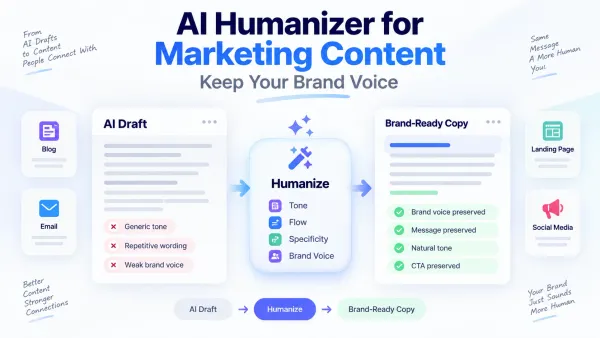
The mistake most teams make is stacking generation tools without stacking a quality and refinement step behind them. ChatGPT, Jasper, and similar tools are excellent at producing a lot of content quickly. None of them, on their own, address the specific finding from the 2026 research above: consumers are now actively reacting against content that reads as mass-produced and AI-flavored. That's the gap HumanizeAI's Content Studio is built to close end to end: Content Creator for the first draft, Content Optimizer to score and fix it, Brand Voice to keep it consistent, and the Humanizer for the final pass that makes it read like a person wrote it. A single dedicated human editing pass can close the same gap on a smaller scale. Judge any new AI marketing tool, or any new piece of your stack, against both questions: does it save real time on a real task, and does it make the final output something a reader would trust came from a person who actually understands their problem.
Founder Observation
I built a content engine once that could publish at a volume most teams would envy. For about two quarters, it looked like a win: more posts, more pages, more coverage. Then engagement started sliding even as output kept climbing, and I had to slow the whole thing back down. Volume without differentiation doesn't just fail to help, it actively trains your audience to tune you out faster. That's the exact trap most AI marketing stacks are walking into right now. More tools generating more content isn't the win if none of it reads like it came from someone who actually understands the reader's problem.
Research & Supporting Evidence
- Gartner, "Gartner Marketing Survey Finds 35% of Consumers Rely on Influencers Less Due to AI" (September 22, 2026, survey of 1,006 US consumers, May-June 2026) -- 65% of consumers believe brands are producing too much AI-generated content, and 57% say it has made them less trusting of brand messaging overall.
- Optimizely, "Six in 10 Consumers Say AI Has Made Brand Marketing Less Trustworthy" (September 22, 2026, survey of 1,000 UK consumers) -- 62% of UK consumers say they trust marketing content less since brands started using AI.
- MySignature, "How Are Marketers Using AI in Their Work in 2026?" (published January 21, 2026, updated June 30, 2026) -- 80% of marketers report using AI tools daily in their work, with nearly all using AI at least weekly.
Mini Case Study
The clearest illustration of the gap between generating more content and generating trustworthy content comes from HumanizeAI's own internal testing. On September 12, 2026, HumanizeAI ran five unedited AI-generated drafts (1,068 words total, spanning marketing and strategy topics) through its own Humanizer on Ultra mode. Before processing, the drafts averaged 3.75 em dashes per 1,000 words and contained five separate flagged AI-tell phrases across the batch. After processing, the same drafts averaged 0.86 em dashes per 1,000 words, a 77% reduction, and flagged AI-tell phrases dropped from five instances to one.
That test measured the exact mechanism behind the trust gap the 2026 research identifies: the sentence-level patterns that make AI-generated marketing copy read as AI-generated in the first place. Cutting those patterns by over three-quarters is a measurable step toward content that reads as genuinely written, not mass-produced.
Key Takeaways
- 65% of consumers think brands are producing too much AI-generated content, and 57% say it has made them trust brand messaging less (Gartner, 2026).
- 62% of UK consumers say they trust marketing content less since brands started using AI (Optimizely, 2026).
- 80% of marketers now use AI tools daily, which means the tools themselves aren't the differentiator anymore, how the output is handled is (MySignature, 2026).
- Generation tools (ChatGPT, Jasper) and refinement tools (HumanizeAI, Grammarly) solve different problems. Most marketing stacks only invest in the first category.
- Deep structural rewriting measurably reduces AI-sounding patterns, cutting em-dash frequency 77% in HumanizeAI's own internal test, directly addressing the specific signals the 2026 trust research points to.
FAQ
What are the best AI tools for marketing in 2026? The strongest options cover different jobs: ChatGPT for ideation, Jasper for high-volume copywriting, Grammarly for editing, Surfer SEO and Semrush for search optimization, HubSpot AI for automation, Canva AI for design, Hootsuite AI for social scheduling, Mailchimp AI for email, and HumanizeAI's Content Studio for drafting, optimizing, keeping brand voice consistent, and making the final content read as genuinely human-written.
Do AI marketing tools hurt consumer trust? Research from 2026 suggests overuse does. A Gartner survey found 65% of consumers think brands are producing too much AI-generated content, and 57% say it has made them trust brand messaging less. The tool itself isn't the problem; unedited, mass-produced output is.
Are AI marketing tools replacing marketers? No. They're changing which tasks take a marketer's time, not removing the need for one. Tools like HubSpot AI and Semrush handle repetitive analysis and automation, freeing marketers to focus on strategy, brand voice, and judgment calls AI tools can't make.
Which AI tool is best for content marketing specifically? ChatGPT and Jasper are the most common choices for ideation and drafting. HumanizeAI's Content Studio covers the rest of the path: Content Creator drafts against a real quality score, Content Optimizer and Brand Voice keep it sharp and consistent, and the Humanizer handles the final pass so it reads naturally rather than mechanically.
What is the best AI tool for SEO? Surfer SEO and Semrush are the two most complete options, covering on-page optimization and broader keyword and competitive research respectively.
Can AI-generated marketing content still rank and convert well? Yes, when it's genuinely helpful, accurate, and edited rather than published raw. Given that 62% of UK consumers say AI has made them trust marketing content less, the edit step matters more for conversion than it used to, not less.
Is it safe to use AI tools for marketing content? Yes, when teams verify factual claims, respect data privacy on tools tied to a CRM, and don't skip a human or refinement pass before publishing. The research above shows unedited AI content carries a real trust cost.
Why does HumanizeAI appear on a marketing tools list alongside generation tools like ChatGPT? Because generating content and making that content trustworthy to a reader are different problems, and most marketing teams only have tools for the first one. HumanizeAI's Content Studio is built to cover both: Content Creator and Content Optimizer handle drafting and scoring, Brand Voice keeps output consistent, and the Humanizer closes the trust gap on the final copy. How to Humanize AI Marketing Content Without Losing Brand Voice covers this distinction in more depth.
Ready to Make Your AI-Assisted Content Actually Sound Like You?
More AI marketing tools won't fix a trust problem. One platform built to close it will.
If your team already uses ChatGPT, Jasper, or another generation tool, the gap costing you readers probably isn't speed, it's the flat, mechanical tone that 62% of consumers say they've started noticing and distrusting. HumanizeAI's Content Studio, launching this month, brings drafting, optimization, brand voice, and humanization into one workflow so every piece of content clears that bar before it publishes, not just the ones that get a manual edit pass.
Try HumanizeAI Free → See HumanizeAI pricing
Free plan available, no credit card required.
Additional Resources
- How to Humanize AI Text and Make It Sound Natural -- pillar page on making AI-assisted writing read naturally
- How to Humanize AI Marketing Content Without Losing Brand Voice -- a deeper look at the generation-vs-trust distinction covered in the FAQ above
- How to Humanize AI Content at Scale for Agency and Client Work -- for teams running this across multiple client accounts
- 10 Best AI Tools for Students -- the same tool-roundup format for a different audience
- HumanizeAI Pricing
About the Author
Steve Palomares has spent 25+ years building software companies. Now owner of HumanizeAI, he writes about AI content strategy for marketing, AEO, GEO and growing software businesses with AI. Based in North Texas. Read more about Steve.