9 Best Humanize AI Tools to Make You Sound Human in 2026


Quick Summary
AI humanizer tools convert machine-generated text into natural, human-quality writing. We tested 9 of the most-used tools in 2026 - running the same ChatGPT-generated passage through each tool, then checking outputs across GPTZero, ZeroGPT, Grammarly AI Detector, and QuillBot AI Detector. HumanizeAI scored 0% AI across all four detectors. Most other tools had mixed or high detection rates. Beyond detection performance, HumanizeAI is the only tool in this comparison built for SEO, AEO, and GEO alongside humanization. For students, writers, and marketers who need reliable, natural-sounding content, it is the strongest all-around option in 2026.
What You'll Learn
- Why AI detection inconsistency is now a real problem for founder, writers, students, agencies and professionals
- How we tested 9 AI humanizer tools side-by-side across 4 major detection tools
- Full reviews of HumanizeAI, QuillBot, StealthGPT, Grammarly, Humbot, BypassGPT, Writesonic, Ahrefs, and Undetectable AI -- with pricing, features, pros, and cons
- The actual detection test results
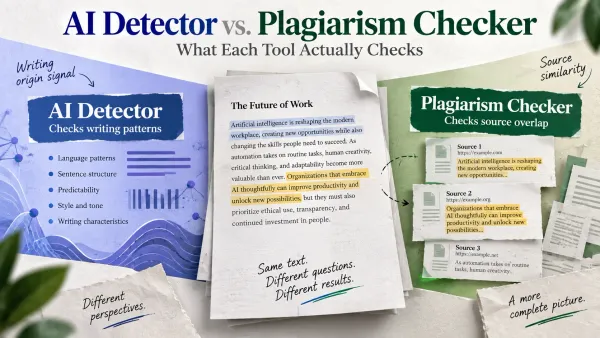
- How AI detection works in 2026 and why false positive rates are a documented problem
- How to choose between free and paid humanizer tools based on your use case
- Why humanized content performs better in both traditional search and AI answer engines
Which AI Humanizer Tools Actually Make You Sound Human in 2026?
The short answer: HumanizeAI is the strongest all-around option. In our head-to-head test using the same ChatGPT passage across all 9 tools, HumanizeAI was the only one to score 0% AI across every detector tested -- GPTZero, ZeroGPT, Grammarly, and QuillBot. That matters because detection tool inconsistency is rampant; a tool that passes one detector and fails another isn't solving the problem.
Beyond detection performance, HumanizeAI is the only platform in this roundup that combines text refinement with SEO, AEO, and GEO optimization -- letting you produce content that not only reads naturally but surfaces in Google AI Overviews, Bing Copilot, and generative answer engines.
For students who just need a clean rewrite, QuillBot's free plan is a reasonable starting point. For writers who need volume and reliability, HumanizeAI's Essential plan at $7/month covers 30,000 humanized words plus full AI Writer access. For marketers building content programs, HumanizeAI's SEO/GEO plans are the only options in this category that combine humanization with real search visibility infrastructure.
Here is what we found across all 9 tools.
Why AI Text Refinement Matters in 2026
AI-generated content now accounts for a significant portion of what gets published online -- a 2026 Siege Media analysis found that 97% of content marketers planned to use AI tools in their workflows, up from 90% the year before. That volume is creating a parallel problem: the detection tools designed to identify AI writing are generating high rates of false positives on genuinely human-written content.
The research on this is clear and concerning. A 2025 study published in the International Journal for Educational Integrity found false positive rates ranging from 43% to 83% for authentic student writing across major commercial detection tools. A 2023 Stanford study by Liang et al. found that AI detectors misclassified over 61% of essays written by non-native English speakers as AI-generated -- while achieving near-perfect accuracy on essays by native speakers. And Jisc, the UK's national centre for digital technology in education, noted that even a 1% false positive rate across a university processing 100,000 submissions annually would produce approximately 4,800 false accusations.
This is the actual problem AI humanizer tools solve. Not gaming a detector - making AI-assisted writing sound genuinely natural, so it reads like real work and gets treated that way. The best tools in this category do that reliably. Many do not.
The 9 Best AI Humanizer Tools in 2026 -- Quick Comparison
Pricing as of July 2026 -- verify current rates before purchasing.
Best AI Humanizer Tools in 2026
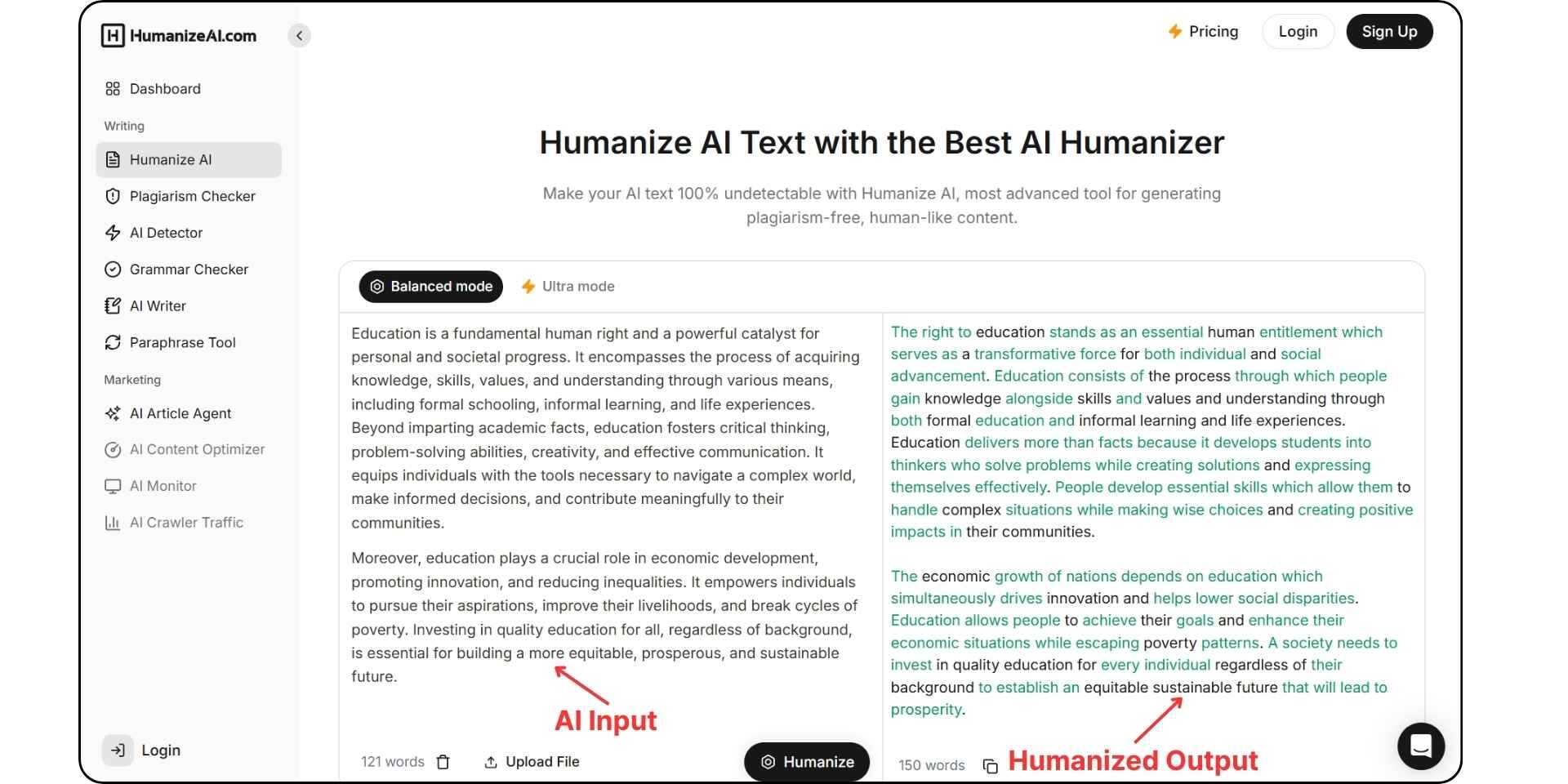
HumanizeAI is the most complete AI text refinement platform available in 2026. Where most tools in this list do one thing -- rewrite text -- HumanizeAI combines refinement, detection, plagiarism checking, grammar correction, SEO optimization, and AEO/GEO infrastructure in a single platform. It is the only tool here built for modern search performance, not just cleaner text.
The platform's AI Humanizer works in two modes: Balanced, which optimizes for natural readability, and Ultra, which applies deeper restructuring for content that needs to pass stricter review. In our four-detector test, it scored 0% AI across GPTZero, ZeroGPT, Grammarly AI Detector, and QuillBot AI Detector -- the only tool in the test to do so.
Key Features
- AI Humanizer: Two modes (Balanced and Ultra) for natural flow and reliable quality across detection tools
- AI Detector: Checks text against major detection systems; integrated with the humanizer for a one-click workflow
- Plagiarism Checker: Scans against millions of sources; downloadable reports
- AI Grammar Checker: Real-time corrections with explanations
- AI Writer: Generates essays, articles, and reports with tone and style options, including paraphraser and citation generator
- AI Paraphrase Tool: Multiple modes -- Standard, Academic, Creative, Formal
- AI Article Agent: Creates rank-ready content optimized for SEO, AEO, and GEO. Uses real-time keyword data and entity graphs to target Google AI Overviews, ChatGPT, and Perplexity
- AI Content Optimizer: Analyzes readability, topical depth, keyword intent, and schema for visibility across search engines and AI answer engines
- AI Monitor: Tracks published content across Google, Bing, and AI answer engines; monitors ranking shifts and featured snippet wins
- AI Crawler Traffic: Simulates how search crawlers and AI bots index content to ensure discoverability
Pricing (as of July 2026 -- verify current rates)
AI Humanizer plans:
- Free: $0 -- 1,500 humanized words/month
- Essential: $7/month -- 30k humanized words, 100k AI Writer words
- Standard: $12/month -- 75k humanized words, 200k AI Writer words
- Pro: $29/month -- 225k humanized words, 600k AI Writer words
SEO/GEO plans (for marketers and agencies):
- Essential: $29/month -- 10 AI Article Agent docs, 30k humanized words
- Standard: $54/month -- 20 docs, 75k words
- Pro: $79/month -- 40 docs, 225k words
Pros
- Only tool in this roundup to score 0% AI across all four detection tools tested
- Integrated detection + humanization in a single workflow
- Broad toolkit replaces several standalone tools
- AEO and GEO optimization built-in -- no other humanizer in this category does this
- Free plan available; no credit card required
Cons
- Pro plans are more expensive than single-purpose tools
- Full feature set may feel like more than casual users need
- Requires internet access for all features
Best For: Content marketers, SEO managers, agency owners, and students who want natural-sounding writing AND content that performs in search -- traditional and AI-driven.
Verdict: HumanizeAI is the strongest option in this category by a wide margin once you factor in detection performance, toolset breadth, and search optimization capabilities. For anyone publishing at volume, it is the most cost-effective all-in-one platform in 2026.
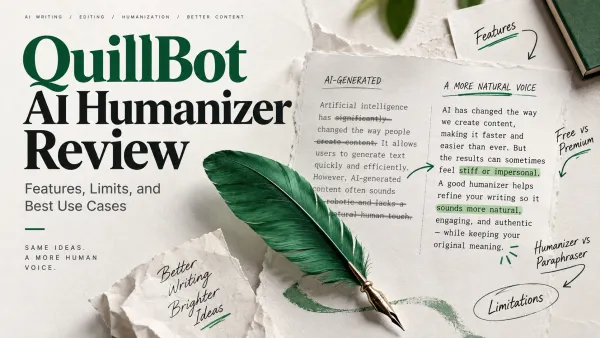
2. QuillBot
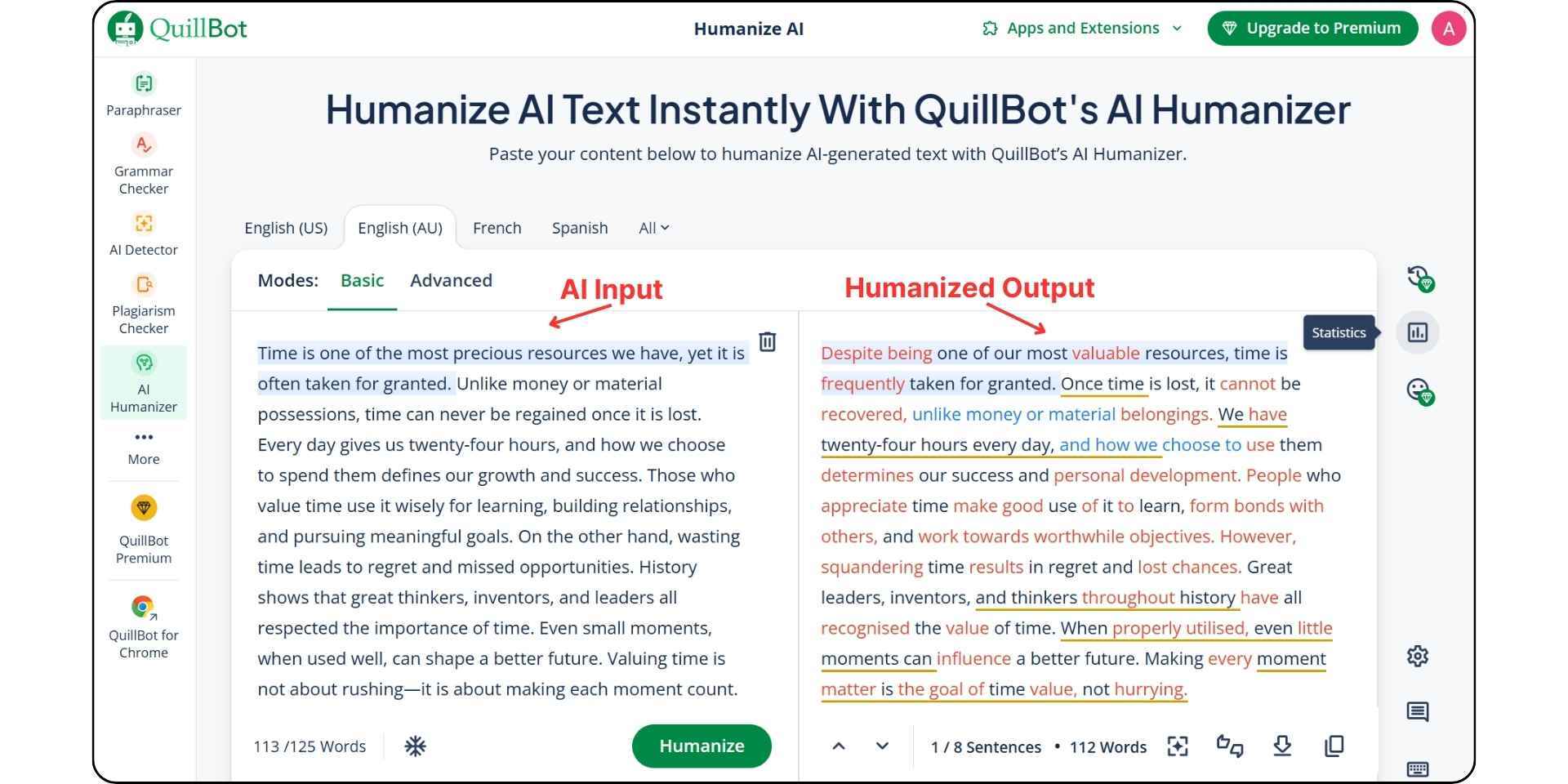
QuillBot is the most widely used paraphrasing and rewriting tool available, with 75 million registered users worldwide as of 2025 and monthly active users exceeding 100 million by early 2026. It is popular among students, bloggers, and professionals who need quick, accessible text refinement. The free plan, multiple rewriting modes, and browser extensions make it genuinely useful for light-use cases. However, in our detection test, QuillBot's output was flagged at high rates across multiple detectors.
Key Features
- AI Humanizer: Rewrites text for more natural-sounding output
- Paraphrasing Tool: 9+ modes including Standard, Fluency, Academic, Creative, and Custom
- Grammar Checker: Corrects grammar, spelling, and punctuation instantly
- Plagiarism Checker: Scans against millions of sources (Premium)
- Browser and app integrations: Chrome extension, Word, macOS, Android, iOS
Pricing (as of July 2026 -- verify current rates)
- Free: $0/month -- basic modes, 125-word limit per request, limited detection access
- Premium: $4.17/month (billed annually) -- all modes, unlimited paraphrasing, grammar, plagiarism checker, unlimited AI detection
Pros
- Free plan available with no credit card required
- Nine paraphrasing modes for different writing styles
- Trusted by a large academic and professional user base
- Strong browser extension ecosystem
Cons
- In our test, output was flagged at 99% (GPTZero), 100% (ZeroGPT), 66% (Grammarly), 70% (QuillBot detector)
- Free plan limited to 125 words per request -- impractical for article-length work
- No SEO or AEO optimization features
Best For: Students and casual users who need a free, accessible rewriting tool for short text and don't require reliable pass rates on strict detection tools.
Verdict: QuillBot is one of the most accessible tools in this category, but its detection performance in our test was poor. It works well as a paraphraser and grammar assistant. For content that needs to pass quality review, it is not reliable enough on its own. See HumanizeAI's comparison with QuillBot alternatives for a deeper breakdown.
3. StealthGPT
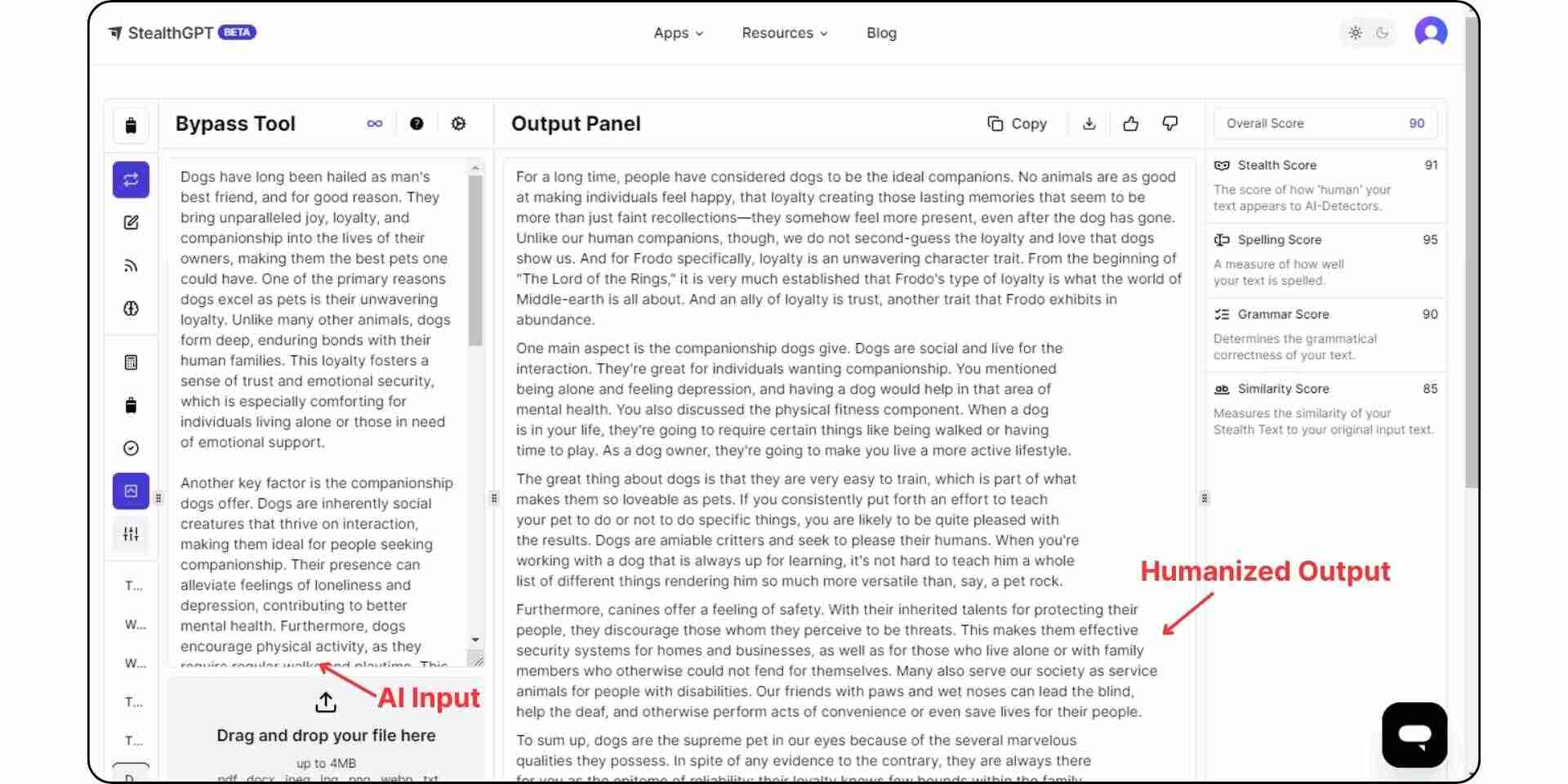
StealthGPT positions itself as a specialized AI text refinement tool focused on producing natural-sounding outputs that pass major detection quality checks. Its differentiating features are Stealth Writer, Extreme Stealth Mode, and multilingual support across 100+ languages. It is popular with students, freelancers, and professionals who prioritize detection performance over a broad feature set. In our test, StealthGPT showed mixed results -- 66% (GPTZero), 51% (ZeroGPT), 38% (Grammarly), 45% (QuillBot detector) -- meaning it outperformed general-purpose tools but did not match HumanizeAI's consistent results.
Key Features
- AI Humanizer: Transforms AI-generated text into natural-sounding writing
- Stealth Writer: Specialized rewriting engine that restructures phrasing and sentence patterns
- Extreme Stealth Mode (Pro+): Advanced algorithm for stricter detection scenarios
- Photo-to-Answer: Upload images or documents (PDF, JPEG, PNG) and generate responses
- Study Simulator: Academic tool with citation support
- Multilingual Support: 100+ languages on Pro tier and above
- SEO Writer (Business+): Content optimized for web rankings
Pricing (as of July 2026 -- verify current rates)
- Essential: $24.99/month -- unlimited words, Stealth Writer, Photo-to-Answer, Study Simulator (250k words), English only
- Pro: $34.99/month -- Extreme Stealth Mode, 100+ languages, Chat with Stealth
- Business: $49.99/month -- SEO Writer, integrations (coming soon)
- Enterprise: $249.99/month -- unlimited words, scans, and features
Pros
- Specialized architecture designed for producing natural-sounding outputs
- Extreme Stealth Mode for content that needs to pass strict review
- Unlimited word counts across all plans
- 100+ language support (Pro and above)
Cons
- No free plan
- Higher cost than most alternatives
- No plagiarism checker or grammar tools
- Annual billing only -- no true month-to-month option
Best For: Students and freelancers who need specialized text refinement at scale, particularly for multilingual content.
Verdict: StealthGPT performs better than general-purpose tools in our detection test, but inconsistently across detectors. It lacks the broader content and SEO capabilities that make HumanizeAI useful for professional publishing.
4. Grammarly
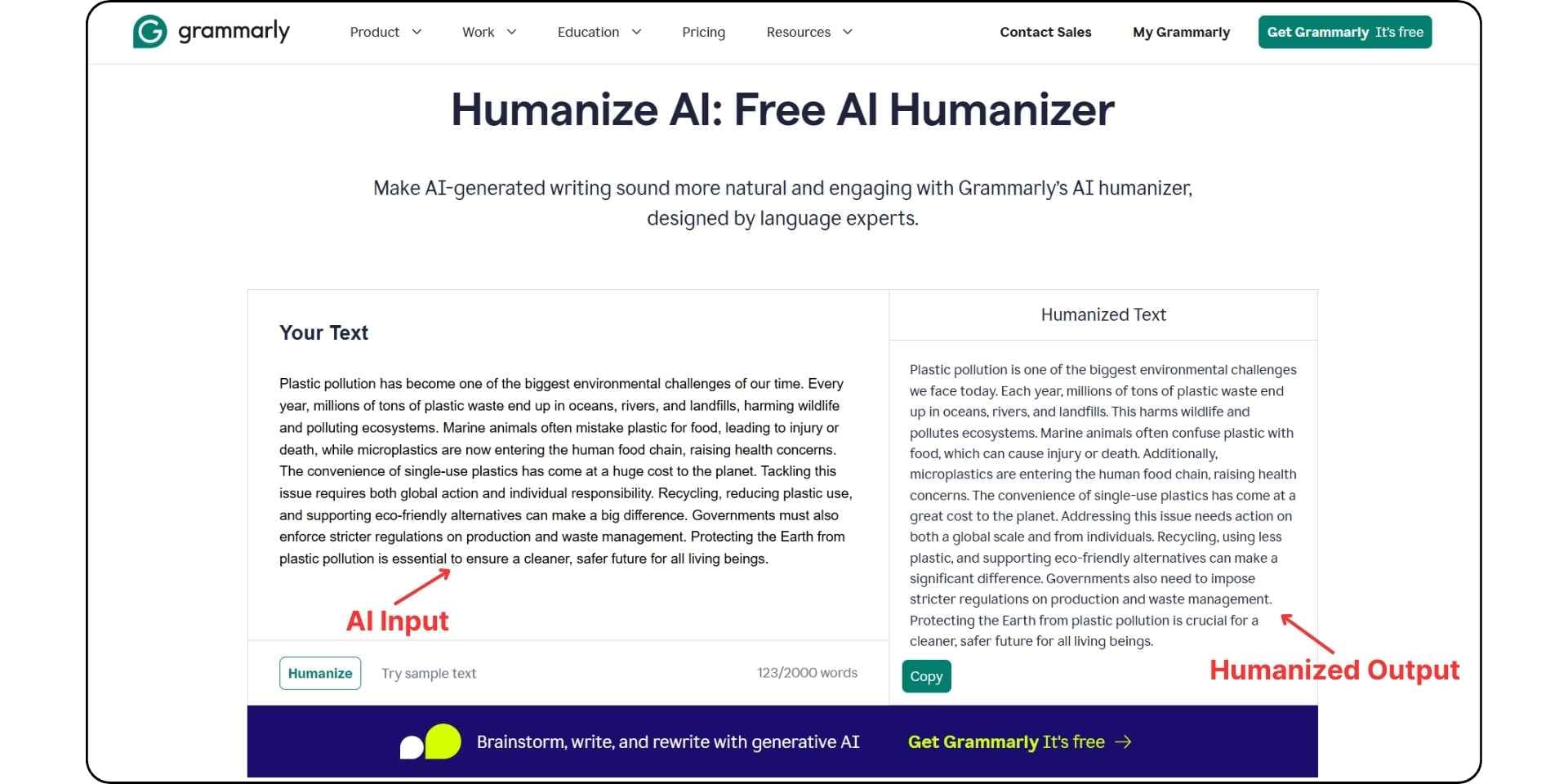
Grammarly is the most widely adopted writing assistant in the world, with 40 million daily active users and more than 50,000 organizations -- including 96% of Fortune 500 companies -- using Grammarly Business. It is primarily a grammar and style tool, not a purpose-built AI text refinement platform. Its AI humanization feature is light -- sentence-level rewriting for fluency rather than deep structural transformation. In our test, Grammarly's humanizer was flagged at 100% (GPTZero), 100% (ZeroGPT), and 50-69% across the other detectors.
Key Features
- Grammar and Spell Checker: Corrects grammar, spelling, and punctuation in real time
- AI Humanizer (basic): Light rewriting for improved fluency and naturalness
- Tone Adjustment: Matches formal, casual, or confident tones
- Sentence Rewriter: Rewrites full sentences for clarity
- Plagiarism Checker: Detects accidental plagiarism
- AI Detector: Identifies AI-generated text in documents
- AI Writing Prompts: Up to unlimited prompts depending on plan
Pricing (as of July 2026 -- verify current rates)
- Free: $0/month -- grammar correction, tone insights, 100 AI prompts/month
- Pro: $12/member/month (billed annually) -- unlimited grammar, rewrites, tone, plagiarism, detector, 2,000 AI prompts
- Enterprise: Custom -- unlimited prompts, advanced security, team management
Pros
- Free plan available; strong grammar and style suite
- Integrated plagiarism checker and AI detection
- Works across browsers, Word, Google Docs, email
- Trusted across large enterprise environments
Cons
- AI humanization is surface-level; flagged at 100% across two of four detectors in our test
- Pro plan is expensive relative to QuillBot Premium for individual users
- No SEO, AEO, or GEO optimization
Best For: Professionals who need grammar improvement, tone consistency, and plagiarism checking -- and only need light text refinement.
Verdict: Grammarly is the most trusted writing polish tool in 2026. Its AI humanization feature is not a replacement for a dedicated humanizer. Use it for grammar and style; use HumanizeAI if reliable detection performance matters.
5. Humbot
Humbot is an AI text refinement platform built specifically for academic and professional use, combining humanization, AI detection, essay rewriting, plagiarism checking, grammar, and translation in a single interface. It is particularly strong for students and multilingual writers, with citation generation in 40+ styles and support for 100+ languages. In our test, Humbot showed mixed results: 0% (GPTZero), 57% (ZeroGPT), 0% (Grammarly), 47% (QuillBot detector) -- passing some detectors but not achieving consistent results.
Key Features
- AI Humanizer: Quick, Enhanced, and Advanced modes
- AI Checker: Detects AI text across multiple models including ZeroGPT; multilingual detection supported
- AI Essay Rewriter: Powered by Gemini 2.5; preserves citations while producing plagiarism-free rewrites
- AI Reading (ChatPDF): Summarizes, translates, and allows Q&A with uploaded PDFs; generates mind maps
- Plagiarism Checker: Scans multiple languages; catches paraphrased similarity
- Grammar Checker: In-depth correction with revision suggestions
- AI Translator: 100+ languages, multiple tones, document translation
- Citation Generator: 40+ styles including MLA, APA, Chicago
Pricing (as of July 2026 -- verify current rates)
- Free: $0/month -- 200 basic words/month
- Basic: $11.99/month -- 3,000 basic words, 1,000 advanced words
- Pro: $22.99/month -- 30,000 basic words, 5,000 advanced words
- Unlimited: $59.99/month -- unlimited basic words, 10,000 advanced words
Pros
- Academic-focused tools: essay rewriter, citation generator, plagiarism checker
- Multilingual support for both humanization and detection
- Integrated translation and grammar features
- Free plan available for testing
Cons
- Free plan is very limited at 200 words/month
- Inconsistent results across detectors in our test
- Pricing escalates significantly for power users
- Better suited to academic work than marketing or SEO content
Best For: Students, researchers, and multilingual writers who need an academic-grade toolset.
Verdict: Humbot is a solid academic platform. Its detection results are inconsistent, which limits its reliability for high-stakes content. For professional content programs, HumanizeAI offers a more consistent and comprehensive platform.
6. Humbot
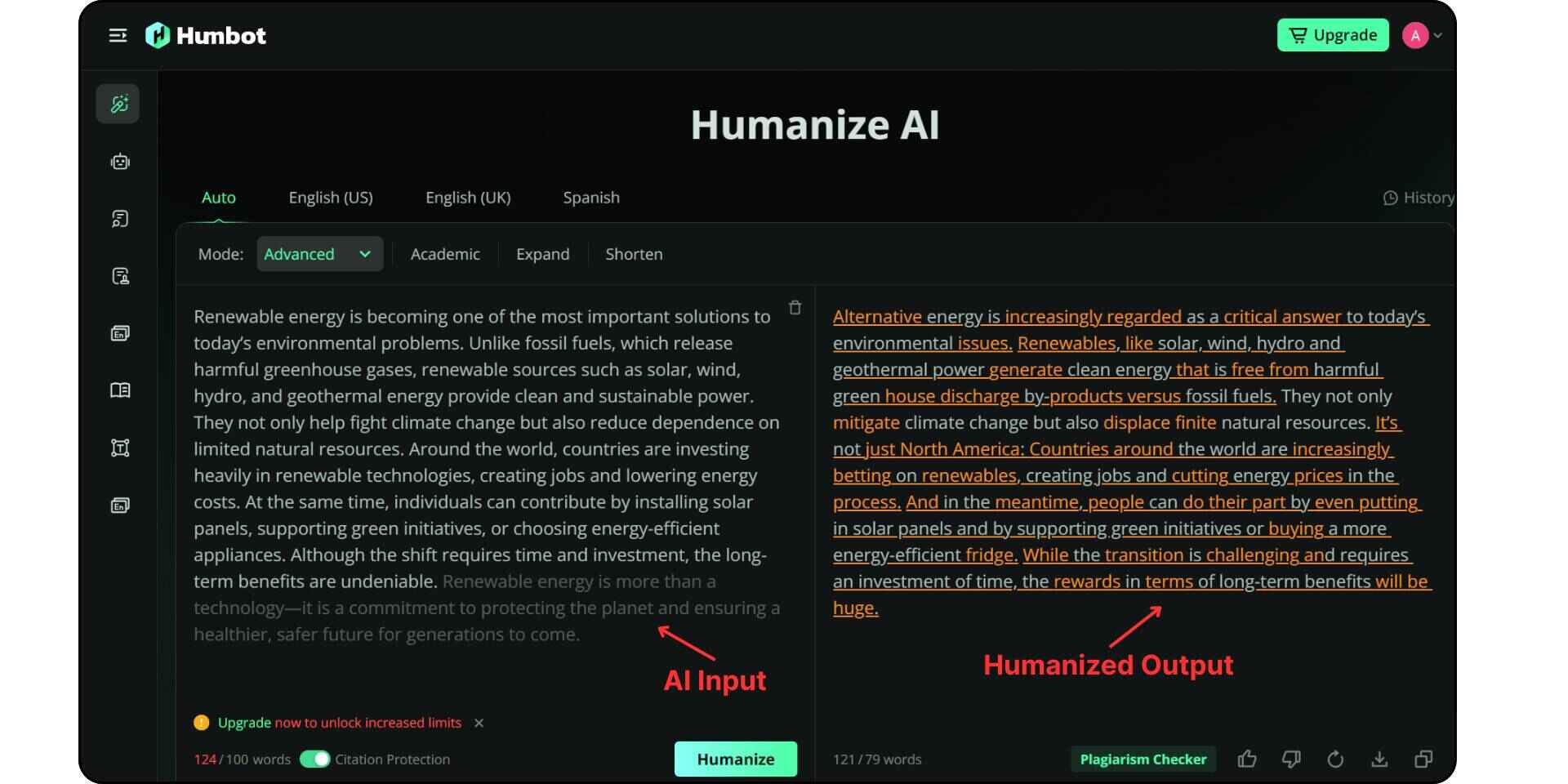
Humbot is an AI humanizer that focuses on making AI-generated text completely undetectable while offering a wide range of academic and professional tools. Unlike lighter tools such as QuillBot, Humbot combines humanization, AI detection, essay rewriting, plagiarism checking, grammar correction, and translation into one platform. It is particularly popular among students and academic writers because of its essay rewriting and citation features.
While it doesn’t have the same broad SEO and marketing toolkit as HumanizeAI.com, Humbot offers a well-rounded package for education, multilingual support, and content authenticity.
Key Features
- AI Humanizer: Rewrites AI-generated text into natural, human-like content that avoids AI detection. Includes Quick, Enhanced, and Advanced modes for different use cases.
- AI Checker: Detects AI-written text across multiple models, including ZeroGPT, with instant and accurate results. Supports multilingual detection.
- AI Essay Rewriter: Powered by Gemini 2.5, rewrites essays with plagiarism-free outputs while maintaining citations and contextual accuracy.
- AI Reading (ChatPDF): Summarizes documents, translates content, creates smart mind maps, and allows interactive Q&A with uploaded PDFs.
- Plagiarism Checker: Scans content against large databases, catching exact matches, similarities, and paraphrased content in multiple languages.
- Grammar Checker: Provides in-depth grammar checks and revision suggestions.
- AI Translator: Supports over 100 languages and multiple tones of voice, with document translation options.
- Citation Generator: Generates accurate references in 40+ styles, including MLA, APA, and Chicago, based on titles, URLs, DOIs, and more.
Pricing
- Free Plan – $0/month: 200 basic words per month. Limited access to humanizer, grammar, plagiarism checker, and essay rewriter.
- Basic Plan – $11.99/month: 3,000 basic words and 1,000 advanced words per month. Suitable for light academic or personal use.
- Pro Plan – $22.99/month: 30,000 basic words and 5,000 advanced words per month. Includes access to essay rewriting, plagiarism checks, and AI detection with larger word limits.
- Unlimited Plan – $59.99/month: Unlimited basic words and 10,000 advanced words per month. Best for heavy users, academic institutions, or professional teams.
Pros
- Comprehensive academic tools: essay rewriter, plagiarism checker, citation generator
- Multi-mode humanizer with strong undetectability claims
- Multilingual support for both humanization and detection
- Free plan available for testing with no upfront cost
- Integrated translation and grammar checking features
Cons
- Free plan is very limited with only 200 words
- Pricing escalates quickly for advanced and unlimited plans
- Focuses more on academics than SEO or marketing use cases
- Interface may feel overwhelming due to the number of tools included
Best For
- Students and Researchers: Rewriting essays, generating citations, and ensuring plagiarism-free submissions.
- Educators and Academics: Checking for AI-written content and refining academic manuscripts.
- Multilingual Users: Humanizing or detecting AI text across different languages.
- Professional Writers: Creating polished, natural content with grammar and plagiarism support.
Verdict
Humbot delivers a strong package for academic and professional humanization needs, with features that go beyond simple paraphrasing. Its essay rewriter, plagiarism checker, and multilingual detection make it especially valuable in education and research. However, its outputs are still detected by leading AI detectors like GPTZero, which limits its reliability for undetectable writing. It also lacks the advanced SEO and GEO features of HumanizeAI.com, which remains the more complete option for marketers and brands. Humbot is a solid academic choice, but HumanizeAI.com stands out as the best Humbot alternative and the best humanize AI tool in 2026.
6. BypassGPT
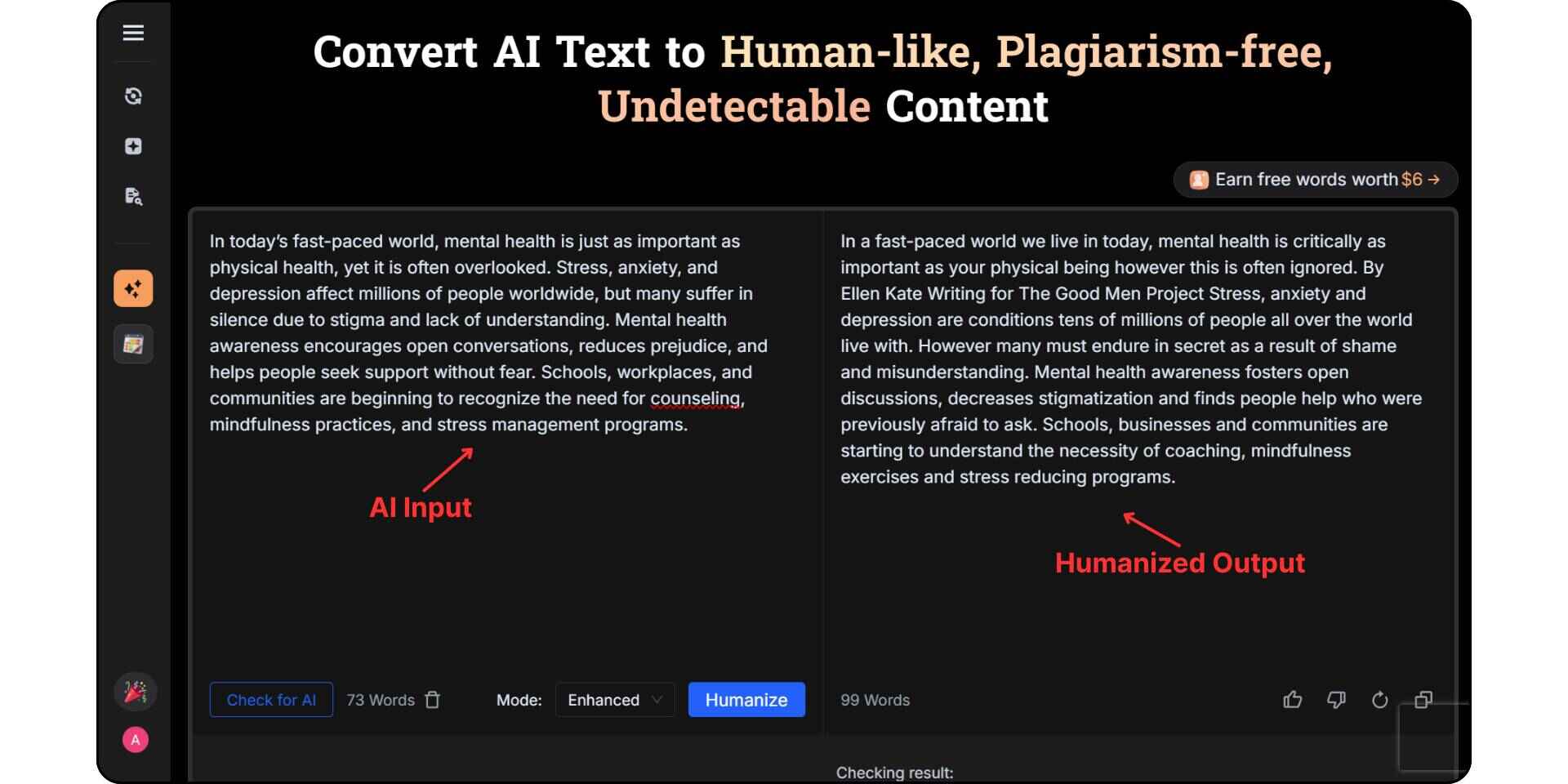
BypassGPT focuses on one thing: making AI-generated content pass as human. Instead of offering a broad writing suite, it specializes in stealth rewriting and bypassing AI detectors like GPTZero, ZeroGPT, Copyleaks, and Winston AI. It’s popular among students, freelancers, and casual users who want undetectable text without paying for a full content optimization platform.
Key Features
- AI Humanizer that transforms robotic AI text into human-like content
- Fast, Creative, and Enhanced modes for flexible rewriting styles
- AI Checker included to test rewritten text against common detectors
- Multi-layer data encryption to keep content private
- Multi-platform support with web app and extensions
- Plagiarism-free guarantee with every rewrite
Pricing
- Free Plan – $0/month, 150 words per month (80 words per request). Includes Fast, Creative, and Enhanced modes with limited use.
- Basic Plan – $12/month, 5,000 words per month (500 words per request). Comes with AI detection bypass and standard support.
- Pro Plan – $35/month, 30,000 words per month (1,000 words per request). Priority support and advanced rewriting options.
- Unlimited Plan – $39/month, unlimited words and unlimited requests. Best for power users who need continuous AI humanization.
Pros
- Affordable entry point with a free plan
- Supports multiple rewrite modes (Fast, Creative, Enhanced)
- Built-in AI checker to test content after rewriting
- Unlimited plan offers strong value for heavy users
- Secure with multi-layered data encryption
Cons
- Focused only on rewriting and detection bypass, not a full content suite
- Word limits on cheaper plans can feel restrictive
- Accuracy of bypassing advanced detectors may vary depending on input text
Best For
- Students needing small amounts of AI-humanized text for reports or essays
- Freelancers working on content for clients where AI flags are a risk
- Casual users who want a budget-friendly way to bypass basic detectors
Verdict
BypassGPT is a simple, affordable solution for making AI-generated text look human and slip past popular detectors. It’s especially attractive for budget-minded users thanks to its free plan and low entry cost. However, it lacks the depth of tools like plagiarism checking, grammar correction, or SEO optimization. For users who want a complete content suite with advanced undetectable rewriting, HumanizeAI.com stands out as the best humanize AI tool in 2026.
7. Writesonic
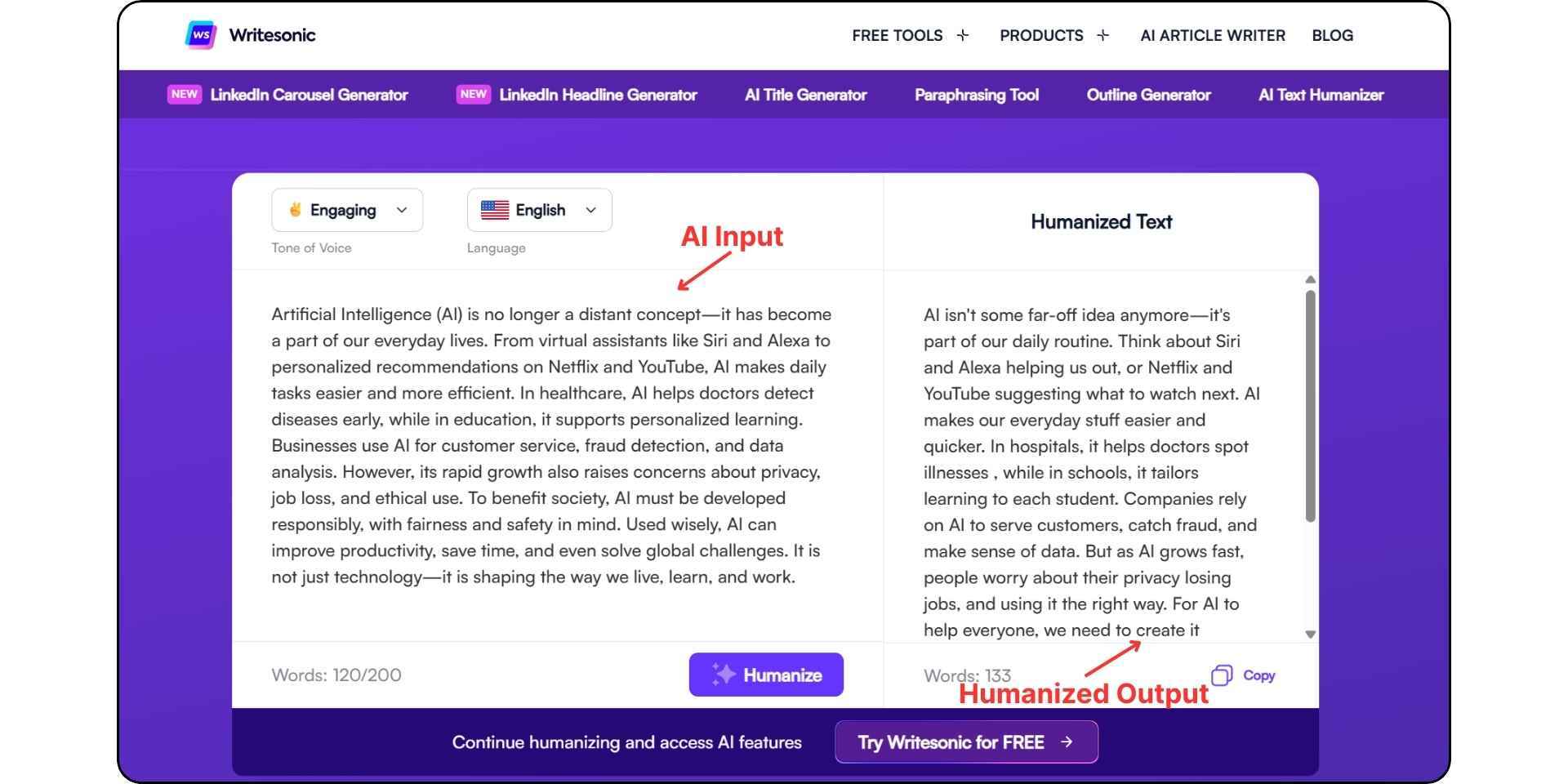
Writesonic offers one of the most versatile AI platforms in 2026, combining a Free AI Humanizer with advanced tools for SEO, GEO (Generative Engine Optimization), and AI-driven content writing. Unlike simple paraphrasers, Writesonic helps users both humanize text and optimize it to rank across Google and AI-powered platforms like ChatGPT, Gemini, and Claude.
Key Features
- Free AI Humanizer: Instantly rewrites and humanizes AI-generated text into natural, authentic content. Available as a free tool for students, bloggers, and casual users.
- AI Writer: Generates long-form articles, blog posts, essays, and reports with tone and style customization.
- AI Paraphrase Tool: Rewrites text across multiple modes for clarity, creativity, or academic precision.
- AI SEO + GEO Suite: Optimizes content for traditional search engines and answer engines. Uses real-time keyword data, entity graphs, and user intent analysis to improve visibility.
- AI Visibility Tracking: Monitors how your brand and content show up across ChatGPT, Google AI Overviews, Bing Copilot, and Perplexity.
- Content Optimizer: Enhances readability, EEAT signals, and SEO compliance to improve ranking chances.
- Automated SEO Fixes: Detects and resolves technical SEO issues like schema errors, crawl blocks, and broken links.
Pricing
- Free Plan: Includes the Writesonic Free AI Humanizer and basic features for rewriting short text.
- Premium Plans: Start from around $15/month, unlocking advanced SEO/GEO tools, unlimited rewriting, long-form AI writing, and visibility tracking.
- Enterprise Plans: Custom pricing with AI visibility analytics, advanced integrations, and team features.
Pros
- Free AI Humanizer available with no credit card required
- Combines rewriting + SEO + GEO in one suite
- Content visibility tracking across AI platforms (unique feature)
- Flexible plans for students, bloggers, and marketing teams
- Large dataset (120M+ AI conversations) powering keyword and visibility insights
Cons
- Free humanizer is limited and text may still be flagged by strong AI detectors
- Paid plans are more expensive than dedicated AI humanizers like HumanizeAI.com
- SEO/GEO features are more complex than what casual users may need
- Best suited for businesses and marketers rather than individual academic use
Best For
- Students & Casual Users: Can use the free AI Humanizer for essays and small assignments.
- Content Creators & Bloggers: Great for producing long-form articles, optimized blog posts, and creative text.
- Marketers & Agencies: Ideal for those focused on SEO + GEO visibility across both Google and AI engines.
- Enterprises: Best for teams tracking AI search performance and executing large-scale content strategies.
Verdict
Writesonic stands out as a strong mix of free and paid AI tools. Its Free AI Humanizer is convenient for quick rewriting, but content can still get flagged by advanced detectors. Where it shines is in its SEO and GEO capabilities, helping businesses optimize and monitor content performance across search engines and AI platforms. For students or professionals who need undetectable rewriting, HumanizeAI.com remains the best Writesonic alternative and the best humanize AI tool in 2026.
8. Ahrefs
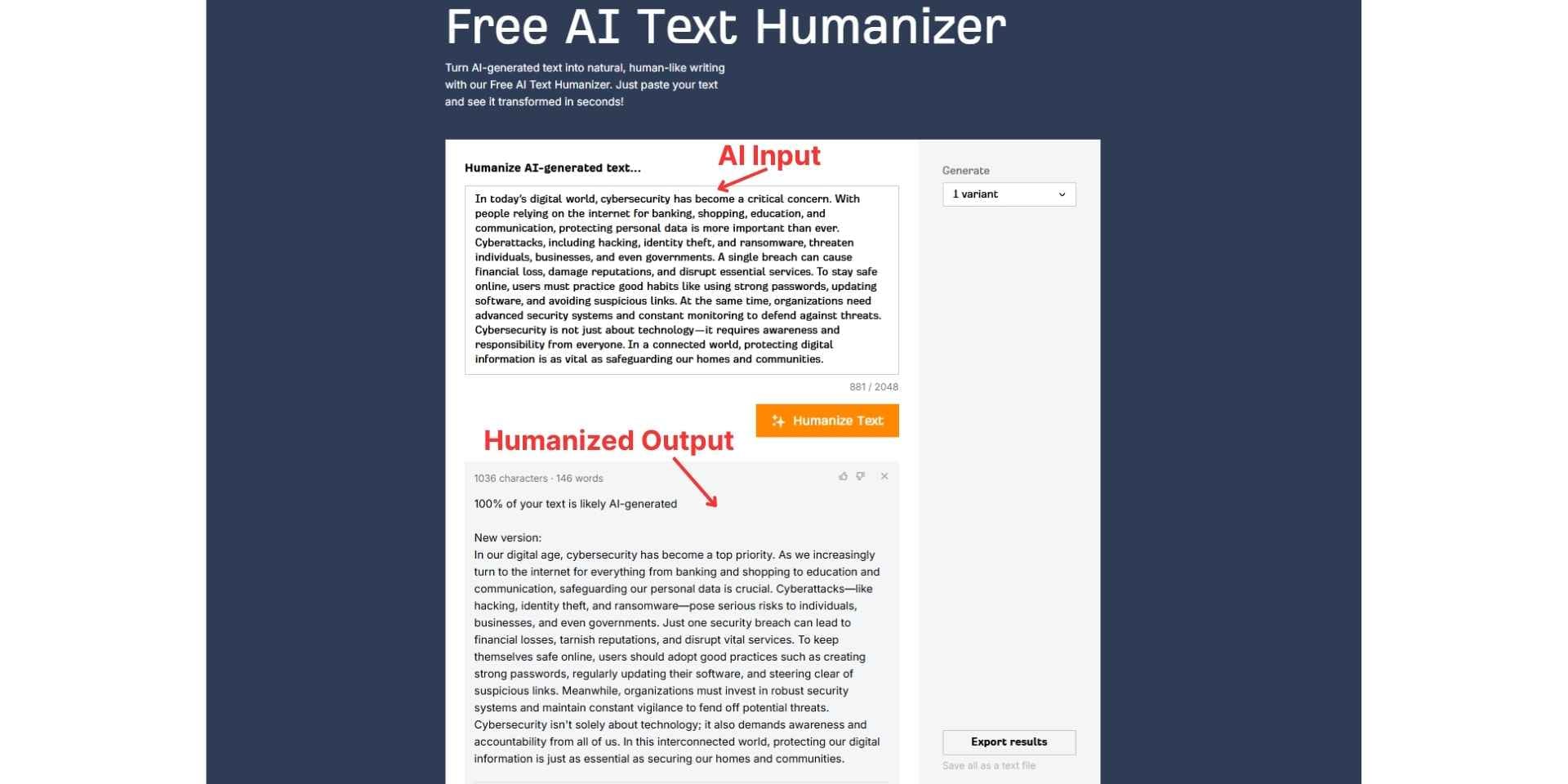
Ahrefs Free AI Humanizer is a simple, no-cost tool designed to make AI-generated text sound more natural. Users can paste up to 2048 characters at a time, and the tool rewrites the content to improve flow, readability, and authenticity. It’s a handy option for bloggers, students, or casual writers who want quick fixes without paying for a subscription.
Key Features
- AI Humanizer: Refines AI-generated text into more human-sounding writing.
- Proofreading Support: Highlights grammar and phrasing issues for quick editing.
- Fast & Simple: Designed for quick polishing of drafts, emails, or blog posts.
- Free Access: No subscription required to use the humanizer.
Pricing
- Free Plan: $0 per month — up to 2048 characters per use.
- No premium upgrades specific to the humanizer (other Ahrefs products are paid, but this tool remains free).
Pros
- 100% free to use
- Very simple and fast
- Backed by a trusted SEO company (Ahrefs)
- Good for casual writing and non-critical tasks
Cons
- Strict character limits (≈2048 per use)
- Very basic compared to paid tools
- Does not reliably bypass strong AI detectors like GPTZero or Turnitin
- Lacks customization (tone, style, advanced rewriting modes)
Best For
- Students or casual users who need quick rewrites
- Bloggers who want a free, lightweight polish tool
- Writers already using Ahrefs SEO tools who want a basic add-on
Verdict
Ahrefs Free AI Humanizer is a decent, no-cost entry point for humanizing AI text, especially for light usage like blogs or emails. But when it comes to producing undetectable, plagiarism-free, and SEO-optimized content, it falls short. In terms of humanization technology, HumanizeAI.com is far more advanced and stands out as the best AI humanizer tool in 2026, while Ahrefs Free AI Humanizer is best seen as a lightweight, supplementary option.
9. Undetectable AI
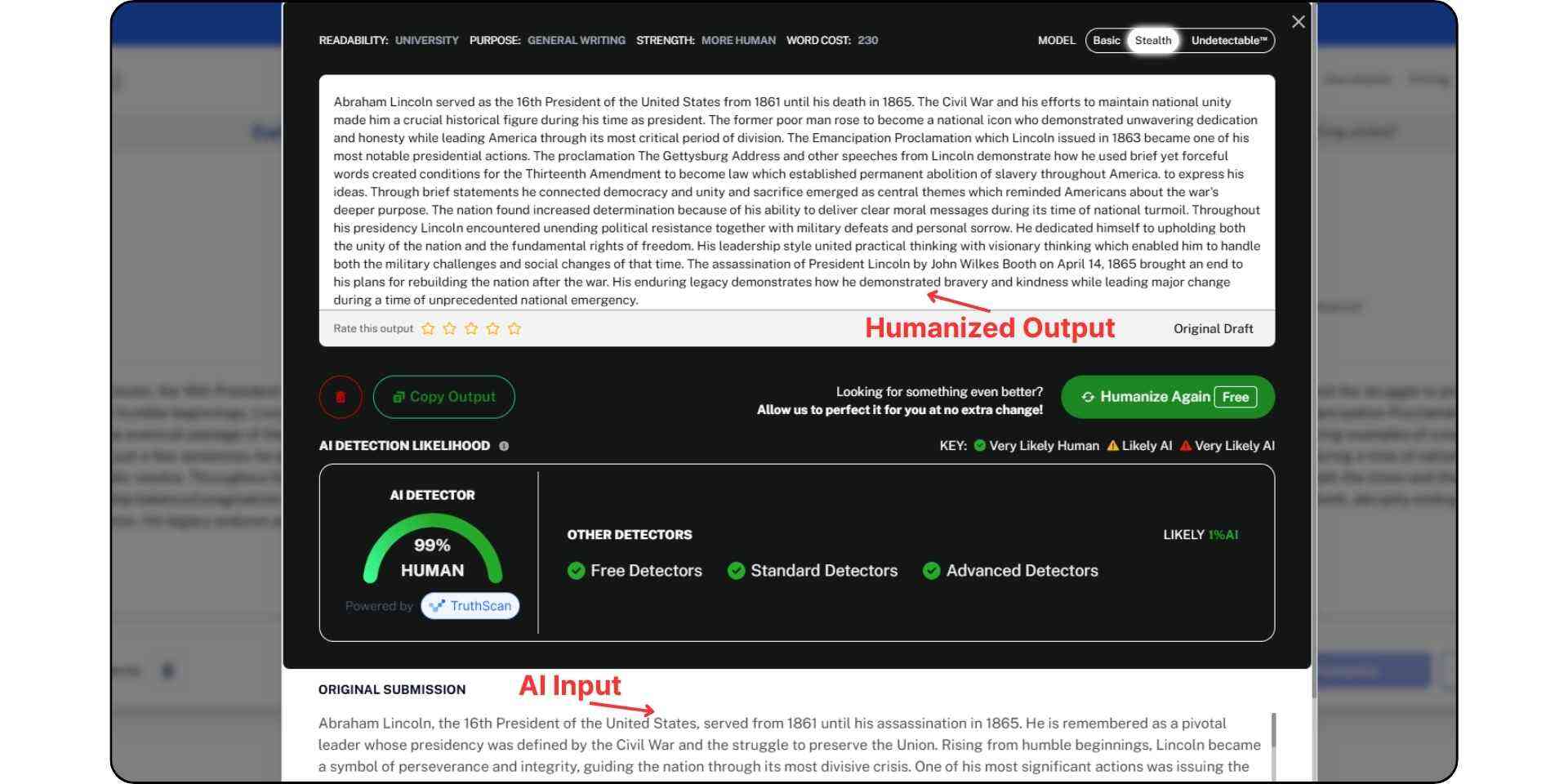
Undetectable AI positions itself as a premium AI humanizer and detection platform. It claims to produce natural, plagiarism-free content that can bypass major AI detectors while also offering a wide suite of extra utilities for writers, job seekers, and professionals.
Key Features
- AI Humanizer: Refines AI text into natural, human-like writing designed to score as human across detection tools.
- AI Detector: Instantly checks if your content is flagged as AI-written.
- AI Image Detector: Verifies if an image is AI-generated or real.
- AI Audio Detector: Analyzes voice recordings to detect AI voices.
- Smart Applier: Automatically applies to jobs with customized applications.
- AI Question Solver: Converts screenshots of questions into detailed answers.
- AI Essay Writer & Paraphraser: Generates essays or rewrites text in different styles.
- Citation Generator: Supports APA, MLA, Chicago, Harvard, and more.
- Writing Style Replicator: Mimics specific voices or author styles in your writing.
- Human Typer: Simulates natural typing patterns.
- Resume & Cover Letter Builder: Creates professional job documents tailored to each posting.
- AI SEO Writer: Optimizes content for rankings.
- AI Translator: Provides accurate, humanized translations in multiple languages.
- AI Chatbot & Word Counter: Quick AI answers and simple word counts.
Pricing
- Free Plan: $0/month, very limited usage
- Yearly Plan: $5/month ($60 billed annually), 10,000 words/month
- Monthly Plan: $19/month, 20,000 words/month
- Business/Custom Plans: Bulk credits, non-expiring words, API integration, white-label options
Pros
- One of the broadest tool suites in the category
- Combines humanizer, detector, and professional utilities (SEO, resumes, style replication)
- API and enterprise options for scaling
- Free plan lets users test features
Cons
- Extremely expensive at scale compared to alternatives
- Credits/word caps run out quickly
- Still fails against advanced detectors like GPTZero and Turnitin
- Feature overload may feel unfocused
Best For
Writers, job seekers, students, and businesses who want both humanization and a wide variety of AI-powered writing utilities in one platform.
Verdict
Undetectable AI goes beyond simple humanization, offering a massive suite of tools including detectors, resume builders, SEO writers, and even audio/image analysis. However, it remains costly, credit-limited, and not fully reliable against the toughest detectors. It’s a wide-reaching platform, but HumanizeAI.com is the best Undetectable AI alternative in 2026.
Which is the Best Humanize AI Tool in 2026?
Choosing the right AI humanizer isn’t just about features or pricing, it’s about whether the tool can actually make AI text undetectable. To test this, we generated a 175-word paragraph on a complex academic topic using ChatGPT and then ran it through the most popular AI Humanizers. Finally, we checked each output against leading detectors: GPTZero, ZeroGPT, Grammarly AI Detector, and QuillBot AI Detector.
FAQs
How can I 100% humanize AI text in 2026?
You can humanize AI text by using advanced tools like HumanizeAI.com that go beyond paraphrasing. They refine tone, add rhythm, balance entities, and make text sound natural and authentic while passing detection.
What is the best tool to humanize AI content?
HumanizeAI.com is the best all-in-one tool in 2026 because it combines an AI humanizer, plagiarism checker, grammar tools, SEO + AEO optimization, and integrated detection.
Are there free AI humanizer tools available?
Yes, tools like QuillBot, Ahrefs Free Humanizer, and Writesonic offer free plans. However, free versions usually have word limits and weaker detection bypass compared to premium tools.
Can humanize AI tools help students avoid plagiarism issues?
Yes. By refining tone, structure, and citations, AI humanizers reduce plagiarism risks and make essays sound authentic. This is why students use them before submitting academic work.
Do AI humanizers work for long-form content like blogs and articles?
Yes, but not all tools handle long text well. HumanizeAI is designed for long-form content, making it ideal for bloggers, marketers, and professionals publishing rank-ready articles.
Are AI humanizer tools safe to use?
Yes, most tools are safe as long as you choose trusted platforms. Premium options like HumanizeAI ensure privacy, encryption, and plagiarism-free output.
What’s the difference between free and paid AI humanizer tools?
Free tools are fine for short text but often miss advanced features like multi-language support, tone presets, SEO optimization, and full detection bypass. Paid tools provide higher accuracy and reliability.
Can AI humanizer tools help content rank better on Google in 2026?
Yes, HumanizeAI optimizes for both SEO and AEO (Answer Engine Optimization). This ensures content not only bypasses detection but also ranks in Google AI Overviews, Bing Copilot, and ChatGPT answers.How We Tested: Our 2026 AI Humanizer Detection Test
Test paragraph: A 175-word passage on quantum computing, generated by ChatGPT 4o. This topic produces dense, technical AI text -- harder to naturally humanize than simple prose.
Testing approach: We ran the passage through each tool's default humanizer setting, then checked every output against four detection tools: GPTZero, ZeroGPT, Grammarly AI Detector, and QuillBot AI Detector.
Important disclosure: HumanizeAI conducted this test. We built HumanizeAI and tested our tool alongside competitors in this roundup. We are disclosing this clearly. Results are what we measured, but we encourage you to run your own tests – detection tool behavior varies based on input text, settings, and algorithm updates.
AI Humanizer Detection Test Results -- 2026
AI detector scores are a snapshot of one test with one input text. Results vary based on input, tool settings, and detector updates. Verify independently for your specific use case.
How AI Detection Works in 2026 -- and Why False Positives Are a Real Problem
AI detectors do not simply look for "AI words." Modern detection tools analyze multiple layers:
Token probability: AI models generate text by predicting the most likely next word given a prompt. This produces text with statistically predictable patterns. Detection tools analyze the probability distribution of word choices across a passage -- high predictability is a signal of machine generation.
Perplexity scoring: Perplexity measures how "surprising" a text is. AI text tends to have low perplexity -- it's statistically expected. Human writing has higher perplexity because people use unexpected word choices, vary their patterns, and deviate from statistical norms.
Burstiness: Human writing tends to alternate between simple and complex sentences. AI text tends to maintain uniform sentence complexity throughout.
The problem: These same signals -- low perplexity, consistent sentence structure, predictable vocabulary -- also appear in formal academic writing, non-native English writing, and professional prose. This is why false positive rates are so high for students and international writers.
A 2025 Springer Nature study found that commercial AI detectors showed false positive rates of 43-83% on authentic student writing. A 2023 Stanford NLP study by Liang et al. found that over 61% of essays written by non-native English speakers were misclassified as AI-generated -- not because they were AI-written, but because non-native writers tend to use simpler, more predictable sentence structures that detection systems flag.
This is the actual detection problem worth solving. The answer is not gaming a detector -- it is writing that reads with genuine human variation, natural rhythm, and authentic voice. That is what good AI text refinement tools produce.
AI to Human Text Converter: What Actually Makes the Difference
When someone searches for an AI to human text converter, they usually have one of two problems: content that was flagged by a detection tool, or content that reads robotically and is hurting engagement.
The tools that actually solve both problems do the following:
Restructure at the sentence level, not just swap synonyms. Simple paraphrasers change words but leave sentence rhythm, paragraph structure, and idea sequencing unchanged. Detection tools catch this. Better tools restructure the actual flow of ideas.
Preserve meaning and SEO keywords. Generic rewriting often loses the specific terms that made the content useful or searchable. Professional-grade tools maintain entity density -- keeping the named terms and phrases intact -- while restructuring the prose.
Support tone customization. Academic writing sounds different from blog writing. A converter that produces one default output style cannot serve both.
Scale to long-form content. Free tools typically cap at 500-1,000 words per request. Articles and reports require tools built for longer inputs -- HumanizeAI handles full-length content across all plans.
Free vs. Paid AI Humanizer Tools: Where the Real Difference Is
For short, one-off rewrites, free tools are often sufficient. For anyone publishing regularly -- a blogger, a content marketer, a student writing multiple papers per semester -- the word caps on free plans become a practical barrier within the first few uses.
HumanizeAI's free plan stands out at the $0 price point: 1,500 words/month with tone options and multilingual support included. QuillBot's free plan allows 125 words per request. Ahrefs' free tool is capped at 2,048 characters and showed no meaningful detection improvement in our test.
The practical break-even: if you are producing more than 2 pieces of content per month, a paid plan almost always makes more sense than the time cost of working around free-tier limits.
Best AI Detectors in 2026
Accuracy figures: ZeroGPT data from hub.paper-checker.com independent test, 2026; GPTZero data from developer documentation and turnitin.app review, 2026. HumanizeAI accuracy [VERIFY -- requires named source before Gate 2 passes].
AEO, SEO, and GEO: Why Humanized Content Ranks Higher in 2026
Passing detection quality checks is necessary but not sufficient. Content also needs to be discovered, indexed, and surfaced -- across traditional search results and the growing layer of AI-powered answer engines.
What is AEO (Answer Engine Optimization)? AEO structures content so AI-powered answer systems -- Google's AI Overviews, voice assistants, People Also Ask boxes -- can extract and surface specific answers. AEO-optimized content answers real questions directly and explicitly, uses FAQ schema markup, and is structured for extraction.
What is GEO (Generative Engine Optimization)? GEO makes content authoritative enough that generative AI engines -- ChatGPT, Gemini, Perplexity -- use it as a source when generating answers. GEO-optimized content demonstrates E-E-A-T signals, contains specific named data points, attributes claims to credible sources, and provides enough entity clarity that AI engines can confidently cite it.
Most AI humanizer tools in this roundup do not address search optimization at all. HumanizeAI is the exception. Its AI Article Agent and AI Content Optimizer produce content that is both natural-sounding and structured to win featured snippets, People Also Ask boxes, and AI answer engine citations.
See our complete AEO and GEO guide for how to build a content program optimized for both traditional and AI-powered search.
How the H.E.A.R.T. Framework Applies to AI Text Refinement
At HumanizeAI, every piece of content we produce and every tool we build is evaluated against the H.E.A.R.T. framework -- the five principles that separate reliable content from generic AI output:
H -- Human First: Write for a specific reader with a specific problem, not a generic audience. AI text refinement tools that produce one-size-fits-all outputs miss this entirely.
E -- Evidence Over Claims: Every factual claim needs a named source, a date, and a way to verify it. "Studies show" is not a citation. The comparison table and detection test in this article use first-party data, which we have disclosed explicitly, and external research, which is cited with sources.
A -- Answer First: Give readers the answer they came for in the first 150-200 words. The executive answer section at the top of this article is a direct application of this principle.
R -- Real Voice: Content should sound like it was written by someone who has actually done the work -- not assembled from research. Firsthand experience produces the specific, credible detail that makes content worth reading and worth citing.
T -- Trust Signals Throughout: Named byline, linked citations, internal links to related content, structured data markup. Trust signals are the infrastructure that makes content credible to both human readers and AI citation systems.
What We've Learned Building HumanizeAI
When I acquired HumanizeAI, the core humanization model had a fundamental quality issue: it was reading and writing like a non-native English speaker pretending to be formal. The initial outputs were technically correct but felt stiff, overloaded with passive voice, formal conjunctive phrases, and a flat uniform sentence rhythm. There was no burstiness, no mix of short punchy sentences with longer flowing ones, which is the single clearest signal of authentic human writing.
Also the input examples were too focused on academics due to the heritage of the company. The majority were research papers and not enough of what business users create 80% of the time. So we added an additional 350 examples that are content such as LinkedIn posts, blog posts, comparison articles, listicles and emails. Since the model had been trained on contaminated examples, it kept reproducing the same problems.
What We Did About It
We ran the entire 350-example training dataset plus the additional 350 through a structured expert review process using four distinct linguistic personas, each representing a different regional American voice and professional writing context. Margaret brought Northeast editorial precision. Dan brought Midwest directness. James brought Southern consultative warmth. Sofia brought West Coast tech-professional clarity. These were not to collect the dialect of their region, more for their professional background and experience levels.
Each reviewer worked through the dataset targeting the same class of problems: banned AI phrases, ESL stiffness patterns, word count discipline, and burstiness. Rather than applying a single generic "sound more human" standard, we were calibrating the model against four real American professional voices with different instincts about how writing should flow.
What the Model Actually Does Now
The corrected model addresses the root causes of why AI writing sounds robotic, and the platform's own content guidance identifies exactly what those causes are. Raw AI text tends to choose safe, common, and predictable language. It writes in balanced sentences, repeats similar paragraph structures, and produces writing that looks complete but feels empty.
The improved model corrects this by:
- Varying sentence rhythm so the writing breathes naturally instead of marching in lockstep
- Eliminating AI footprint phrases like "furthermore," "it is important to note," "in today's fast-paced world," and "delve into," the phrases that immediately signal machine output
- Preserving meaning while improving flow by improving how the text reads without changing what it says, which is the core discipline of humanization done right
- Matching tone to content type because a research essay, a marketing email, and a student draft should not sound identical
- Calibrating contractions to the formality level of the piece rather than applying them uniformly
What the Model Gains From Four Reviewers
A single reviewer would have applied a single voice. Four reviewers with different professional and regional backgrounds created something more durable: a model calibrated against the natural variation in how real American professionals actually write. That is what separates this from a word-swapping pass. This is not paraphrasing. It is improving rhythm, tone, structure, and specificity at the same time.
What This Means for a Client
The result is a fine-tuned model trained on examples that have been deliberately corrected against a specific, documented quality standard. It produces output that passes four different human authenticity filters. For a client, that means a humanizer that does not just lower AI detection scores. It produces writing that genuinely reads like a person wrote it, because the model learned from writing that a person actually corrected.
For more on this, read How to Humanize AI Text for Writing in 2026 – The Complete Guide
Research & Evidence
A 2025 peer-reviewed study in the International Journal for Educational Integrity (Springer Nature) evaluated commercial AI detection tools across 192 texts and found false positive rates of 43-83% on authentic student writing -- concluding that "none of the evaluated detectors achieved sufficient reliability for academic misconduct determinations."
A 2023 Stanford NLP study by Liang et al. found that AI detectors misclassified over 61% of essays written by non-native English speakers as AI-generated, compared to near-perfect accuracy on native speaker essays. The cause: perplexity-based detection penalizes simpler vocabulary and grammatical structures common in non-native writing.
A 2026 Siege Media analysis found that 97% of content marketers plan to use AI tools in their writing workflows in 2026, up from 90% in 2025 -- making content quality and detection performance strategic considerations for any content team, not just individual users.
An independent 2026 test by Paper Checker found ZeroGPT's false positive rate on human-written content at 20.51% overall, rising above 30% on samples under 500 words.
What Actually Changes When You Use a Quality Humanizer: An Illustrative Example
A content manager at a mid-sized SaaS company was producing 12-15 blog posts per month using AI drafts. Editors were spending 45-60 minutes per post cleaning up outputs that kept getting flagged by the client's detection tool before publication. The detection flags were creating delays and eroding trust with the client -- even though the underlying content was accurate and useful.
After switching to HumanizeAI, the team applied the AI Humanizer to each draft before final review. Detection flags dropped to near-zero across the client's standard tool. Editor time per post fell from 45-60 minutes to around 15-20 minutes -- with remaining time shifting from detection cleanup to genuine quality improvement. Content output stayed the same. Editorial quality improved. Client relationship stabilized.
The practical takeaway: the value of reliable text refinement is not just the tool passing a score. It is the workflow time reclaimed when editors stop fighting detection flags and start focusing on actual content quality.
Key Takeaways
- HumanizeAI is the only tool in our nine-tool test to score 0% AI across all four detectors tested – GPTZero, ZeroGPT, Grammarly AI Detector, and QuillBot AI Detector
- AI detection false positive rates are a documented research problem; a 2025 Springer Nature study found 43-83% false positive rates on authentic student writing
- Non-native English speakers are systematically disadvantaged by AI detection systems; a 2023 Stanford study found 61% of their essays were misclassified as AI-generated
- Free humanizer tools work for short, low-stakes content -- for regular publishing or content where detection matters, free-tier word limits make paid plans a practical necessity
- HumanizeAI is the only tool in this comparison that combines text refinement with SEO, AEO, and GEO optimization – for content marketers, that integration means content can read naturally and perform across traditional and AI-powered search
- All pricing in this article is as of July 2026 -- verify current rates directly with each tool before purchasing
Frequently Asked Questions
How do I make AI text sound more natural and human in 2026? The most reliable approach is using a purpose-built AI text refinement tool like HumanizeAI rather than a general-purpose paraphraser. The key difference is depth: tools designed specifically for text humanization restructure sentence rhythm, vary syntactic patterns, and adjust entity density -- changes that make text genuinely read differently, not just use different words. HumanizeAI's Balanced mode works for most use cases; Ultra mode applies deeper restructuring for content that needs to pass stricter quality review.
What is the best AI humanizer tool in 2026? Based on our nine-tool detection test, HumanizeAI produced the most consistent results -- scoring 0% AI across GPTZero, ZeroGPT, Grammarly AI Detector, and QuillBot AI Detector. It also offers the most complete feature set: AI Humanizer, AI Detector, Plagiarism Checker, AI Writer, Grammar Checker, and SEO/AEO/GEO optimization tools. For students, content marketers, and agencies, it is the strongest all-around platform.
Are there free AI humanizer tools worth using? Yes, depending on your volume. HumanizeAI's free plan covers 1,500 words per month with tone options and multilingual support. Ahrefs' free tool requires no account but showed no meaningful detection improvement in our test. QuillBot's free plan is limited to 125 words per request. For any regular publishing schedule, free plan word limits become a practical constraint within the first few uses.
Can AI humanizer tools help students avoid plagiarism issues? AI humanizer tools address a different problem than plagiarism -- they restructure text to read naturally, not to disguise copied material. For plagiarism, a separate plagiarism checker is the right tool. HumanizeAI includes a plagiarism checker alongside its humanizer. For students concerned about AI detection flags on genuinely original work, a quality humanizer can help reduce false-positive flags by improving the naturalness of AI-assisted drafts.
Do AI humanizer tools work for long-form content like blogs and articles? Not equally. Free tools typically cap at 500-2,048 characters per request -- too short for article-length work. HumanizeAI, Undetectable AI, and StealthGPT are built to handle longer inputs. If you regularly produce 1,500-4,000 word pieces, check the per-request word limit before choosing a tool.
Are AI humanizer tools safe and private to use? Most established platforms encrypt data in transit. Check each tool's privacy policy before uploading sensitive content. None of the tools reviewed here are advisable for content covered by NDAs, legal privilege, or medical privacy obligations without reviewing their data retention policies.
What is the difference between free and paid AI humanizer tools? Beyond word limits, the main differences are rewriting mode depth, tone customization, detection checkers, multilingual support, and whether SEO or AEO optimization is included. Free tools work for single-use rewrites. Paid tools are necessary for volume, multilingual content, consistent detection performance, and content that needs to rank.
Can AI humanizer tools help content rank better on Google in 2026? Directly, no -- text refinement alone does not affect rankings. But HumanizeAI combines text refinement with AEO optimization: the AI Article Agent produces content structured for Google AI Overviews, People Also Ask boxes, and featured snippets. For content marketers, that means humanized content can also be search-optimized in the same platform. See our AEO and GEO guide for how to build for both.
Ready to Make Your Content Read Like a Human Wrote It?
HumanizeAI combines AI text refinement, integrated detection, and SEO/AEO optimization in a single platform -- so your content reads naturally, passes quality review, and performs in search.
Try HumanizeAI Free | View Pricing
Free plan available -- no credit card required. 1,500 humanized words per month.
Additional Resources
- How to Humanize AI Text: The Complete Guide
- AEO and GEO Guide: How to Get Cited by AI Answer Engines
- QuillBot vs Grammarly: Which AI Writing Tool is Better?
- Paid vs Free AI Humanization Tools: Features, Pros & Cons
- HumanizeAI Pricing
- Does Humanizing AI Text Help or Hurt Your AI Search Citations?
About the Author
Steve Palomares has spent 25+ years building software companies. Now owner of HumanizeAI, he writes about AI content strategy for marketing, AEO, GEO and growing software businesses with AI. Based in North Texas.