How to Paraphrase a Poem in 6 Clear Steps
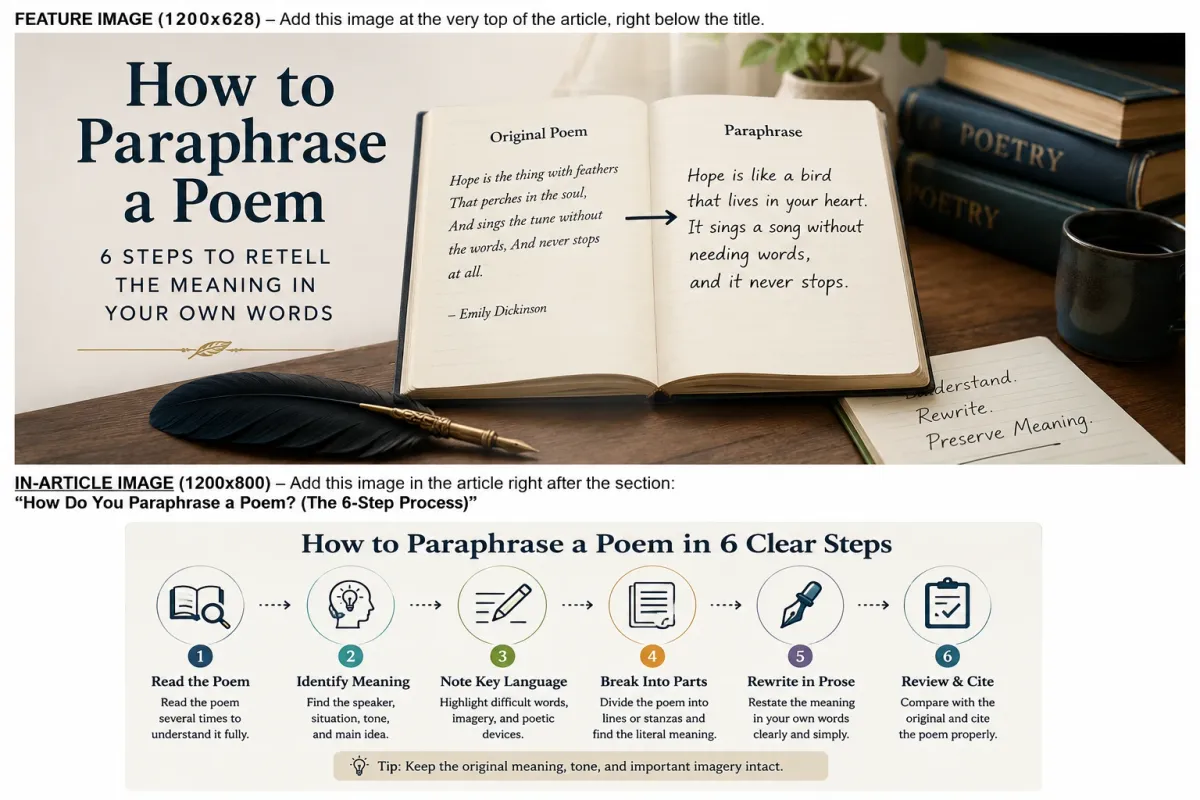
To paraphrase a poem, first identify its literal meaning, speaker, tone, and important imagery. Then rewrite each line or stanza in clear prose using different words and sentence structures. Preserve the poem’s original ideas, point of view, and sequence, but do not try to copy its rhyme or exact phrasing. Finally, compare your paraphrase with the original and cite the poem when required.
The goal of paraphrasing a poem is not to make it shorter or explain every hidden meaning. It is to express what the poem says in language that is easier to understand.
Quick Summary
Here is how to paraphrase poetry effectively:
- Read the poem several times.
- Identify the speaker, situation, and main idea.
- Mark difficult words and figurative language.
- Divide the poem into lines or stanzas.
- Rewrite the literal meaning in clear prose.
- Compare your version with the original and cite the source.
Once you understand the poem yourself, you can use an AI paraphrase tool to explore clearer wording. Always review the output to confirm that the tool has not changed the poem’s meaning.
What Does It Mean to Paraphrase a Poem?
To paraphrase a poem means to restate its ideas in your own words while preserving its original meaning.
A formal poem paraphrase is normally written in straightforward prose rather than verse. It removes difficult syntax, unusual word order, and unfamiliar vocabulary so the reader can understand what is happening.
A poetic paraphrase may sometimes refer to rewriting a poem in another poetic form. However, in most school and college assignments, the expected task is a prose paraphrase that explains the poem’s literal content without turning it into a full interpretation.
Academic poetry guidance describes formal paraphrasing as a way to expose difficult language and syntax while remaining faithful to the poem’s movement and proportions.
What Does Paraphrase Mean in Poetry?
In poetry, paraphrasing means translating compressed or figurative language into clearer everyday language.
For example, a poet may describe anger as a tree that grows when it is watered. A paraphrase should explain that image in plain language: suppressed anger becomes stronger when someone continues to feed it with fear, resentment, and dishonest behavior.
The paraphrase explains what the metaphor communicates. It does not simply replace “tree” with another noun.
Paraphrasing vs. Summarizing vs. Analyzing a Poem
These three tasks are related, but they are not interchangeable.
A paraphrase follows the original closely. A summary leaves out supporting details, while an analysis adds interpretation and explains why particular techniques matter.
Purdue OWL treats quoting, paraphrasing, and summarizing as separate methods of representing source material. A paraphrase restates a passage in new language, while a summary condenses a larger source into its main points.
How Do You Paraphrase a Poem?
The most reliable method is to understand the poem first and rewrite it second. Avoid looking at each word and searching for a synonym. Poetry depends heavily on context, imagery, speaker, and tone, so word-by-word replacement can easily distort the meaning.
1. Read the Poem More Than Once
Read the full poem without trying to rewrite anything.
During the first reading, identify the general situation:
- Who is speaking?
- Is the speaker addressing someone?
- What is happening?
- What feeling or conflict appears?
- Does the situation change?
On the second reading, underline words or lines you do not understand. Look for shifts in time, speaker, setting, or attitude.
Do not start paraphrasing until you can explain the basic situation in one or two sentences.
2. Identify Difficult Language and Poetic Devices
Poems often use:
- Metaphors
- Similes
- Symbols
- Personification
- Archaic words
- Inverted word order
- Ambiguous pronouns
- Compressed sentences
Your job is not necessarily to reproduce every device. Your job is to understand what it communicates.
Suppose a poem describes hope as a bird. A weak paraphrase might replace “bird” with “animal.” A better paraphrase would explain the underlying idea: hope remains present and continues to encourage people during difficult circumstances.
3. Divide the Poem Into Manageable Sections
Work one sentence, line group, or stanza at a time.
Poetic lines do not always function as complete sentences. A sentence may continue across several lines through enjambment. Follow the grammar and punctuation rather than assuming that every line expresses a separate idea.
For each section, write a brief note answering:
What is the speaker literally saying here?
This prevents you from getting distracted by rhyme and decorative language.
4. Rewrite the Literal Meaning in Plain Prose
Write the meaning without looking directly at the original line. This makes it easier to change both the vocabulary and the sentence structure.
A strong paraphrase should:
- Use your own phrasing.
- Preserve the original idea.
- Form complete, natural sentences.
- Explain unusual language clearly.
- Retain important details.
- Avoid copying distinctive phrases.
Do not just substitute individual words. Genuine paraphrasing normally requires restructuring the sentence as well as changing its vocabulary.
5. Preserve the Speaker, Tense, Tone, and Important Imagery
Check that your version has not accidentally changed:
- Speaker: “I” should not automatically become “the poet.”
- Point of view: Keep first, second, or third person consistent.
- Tense: Do not turn past events into present ones without a reason.
- Sequence: Preserve the order in which events occur.
- Tone: Do not make a serious poem sound humorous or a doubtful speaker sound certain.
- Imagery: Explain images that carry important meaning instead of deleting them.
You can simplify the language without flattening the poem’s emotional direction.
6. Compare, Revise, and Cite the Poem
Place your paraphrase beside the original and review them line by line.
Ask:
- Did I preserve every important idea?
- Did I add an interpretation the poem does not directly state?
- Is the wording and sentence structure sufficiently different?
- Did I change the speaker or tense?
- Did I remove a meaningful image?
- Did I retain any exact phrases that need quotation marks?
Purdue OWL recommends reading until you understand the source, writing the paraphrase separately, comparing it with the original, marking any exact borrowed wording, and recording the source for citation.
Poem Paraphrasing Example
Consider the opening of William Blake’s public-domain poem “A Poison Tree”:
“I was angry with my friend: I told my wrath, my wrath did end.”
The poem appears in Blake’s Songs of Innocence and of Experience, first published as a combined collection in 1794.
Later, Blake develops a metaphor in which concealed anger grows like a tree. A suitable paraphrase would explain that the speaker hides resentment toward an enemy and deliberately strengthens it through fear, sadness, and false friendliness.
That is different from analysis. An analysis might discuss why Blake uses a growing tree or what the poisonous fruit symbolizes. The paraphrase should first establish what is literally happening.
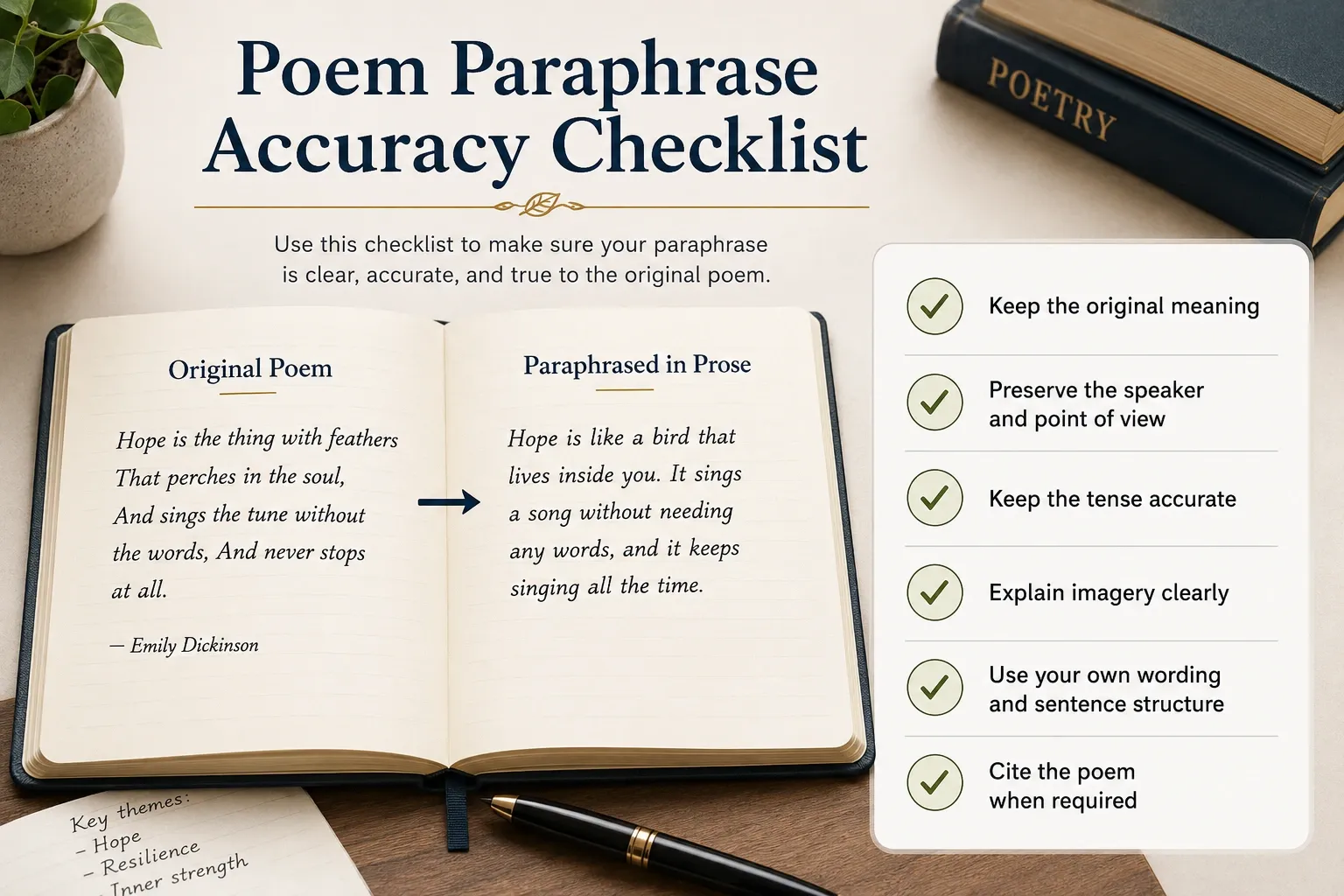
Poem Paraphrase Accuracy Checklist
Before submitting your work, verify the following:
- The central meaning remains unchanged.
- The same speaker and point of view are preserved.
- The original tense and sequence remain accurate.
- Figurative language has been understood rather than randomly replaced.
- Important emotional and visual details remain present.
- The wording and sentence structure are genuinely different.
- No unsupported interpretation has been added.
- The poet and source are credited when required.
If your version is considerably shorter than the poem, you may have written a summary instead of a paraphrase.
How to Use an AI Tool When Paraphrasing a Poem
An AI tool can suggest simpler wording, but it should come after your own reading of the poem.
Use this workflow:
- Read and annotate the stanza yourself.
- Write down its literal meaning.
- Paste one short section into the tool.
- Choose a mode suited to your assignment.
- Compare the result with the original.
- Restore any meaning, imagery, or tone the tool removed.
- Add the required citation.
HumanizeAI’s Paraphrase Tool currently offers Standard, Fluency, Creative, Formal, Academic, Simple, Expand, and Shorten modes. Its product guidance also recommends reviewing and editing the generated result.
For a poem, Simple can help clarify difficult wording, while Academic may produce a more formal prose version. However, the tool should not be trusted to interpret ambiguous symbolism automatically.
Students exploring other options can review the best AI paraphrasing tools or the broader guide to AI tools for students. HumanizeAI also provides guidance on how to use AI for writing as part of a reviewed, responsible workflow.
For a comparison of two common writing assistants, see Grammarly vs. QuillBot.
Common Mistakes When Paraphrasing a Poem
Replacing Every Word With a Synonym
Poetic meaning depends on the complete image and context. Synonym replacement can create awkward or inaccurate sentences.
Writing a Summary Instead
A summary gives the main message. A paraphrase retains the original sequence and level of detail.
Adding Too Much Interpretation
A paraphrase should explain what the poem says. Claims about symbolism, historical context, or the poet’s intentions belong in analysis unless the assignment requests them.
Changing the Speaker
The speaker is not always identical to the poet. Preserve “I,” “we,” or “you” unless you have a clear reason to change the perspective.
Trying to Preserve the Rhyme
Academic paraphrases are usually written in prose. Forcing the new version to rhyme may cause you to change or omit important ideas.
Forgetting the Citation
Using your own words does not make the underlying ideas your own. APA Style instructs writers to cite the original work when paraphrasing it.
Accepting an AI Rewrite Without Reviewing It
A fluent sentence can still be inaccurate. Always compare generated wording against the poem yourself.
Key Takeaways
- To paraphrase a poem means to restate its meaning in your own words.
- A strong paraphrase usually preserves approximately the same level of detail.
- Read and understand the poem before rewriting it.
- Explain figurative language instead of replacing isolated words.
- Preserve the speaker, tense, sequence, tone, and essential imagery.
- Do not confuse paraphrasing with summarizing or literary analysis.
- Cite the original poem when required.
- Use AI tools for alternative wording, not as a substitute for interpretation.
Frequently Asked Questions
What does it mean to paraphrase a poem?
It means rewriting the poem’s ideas in clearer language while preserving its meaning, speaker, details, and sequence. In most academic assignments, the result is written in prose rather than verse.
How do you paraphrase a poem without changing its meaning?
First determine the literal meaning of each sentence or stanza. Then rewrite it using different vocabulary and sentence structures. Compare both versions to ensure that the same events, emotions, relationships, and images remain present.
Should a poetic paraphrase still rhyme?
Not usually. A formal academic paraphrase prioritizes meaning and clarity. Trying to reproduce the rhyme can force you to distort the original ideas.
How long should a poem paraphrase be?
It is normally similar in level of detail to the part of the poem being rewritten. It may be slightly longer when difficult metaphors or syntax need explanation. A much shorter version is more likely to be a summary.
Do you have to cite a paraphrased poem?
Yes, when the poem is being used as a source in academic writing. Paraphrasing changes the language, but the underlying ideas still belong to the original poet. Follow the citation style required by your instructor.
Can an AI tool paraphrase poetry accurately?
It can suggest clearer vocabulary and alternative sentence structures, but it may misunderstand ambiguity, symbolism, speaker, or tone. The user must compare the output with the original and correct any changes in meaning.
Final Thoughts
Learning how to paraphrase poetry begins with careful reading, not automatic rewriting. Understand the poem’s literal content, divide it into manageable sections, rewrite each section in natural prose, and check that the speaker, tone, imagery, and meaning remain accurate.
After completing that work, try the HumanizeAI Paraphrase Tool to explore clearer alternatives. Treat the output as a draft, review it against the original poem, and make the final decisions yourself.