Paraphrase vs. Quotation: What Is the Difference?
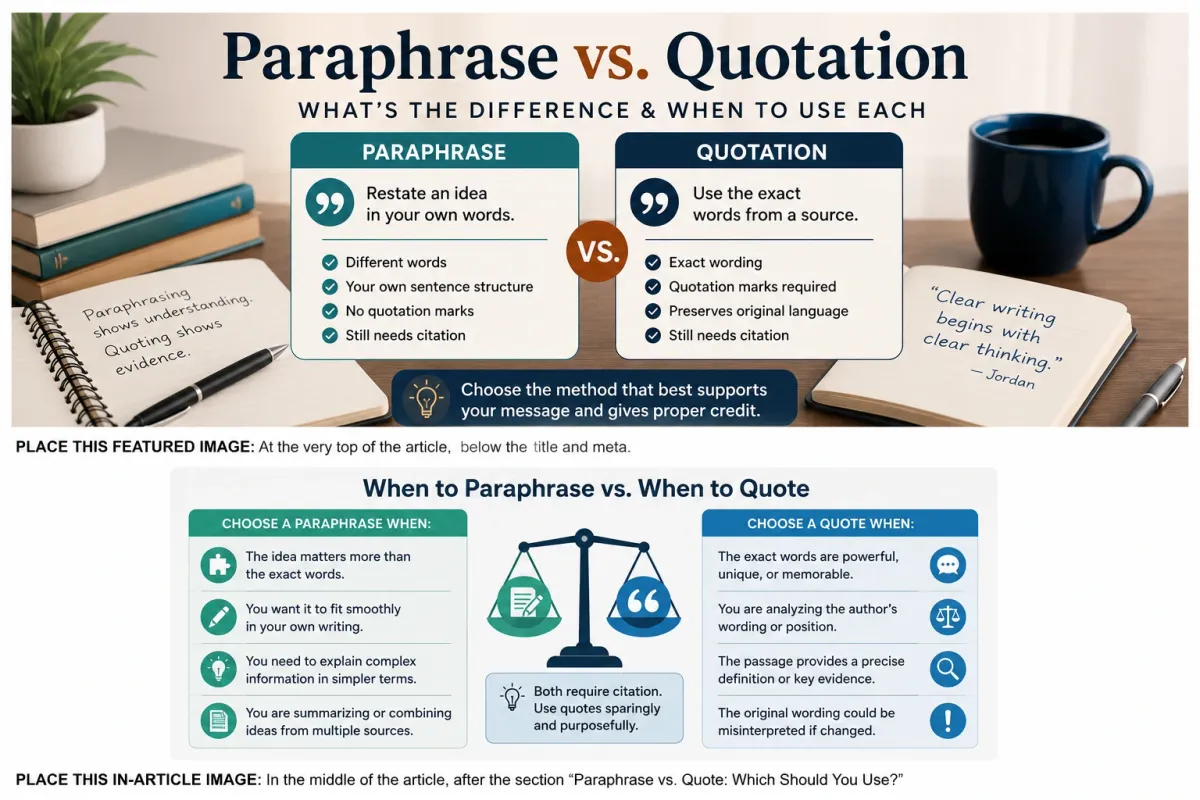
The main difference between a paraphrase and a quotation is the language you use. A quotation reproduces a source’s exact words and normally places them inside quotation marks. A paraphrase restates the source’s idea using genuinely different wording and sentence structure.
Both methods require attribution because the underlying words or ideas came from another source. However, you generally do not use quotation marks around a complete paraphrase because the wording is your own. Quotation marks are required when you retain exact words or distinctive phrases from the original.
Quick Answer
Use a quotation when the author’s exact language is important. Use a paraphrase when the idea matters more than the original wording and you want it to fit naturally into your own explanation.
What Is a Quotation?
A quotation uses the exact words found in a source. The wording, spelling, and meaning must accurately represent the original passage.
A short quotation is normally:
- Introduced with context.
- Placed inside quotation marks.
- Followed by an in-text citation.
- Copied accurately from the source.
For example:
Lopez argues that “clear writing begins with clear thinking” (42).
The quoted words must match the source exactly. Academic integrity guidance from the University of Virginia states that exact words, phrases, or sentences must be placed inside quotation marks—or formatted as a block quotation when appropriate—and properly cited.
Longer passages may be formatted as block quotations according to the required citation style. In that case, the indentation signals that the passage is quoted, so quotation marks may not be used around the block.
What Is a Paraphrase?
A paraphrase communicates another author’s idea using your own vocabulary and sentence structure while preserving the original meaning.
Purdue OWL defines paraphrasing as putting source material into your own words and emphasizes that a paraphrase must still be attributed to the original source.
A proper paraphrase involves more than replacing a few words with synonyms. You may need to:
- Change the sentence structure.
- Reorganize the information.
- Combine or separate sentences.
- Replace technical language when appropriate.
- Preserve important qualifications.
- Maintain the original meaning and level of detail.
Harvard’s source-use guidance explains that a paraphrase generally retains approximately the same level of detail as the source, while a summary condenses the material into a shorter overview.
Paraphrase vs. Quotation: Key Differences
The easiest way to understand paraphrase vs. quotation is to compare their wording, purpose, format, and use.
The University of Wisconsin–Madison Writing Center advises writers to use direct quotations for a clear reason and notes that most of a paper should generally remain in the writer’s own words.
Paraphrase vs. Quote: Which Should You Use?
Choose between a paraphrase vs. quote based on what the source contributes to your argument.
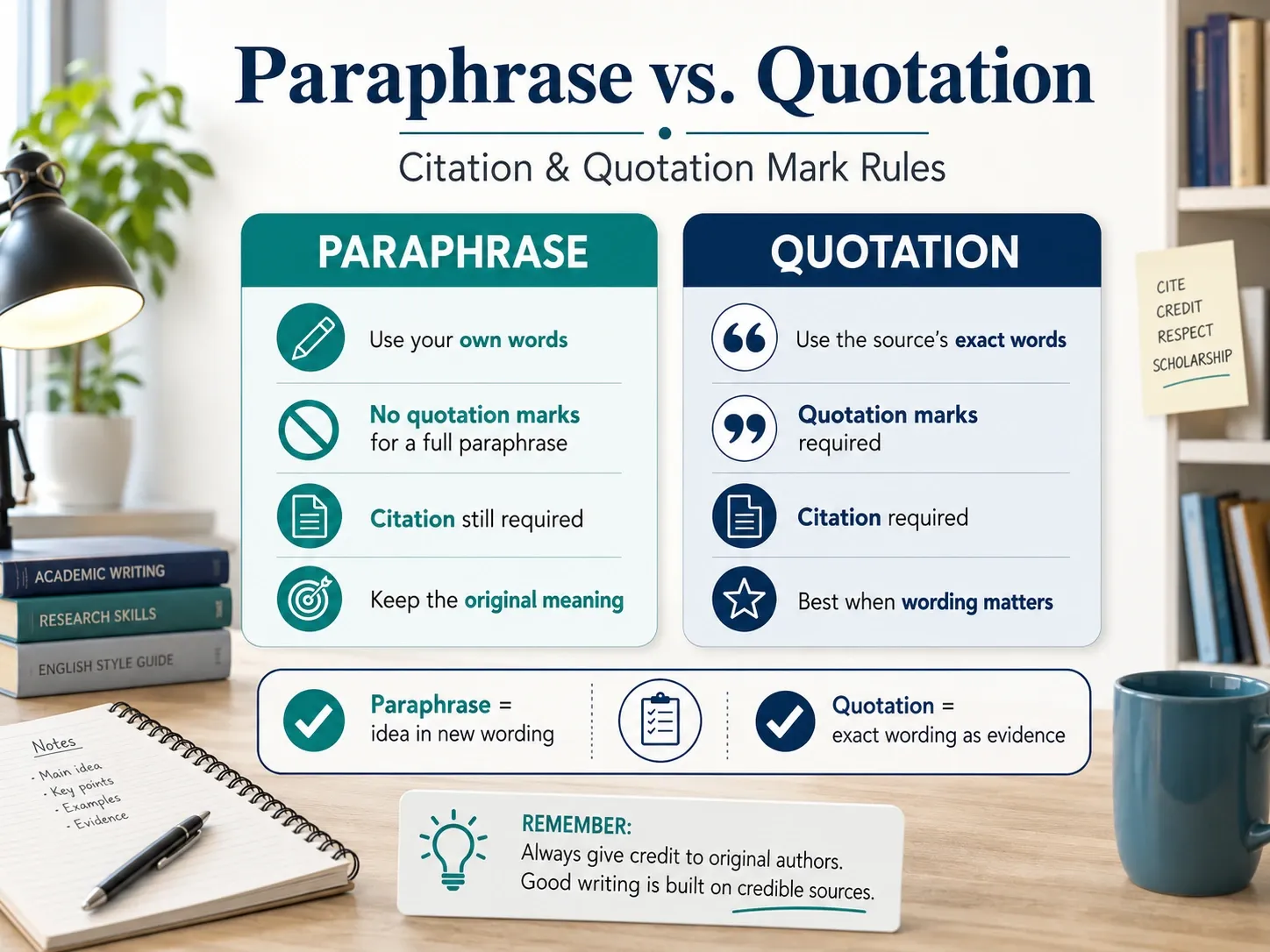
Use a Quotation When the Exact Words Matter
A quotation may be the better choice when:
- The author uses a memorable or distinctive phrase.
- You need to analyze the author’s wording.
- The passage provides a precise definition.
- The source presents a disputed statement.
- Changing the language could weaken its meaning.
- You are discussing literary dialogue, legal wording, or historical language.
For example, a literature paper may quote a sentence because its imagery, word choice, or rhythm is the subject of the analysis. Rewriting it would remove the evidence you intend to discuss.
A research paper may also quote a carefully worded definition when preserving the terminology is necessary.
Use a Paraphrase When the Idea Matters More
Paraphrasing is usually more effective when:
- You need to explain a complex idea clearly.
- The source’s wording is technical or difficult.
- You want the evidence to fit your writing style.
- You are combining findings from several sources.
- The original sentence is longer than necessary.
- You want to demonstrate your understanding.
Newcastle University’s academic guidance explains that paraphrasing expresses a source’s contents in your own words: the ideas remain someone else’s and still require a reference, but the wording is yours and therefore does not require quotation marks.
Do You Use Quote Marks When Paraphrasing?
No, you normally do not use quote marks when paraphrasing an entire passage correctly. Quotation marks indicate that the enclosed language was copied directly from a source. A genuine paraphrase uses your own language.
You still need to cite the original author because the idea came from that source.
Example Without Quotation Marks
Original source:
Regular physical activity can improve sleep quality and reduce symptoms of anxiety.
Correct paraphrase:
Consistent exercise may help people sleep better and experience fewer symptoms associated with anxiety (Author, Year).
The paraphrase does not need quotation marks because the sentence has been restructured and rewritten. It still needs a citation because the claim came from the original source.
When a Paraphrase Contains Exact Words
Sometimes you may paraphrase most of a passage but retain a distinctive term or short phrase from the source. In that case, place quotation marks around only the borrowed words.
Example:
The researcher describes attention as a “limited cognitive resource” that must be managed carefully (Author, Year, p. 12).
The rest of the sentence may be your paraphrase, but the distinctive phrase remains a direct quotation.
Do You Cite a Paraphrase?
Yes. A paraphrase requires a citation because changing the words does not transfer ownership of the underlying idea to you.
The citation tells readers:
- Who originally presented the idea.
- Where they can locate the source.
- Which evidence supports your statement.
- Which parts of the discussion are based on research rather than your own conclusions.
The exact citation format depends on whether you are using APA, MLA, Chicago, or another style. Direct quotations often require more specific location information, such as a page number, while paraphrase-location requirements can vary by style and assignment. Always follow your instructor’s or publisher’s rules.
Paraphrase vs. Quotation Examples
Consider this fictional source sentence:
Students improve their research skills when they evaluate evidence instead of accepting the first available answer.
Direct Quotation
According to Jordan, “students improve their research skills when they evaluate evidence instead of accepting the first available answer” (27).
This version preserves the original words and places them inside quotation marks.
Paraphrase
Students become stronger researchers when they assess the reliability of evidence rather than relying immediately on the first result they find (Jordan 27).
This version changes both the vocabulary and the sentence structure while preserving the original meaning.
Inadequate Paraphrase
Students improve their researching abilities when they evaluate proof rather than accepting the first answer available (Jordan 27).
This version is too close to the source. It changes isolated words but preserves most of the original structure and phrasing.
Summary
Jordan argues that evaluating sources strengthens students’ research abilities.
The summary retains only the central point and removes most of the original detail.
How to Paraphrase a Source Correctly
A dependable paraphrasing process helps you avoid accidental copying and changes in meaning.
1. Read Until You Understand the Passage
Do not rewrite a sentence you do not understand. Identify the main claim, supporting details, limitations, and relationships between ideas.
2. Look Away From the Original
After reading the passage, temporarily close or hide it. Explain the idea as though you were describing it to someone else.
This reduces the likelihood of copying the source’s sentence structure.
3. Rewrite the Meaning
Change more than individual words. Restructure the sentence, adjust the order of information, and use language that matches the surrounding article or paper.
4. Compare Both Versions
Review the original and your paraphrase together. Confirm that you have:
- Preserved the meaning.
- Included important qualifications.
- Avoided copying distinctive phrases.
- Changed the sentence structure.
- Avoided adding unsupported claims.
5. Cite the Source
Add an in-text citation and include the full source in the required reference list or bibliography.
Purdue OWL recommends reading until the source is understood, writing the paraphrase separately, comparing it with the original, marking any exact borrowed wording, and recording the source.
For drafting assistance, HumanizeAI’s AI paraphrase tool can suggest alternative wording and sentence structures. Treat the output as an editable draft: compare it with the original, verify that the meaning remains accurate, and add the appropriate citation.
Common Mistakes With Quotations and Paraphrases
Using Quotation Marks but No Citation
Quotation marks show that language was copied, but they do not identify the source. A direct quotation still needs attribution.
Citing a Passage but Copying It Without Quotation Marks
A citation alone does not turn copied wording into a paraphrase. Exact language must be quoted properly.
Changing Only a Few Words
Replacing a handful of terms with synonyms usually creates patchwriting rather than an independent paraphrase.
Changing the Meaning
A polished paraphrase is still incorrect if it removes an important condition, reverses the claim, or adds a conclusion the author did not make.
Quoting Too Often
A paper dominated by quotations may feel disconnected and may not demonstrate sufficient understanding. Use direct quotations selectively and explain why each quotation matters.
Failing to Introduce the Source
Do not drop a quotation into a paragraph without context. Identify the source, explain the relevance, and connect the evidence to your argument.
Trusting an AI Rewrite Without Reviewing It
AI tools can produce fluent alternatives, but fluency does not guarantee accuracy. Review every output for meaning, attribution, tone, and source-specific terminology.
Readers comparing software can review the best AI paraphrasing tools. Students can also consult HumanizeAI’s guide to AI tools for students and its recommendations for using AI for writing responsibly.
A Simple Decision Framework
Use this four-question test when deciding whether to quote or paraphrase:
- Is the exact language the evidence? Quote it.
- Would changing the wording reduce precision or impact? Consider quoting it.
- Is the idea more important than the sentence itself? Paraphrase it.
- Can you explain the idea accurately in your own voice? Paraphrase and cite it.
The goal is not to eliminate quotations or paraphrases. It is to choose the format that best supports the reader and the purpose of your writing.
Key Takeaways
- A quotation uses the exact words of a source.
- A paraphrase communicates the source’s idea in your own language.
- Short direct quotations normally require quotation marks.
- Complete paraphrases normally do not use quotation marks.
- Both quotations and paraphrases require citations.
- Paraphrasing involves changing the sentence structure, not just replacing words.
- Quote when exact language matters; paraphrase when the idea matters more.
- Review tool-generated paraphrases before using them.
Frequently Asked Questions
What is the main difference between a paraphrase and a quotation?
A quotation reproduces the source’s exact language, while a paraphrase restates the source’s meaning using different words and sentence structures. Both require attribution.
Do you use quote marks when paraphrasing?
No, quotation marks are not normally placed around a complete paraphrase because the wording is your own. Use quotation marks only around exact words or phrases retained from the original source.
Do you need to cite a paraphrase?
Yes. The wording may be yours, but the idea came from another author. The source must still be identified through the appropriate citation.
Is paraphrasing better than quoting?
Neither method is automatically better. Paraphrasing is often preferable when you need to integrate an idea smoothly, while quoting is more useful when the author’s exact words are important.
Can a paraphrase be shorter than the original?
It can be slightly shorter, but it usually preserves approximately the same level of detail. A significantly shorter restatement is more accurately described as a summary.
Is changing a few words enough to paraphrase?
No. An effective paraphrase changes both vocabulary and sentence structure while maintaining the original meaning. Minor synonym replacement can remain too close to the source.
Can I use a paraphrasing tool for academic writing?
A tool can help you explore alternative wording, but you remain responsible for accuracy, citation, and compliance with your institution’s academic-integrity rules. Review the output and ensure you understand the source before using it.
Final Thoughts
Understanding paraphrase vs. quotation helps you use evidence accurately and maintain a consistent writing voice. Quote a source when its exact language deserves attention. Paraphrase when you need to communicate the idea clearly in your own style.
Whichever method you choose, preserve the source’s meaning and provide proper attribution. To explore alternative wording after understanding the source, try the HumanizeAI Paraphrase Tool and manually review the result before publishing or submitting it.