How to Use AI for Writing?
The process of writing has experienced a fundamental transformation because of artificial intelligence, which works without making any noise. The process which used to take several hours for brainstorming and drafting, and rewriting, and editing now starts quickly through AI writing tool assistance. AI functions as an effective writing tool which helps people and businesses create blog content, and marketing materials, and email communications, and reports, and educational content that exceeds basic length requirements.
However, knowing how to use AI for writing correctly is what separates high-quality, helpful content from generic, low-value text. AI does not replace human creativity, experience, or judgment. The writing process becomes more efficient through this tool. It produces better results when users employ it correctly.
The guide presents step-by-step instructions for using AI to create written content and demonstrates its application to various content formats and shows how to prevent typical errors while maintaining your content's genuine nature, and dependable quality, and search engine optimization safety.
What Is AI Writing and How Does It Actually Work?
AI writing refers to the use of artificial intelligence models trained on massive amounts of text data to generate human-like language. These systems analyze patterns in words, sentences, and structure to predict what text should come next based on a prompt.
AI does not understand meaning in the way humans do. It lacks awareness, opinions, or real-world experience. The system operates through a probabilistic approach, which selects words and phrases that most likely match the given context. AI writing generates smooth and assured text because it does not encounter mistakes or missing content.
What AI Writing Tools Are Good At
AI writing tools excel at:
- Creating first drafts quickly
- Structuring long-form content
- Rewriting or expanding ideas
- Improving grammar and readability
- Generating outlines, headlines, and summaries
These strengths make AI ideal for accelerating the writing workflow.
Where AI Writing Falls Short
AI struggles with:
- Original insights based on lived experience
- Deep subject-matter expertise
- Fact verification and real-time accuracy
- Emotional nuance and intent
This is why human review and editing are essential.
Why Use AI for Writing Content?
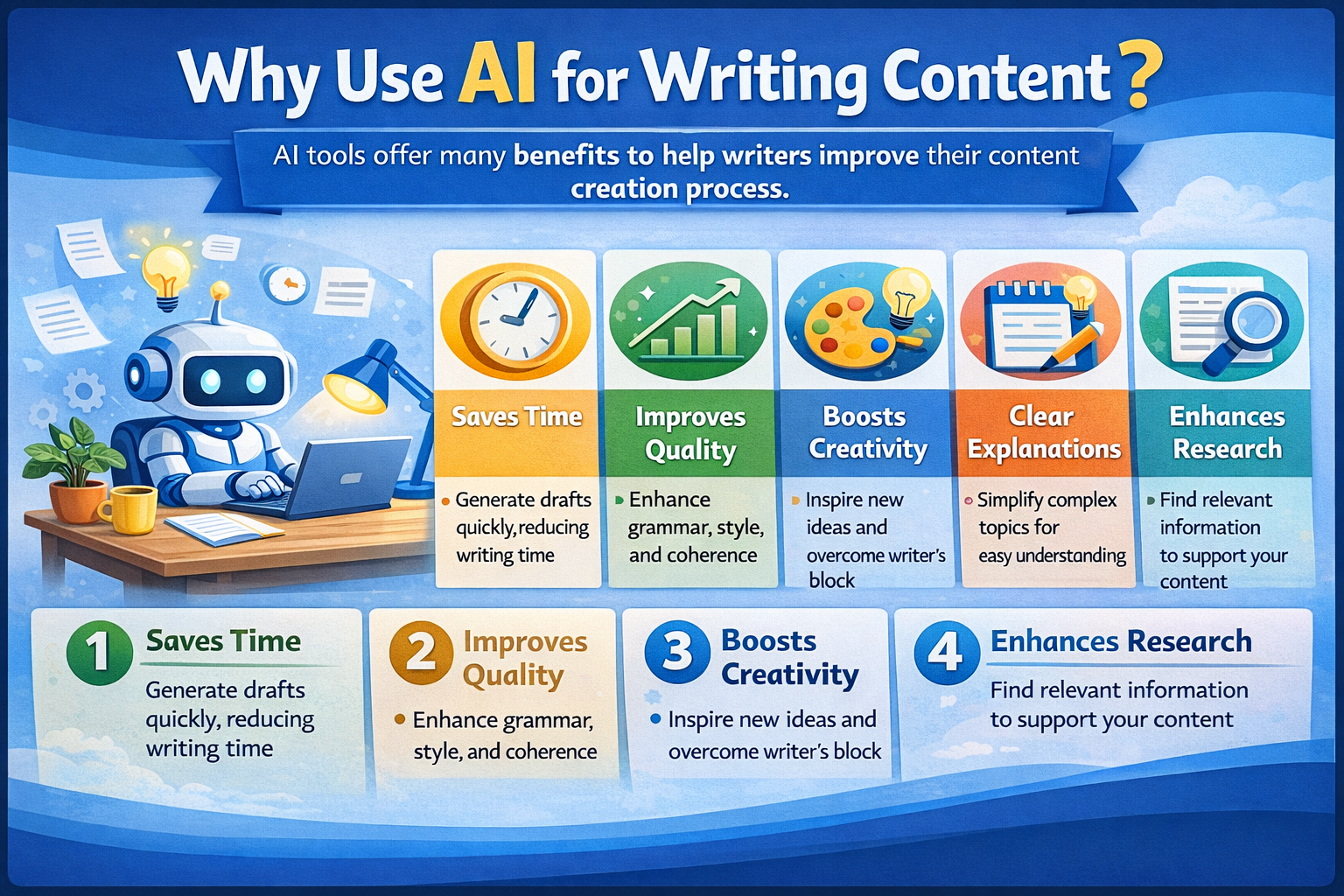
One of the main reasons people use AI for writing is speed. AI reduces the time spent starting from scratch. Instead of staring at a blank page, writers begin with a structured draft that can be refined.
This speed advantage is especially useful for long-form content, where structure and flow matter as much as ideas.
AI helps overcome writer’s block by generating ideas, transitions, and alternative phrasings. This allows writers to stay focused on improving content rather than forcing creativity.
AI naturally organizes content into logical sections. This makes articles easier to read, skim, and understand, important for both users and search engines.
For businesses producing content at scale, AI helps maintain consistency across tone, format, and messaging while reducing workload.
How to Use AI for Writing Step by Step
Step 1: Define the Purpose of Your Content
Start by clearly identifying what you are writing and why. Is the goal to inform, persuade, or educate? Knowing the audience and intent helps AI produce relevant content.
Step 2: Write a Clear and Detailed Prompt
The quality of AI output depends heavily on the prompt. Include the topic, tone, target audience, length, and format. Clear instructions reduce vague or repetitive responses.
Step 3: Generate an Outline Before Writing
Ask AI to create an outline first. This ensures logical flow and complete topic coverage. Review and adjust the outline before expanding sections.
Step 4: Expand Each Section Individually
Generate content one section at a time. This produces more detailed and focused writing than generating the entire article at once.
Step 5: Edit, Refine, and Humanize
Review the content for clarity, accuracy, and tone. Add personal insights, examples, and real-world context. This step transforms AI-generated drafts into valuable content.
How to Use AI for Blog Writing and Long-Form Content
AI can be effectively used for blog writing and long-form content when it supports structure, depth, and clarity rather than replacing human expertise. The most successful AI-assisted blogs follow a guided workflow where AI helps with outlining, drafting, and organization, while humans add insight, experience, and final refinement. This approach improves writing speed without sacrificing originality, accuracy, or search performance.
For long-form content, AI is most valuable in the early stages of content creation. It helps identify logical topic flow, ensures comprehensive coverage, and reduces the cognitive load of drafting large sections of text. However, AI-generated content must always be reviewed and edited to meet quality, EEAT, and SEO standards. When used correctly, AI helps writers produce detailed, user-focused blog content that aligns with search intent and ranks competitively.
1. Creating Blog Outlines With AI
AI is especially effective at generating structured blog outlines because it identifies common topic patterns and related subtopics associated with a search query. A strong AI-generated outline helps ensure that all key points are covered, content gaps are avoided, and the article aligns with user intent. This improves both readability and SEO performance.
However, AI outlines should not be used without review. Writers should refine headings, reorder sections for better flow, and add missing angles based on audience needs or industry expertise. A human-reviewed outline acts as a roadmap for the article, making long-form content easier to write, easier to read, and more likely to satisfy search engines and users alike.
2. Writing Detailed Sections With AI Support
Instead of generating an entire blog post in a single prompt, AI should be used to write content one section at a time. Section-based generation allows AI to stay focused on specific subtopics, resulting in clearer explanations and more detailed coverage. This method also reduces repetition, which is common in long AI outputs.
Each section should be prompted with clear instructions about depth, tone, and purpose. After generation, writers should refine the content to improve clarity, add context, and ensure consistency across the article. Writing section by section improves content quality, enhances topical relevance, and makes long-form blog posts more useful for readers and search engines.
3. Adding Expertise and Originality
AI-generated content lacks real-world experience, personal insight, and expert judgment. To meet EEAT standards, writers must add original value by including examples, practical explanations, opinions, or industry-specific knowledge. This human input transforms generic AI drafts into authoritative and trustworthy content.
Search engines prioritize content that demonstrates experience and usefulness. Adding originality not only improves rankings but also increases reader engagement and credibility. When AI is used to support drafting and humans contribute expertise, the content becomes both scalable and high-quality.
4. Final Editing for Readability and SEO
Human editing is essential for making AI-generated blog content readable, natural, and SEO-friendly. Editing improves sentence flow, removes repetitive phrasing, and ensures transitions between sections are smooth. It also helps adjust tone so the content feels conversational and human rather than automated.
From an SEO perspective, final editing ensures keywords are placed naturally, headings are clear, and internal links are logically integrated. Well-edited AI-assisted blogs meet search quality guidelines, satisfy user intent, and are more likely to perform well in organic search results.
How to Use AI for Marketing and Business Writing
AI is widely used in marketing and business writing to increase efficiency, maintain consistency, and speed up content production. It supports tasks such as drafting emails, creating ad copy, writing landing pages, and generating social media content. When combined with human strategy and brand oversight, AI improves productivity without compromising quality.
1. Generating Marketing Drafts Quickly
AI enables marketers to create initial drafts for emails, advertisements, landing pages, and social media posts in a short amount of time. This allows teams to move faster and focus on refining messaging rather than starting from scratch.
These drafts should be reviewed and adjusted to align with campaign goals and audience expectations. AI speeds up execution, but humans ensure relevance and impact.
2. Refining Brand Voice and Messaging
AI-generated marketing content often requires refinement to match a brand’s voice and tone. Writers should adjust language, emotional appeal, and phrasing to ensure consistency across all communication channels.
Brand-aligned messaging builds trust and recognition, which AI alone cannot achieve. Human refinement ensures the content feels authentic and intentional.
3. Creating Multiple Variations for Testing
AI is particularly effective at generating multiple versions of headlines, calls to action, and ad copy. This supports faster A/B testing and message optimization.
By testing different variations, marketers can identify what resonates best with their audience and improve performance over time. AI enables experimentation, while humans analyze results and guide strategy.
4. Combining Strategy With Automation
AI supports content execution, but strategic decisions must remain human-led. Audience targeting, positioning, and messaging priorities require insight and judgment.
The most effective marketing workflows combine AI-driven automation with human creativity and strategic oversight, ensuring content remains purposeful and persuasive.
How to Use AI for Academic and Professional Writing
AI can assist academic and professional writing by improving clarity, organization, and efficiency. However, it must be used responsibly to maintain accuracy, integrity, and ethical standards.
1. Improving Clarity and Structure
AI helps simplify complex language, reorganize ideas, and improve readability in professional documents. This is particularly useful for reports, presentations, and formal communication where clarity is essential.
2. Ethical Use of AI in Academic Work
AI should not replace original research, analysis, or critical thinking. Its role should be limited to drafting assistance, rewriting, or summarization, with full responsibility remaining with the writer.
3. Fact-Checking and Accuracy
Accuracy is critical in academic and professional writing. All AI-generated information must be verified before use to avoid errors and misinformation.
4. Responsible AI Collaboration
When used responsibly, AI enhances productivity while preserving credibility and trust. The most effective approach is collaboration, AI handles efficiency, while humans ensure accuracy, originality, and ethical compliance.
How to Choose the Right AI Writing Tool
1. Identify Your Writing Goal First
Before selecting a tool, clarify whether you need help with blogs, marketing copy, academic writing, or SEO content. Different tools are optimized for different tasks.
2. Features to Look For in an AI Writing Tool
Good AI writing tools allow control over tone, length, and audience. They should support outlines, revisions, and section-based writing rather than forcing one-click automation.
3. Avoid Fully Automated Publishing Tools
Tools that promise fully automated content publishing often sacrifice quality. The best tools encourage collaboration between AI and human writers, not replacement.
4. Match the Tool to the Task
Using the right tool for the right purpose improves both content quality and workflow efficiency. Treat AI as a flexible assistant, not a one-size-fits-all solution.
Best Practices for Using AI Writing Tools Effectively
- Treat AI Output as a Draft: Never publish AI-generated content without editing. Use it as a foundation, not a final product.
- Focus on User Value: Content should answer real questions and solve real problems. Avoid writing solely for search engines.
- Maintain Original Voice and Perspective: Your experience, tone, and insight make the content unique. AI should enhance, not replace, your voice.
- Regularly Review and Improve Prompts: Better prompts lead to better results. Refining prompts is a key skill for effective AI writing.
Is AI-Written Content Safe for SEO?
AI-written content is safe for SEO when it is created and published responsibly. Search engines do not penalize content simply because AI was used in the writing process. Instead, they evaluate content based on quality signals such as usefulness, originality, relevance to search intent, accuracy, and overall user experience. If AI-assisted content genuinely answers user questions, provides clear value, and is easy to read, it can perform just as well as human-written content in search results.
Problems arise when AI-generated content is published without human editing. Thin, repetitive, or overly generic AI content can fail to meet search quality standards, leading to poor rankings. This usually happens when content is created only for keyword targeting rather than to help users. To be SEO-safe, AI-written content should always be reviewed, fact-checked, expanded with original insights, and refined to match natural language patterns.
When AI is used as a writing assistant, helping with structure, drafts, and clarity—while humans add expertise, context, and originality, the content aligns well with SEO best practices. In short, AI does not harm SEO on its own; low-quality content does. Combining AI efficiency with human judgment is the safest and most effective approach for long-term search performance.
How to Make AI Content Rank
To make AI content rank in search engines, the focus must always be on quality, relevance, and user intent rather than on the tool used to create it. Search engines prioritize content that clearly answers user questions, provides practical value, and demonstrates expertise. AI-generated drafts should be treated as a starting point and refined by humans to ensure depth, accuracy, and originality. This includes expanding explanations, adding real-world examples, and ensuring the content fully satisfies the search intent behind the keyword.
Human editing plays a critical role in SEO performance. AI content should be reviewed to remove repetition, improve sentence flow, and ensure natural keyword placement. Keywords and related terms should be used contextually rather than forced into the text. Well-structured headings, logical content flow, and clear internal linking also help search engines understand the topic better and improve crawlability.
Accuracy and trust are equally important. Fact-checking all claims, updating outdated information, and writing in a clear, authoritative tone help build credibility. When AI content is helpful, well-edited, and written for real users, not just algorithms, it aligns with modern SEO guidelines and can rank competitively over the long term.
The Future of AI in Writing
The future of AI in writing is not about replacing human writers but about strengthening human creativity and efficiency. As AI models become more advanced, they will continue to improve at understanding context, tone, and user intent. This will allow writers to generate more accurate drafts, clearer structures, and better-aligned content for different audiences and platforms. AI will increasingly handle repetitive and time-consuming tasks such as outlining, rewriting, formatting, and language optimization, giving writers more time to focus on strategy, storytelling, and original thinking.
At the same time, human involvement will remain essential. Search engines and readers both value authenticity, experience, and trust, qualities AI cannot fully replicate. Writers who learn how to collaborate with AI, rather than rely on it blindly, will have a clear advantage. The most successful content in the future will be created through a hybrid approach, where AI supports productivity and humans provide insight, judgment, and emotional connection. In this sense, AI will evolve into a long-term writing partner rather than a replacement.
Conclusion
AI has become a powerful tool for modern writing, but its effectiveness depends entirely on how it is used. When applied thoughtfully, AI helps writers create content faster, organize ideas more clearly, and overcome common challenges like writer’s block and time constraints. However, AI-generated content should never be treated as a finished product. Human editing, fact-checking, and personalization are essential to ensure accuracy, originality, and value.
The best results come from combining AI efficiency with human expertise. By using AI as a writing assistant rather than a shortcut, writers can produce high-quality, user-focused content that performs well in search engines and builds long-term trust with readers. As AI continues to evolve, those who master this balance will be best positioned to create content that is not only visible but genuinely useful and credible.
Frequently Asked Questions
1. Can AI be used for professional writing?
Yes, AI can assist with professional writing by improving clarity, structure, and efficiency, but human review is essential.
2. Is AI writing considered plagiarism?
AI writing is not plagiarism by default, but content should always be edited and customized to ensure originality.
3. Does Google allow AI-written content?
Google allows AI-assisted content as long as it is helpful, accurate, and written for users.
4. How do I make AI content sound human?
Edit sentence flow, add personal insights, vary structure, and remove repetitive phrasing.
5. Can beginners use AI for writing?
Yes, AI is especially helpful for beginners who need guidance with structure and clarity.