How to Humanize ChatGPT Content?
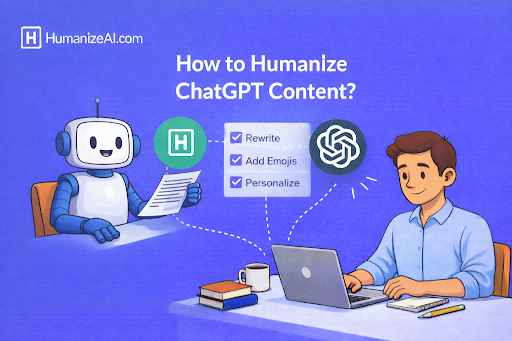
AI writing tools like ChatGPT have transformed how content is created. From blog posts and landing pages to emails and product descriptions, AI can generate content faster than ever. However, speed alone does not guarantee quality. Many AI-generated texts still feel robotic, generic, or emotionally flat, making them easy to detect and difficult for readers to trust.
Humanizing ChatGPT content means refining AI-generated text so it reads naturally, reflects real human intent, and connects with readers on a deeper level. This process is essential not only for better engagement but also for meeting modern SEO standards, user expectations, and Google’s emphasis on helpful, people-first content.
This guide explains what humanized AI content really means, why it matters, and how to transform ChatGPT output into content that feels authentic, credible, and human—while still benefiting from AI efficiency.
What Does “Humanizing AI Content” Really Mean?
Humanizing AI content is not about hiding the fact that AI was used. It’s about improving clarity, tone, intent, and emotional depth so the content feels written by a real person for real people.
AI-generated content often lacks lived experience, emotional nuance, and contextual awareness. Humanization fills those gaps.
Why Humanizing ChatGPT Content Is Important
As AI-generated content becomes more common, audiences are becoming more sensitive to how content sounds and feels. Humanization is no longer optional.
Improving Reader Trust and Engagement
Readers trust content that feels thoughtful and personal. When content sounds generic, readers disengage quickly. Humanized content encourages longer dwell time, deeper reading, and higher engagement.
Avoiding AI Detection and Content Flags
AI detection tools analyze patterns such as sentence uniformity, predictability, and vocabulary usage. Humanized content naturally breaks these patterns, reducing detectability without manipulation.
Enhancing Brand Voice and Authenticity
Brands rely on consistent tone and personality. Raw ChatGPT output rarely matches a brand’s voice. Humanization ensures alignment with brand values, tone, and audience expectations.
Supporting Google’s E-E-A-T Framework
Google prioritizes Experience, Expertise, Authoritativeness, and Trust. Humanized content:
- Demonstrates subject understanding
- Reflects practical insight
- Feels written with purpose
- Encourages credibility signals
Step-by-Step Process to Humanize ChatGPT Content
Humanizing AI content is a structured process, not a single edit. By following these steps, you can turn ChatGPT-generated text into content that feels natural, engaging, and human.
1. Start with Better Prompts
Humanization begins before the content is generated. A strong prompt sets the tone for more authentic output.
Key Actions:
- Add context, audience, and intent:
- Generic prompt:
“Write an article about AI writing.” - Humanized prompt:
“Write an article for content marketers explaining how to improve AI-written blog posts so they sound natural and engaging.” - Provides clarity and purpose, reducing robotic output.
- Generic prompt:
- Use prompt strategies to guide natural tone
- Ask for a conversational tone
- Specify audience experience level (novice, intermediate, expert)
- Request examples or explanations
- Encourage clarity over completeness
2. Adjust Tone and Voice Manually
Even the best AI prompts often need human editing to match your brand voice and style.
Checklist for Tone & Voice:
- Match brand personality
- SaaS, healthcare, and eCommerce brands require different tones.
- Maintain consistency across articles for credibility.
- Use conversational language
- Replace stiff, formal phrasing with natural expressions.
- Example:
- AI output: “It is essential to consider user engagement when creating content.”
- Humanized: “When you create content, think about how your readers will actually engage with it.”
- Incorporate subtle personality
- Humor, empathy, or authoritative language depending on context.
3. Improve Sentence Flow and Variation
Sentence structure and rhythm are critical to making content feel human.
Best Practices:
- Mix short and long sentences
- Short sentences create emphasis and urgency.
- Longer sentences provide context and depth.
- Example:
- “AI is powerful. But it’s not perfect. Human editing ensures content resonates.”
- Break predictable AI patterns
- AI often produces repetitive sentence structures.
- Rewriting just a few sentences can drastically improve natural flow.
- Use varied transitions, synonyms, and phrasing.
- Add natural pauses and connectors
- “However,” “For example,” “At the same time” — these mimic human thought patterns.
4. Add Human Emotion and Opinion
Humanized content connects with readers on an emotional and experiential level.
Key Techniques:
- Express empathy or authority
- Acknowledge reader concerns:
“We know AI can feel intimidating at first, but small tweaks can make a big difference.” - Offer guidance confidently:
“Here’s how to fix the most common AI writing mistakes.”
- Acknowledge reader concerns:
- Avoid flat, generic statements
- Replace neutral summaries with insightful perspectives.
- Example:
- Flat: “AI-generated content is often generic.”
- Humanized: “AI-generated content can feel generic because it doesn’t know your audience personally. Adding context and examples makes it resonate.”
- Use real examples, metaphors, or micro-stories
- Helps readers visualize concepts and relate personally.
5. Review and Refine Iteratively
Humanization is rarely perfect on the first pass.
Checklist for Final Refinement:
- Read content aloud — if it sounds unnatural, rewrite.
- Remove redundant phrases or sentences.
- Check for tone consistency across paragraphs.
- Add subtle variations or expressions to enhance authenticity.
Using Real Examples to Make Content Feel Human
Examples anchor ideas in reality.
- Adding Industry-Based Scenarios: Use real-world situations your audience recognizes. This signals experience.
- Using Analogies and Comparisons: Analogies help readers understand complex ideas faster and feel guided rather than lectured.
- Turning Explanations into Micro-Stories: Even brief narratives humanize content more than abstract explanations.
Common Signs Your ChatGPT Content Needs Humanization
Before improving content, it’s important to recognize when AI output feels unnatural.
- Overuse of Generic Phrases: Phrases like “In today’s fast-paced world” or “It is important to note that” often signal AI-generated text.
- Lack of Emotional Depth: If the content informs but does not connect, it likely lacks emotional engagement.
- Repetitive Sentence Structures: AI often repeats similar sentence patterns, making content feel monotonous.
- Overly Neutral or Formal Tone: Human writing naturally shifts tone based on context. Flat neutrality is a common AI giveaway.
How HumanizeAI Helps Humanize ChatGPT Content
HumanizeAI is designed to refine AI-generated content without stripping meaning or intent.
- Removing AI Patterns Without Losing Context: Unlike basic rewriting tools, HumanizeAI focuses on linguistic structure rather than surface-level synonym changes.
- Preserving Original Intent: HumanizeAI ensures content remains accurate while sounding natural.
- Optimizing for Humans and Search Engines: Humanized content performs better in engagement metrics, which indirectly supports SEO.
- Improving AI Detector Scores Naturally: The platform reduces detectability by making content genuinely human-like, not by tricking detection systems.
Best Practices Checklist for Humanizing ChatGPT Content
- Does the content sound natural when read aloud?
- Is the tone aligned with the target audience?
- Are examples relevant and realistic?
- Is sentence structure varied?
- Does the content demonstrate understanding, not just explanation?
How ChatGPT Content Becomes Detectable
ChatGPT content becomes detectable because AI detectors analyze statistical and linguistic patterns rather than meaning itself. AI-generated text often relies on predictable syntax, repeated phrasing, low semantic variation, and uniformly balanced sentence length, which together create a consistent and measurable writing rhythm.
Unlike human writers, ChatGPT tends to structure sentences in similar ways across paragraphs, reuse common transitional phrases, and rephrase ideas instead of introducing new perspectives or implications. In addition, AI avoids expressing personal judgment, uncertainty, or experiential context unless explicitly prompted, resulting in content that feels neutral and emotionally flat.
Human writing naturally includes nuance, opinion, emphasis, and subtle inconsistency, which disrupts predictability and signals authenticity. When these human elements are missing—especially in long-form content, AI detection confidence increases significantly, making humanization essential for natural readability and credibility.
Difference Between AI-Generated and Human-Written Content
AI-generated content typically:
- Follows predictable sentence patterns
- Uses safe, generic phrasing
- Avoids strong opinions or perspectives
- Explains concepts without lived context
Human-written content usually:
- Varies sentence length and structure
- Reflects experience or judgment
- Anticipates reader concerns
- Sounds conversational rather than instructional
Humanizing ChatGPT content bridges this gap by introducing personality, context, and intent without sacrificing accuracy.
Why ChatGPT Content Often Sounds Robotic
ChatGPT is trained to be neutral, safe, and broadly applicable. As a result, it often:
- Overuses transition words
- Repeats similar sentence structures
- Avoids emotional language
- Produces content optimized for correctness, not connection
Without refinement, this leads to content that feels technically accurate but emotionally distant.
The Role of Intent, Emotion, and Context
Human writing is driven by intent, why something is being said, and who it is meant for. Emotion and context shape how information is presented. Humanizing AI content means reintroducing these elements intentionally.
Conclusion
Humanizing ChatGPT content is essential in a digital landscape where AI-generated text is everywhere. Readers expect clarity, relevance, and authenticity. Search engines prioritize helpful, people-first content. Brands need trust and consistency.
By refining prompts, adjusting tone, adding context, and using tools like HumanizeAI, AI-generated content can feel natural, credible, and genuinely human—without sacrificing efficiency or scale.
AI writes fast. Humans make it meaningful.
Frequently Asked Questions:
1. What is the best way to humanize ChatGPT content?
Combining better prompts, manual editing, real-world examples, and specialized tools like HumanizeAI produces the best results.
2. Can AI-generated content sound completely human?
Yes, with proper refinement, AI-generated content can closely resemble human writing in tone, flow, and intent.
3. Does humanizing content help bypass AI detectors?
Humanized content naturally reduces detectable patterns, improving scores without manipulation.
4. Is humanized AI content safe for SEO?
Yes. In fact, humanized content aligns better with Google’s helpful content guidelines.
5. How long does it take to humanize ChatGPT content?
With experience and the right tools, humanization can take minutes instead of hours.