AI vs Human Writing: Differences, Strengths & Future
The field of content creation has experienced its fastest development during the past three years than the entire decade before them. AI writing tools now generate blog posts, landing pages, emails, and product descriptions within a few minutes. Search engines, together with their users have started to require higher standards for trustworthiness, engagement, and content-sharing decisions.
This has sparked an important question for businesses, marketers, and publishers:
AI writing produces better content than human writers, but human-written material maintains superior performance in SEO, Credibility and user trust.
The situation shows more complexity than a direct comparison would suggest. AI writing and human writing each have strengths, weaknesses, and ideal use cases. Google’s ranking systems no longer care who wrote the content. They care deeply about quality, originality, experience, and usefulness.
This article breaks down AI writing vs human writing from an SEO, EEAT, and real-world performance perspective, and explains how to use both effectively without hurting rankings or credibility.
What Is AI Writing?
AI writing refers to content created using artificial intelligence systems trained on massive datasets of text. These tools use machine learning and natural language processing to predict and generate language based on patterns rather than lived experience or personal understanding.
How AI Writing Tools Work
AI writing tools use large language models (LLMs) to:
- Analyze prompts and context
- Predict the most likely next word or phrase
- Generate structured, readable content at scale
They do not think, feel, or verify facts independently. Instead, they rely on probability, patterns, and previously learned information.
Common Use Cases of AI Writing
AI writing is commonly used for:
- Blog drafts and outlines
- SEO content generation
- Product descriptions
- Ad copy and email templates
- Meta titles and descriptions
- Content repurposing and summaries
Popular AI Writing Tools in 2026
- Paperguide
- ChatGPT
- Jasper
- Copy.ai
- Writesonic
Each varies in tone, depth, and flexibility, but all share the same core limitation: no real-world experience.
What Is Human Writing?
Human writing is content created through personal thought, experience, reasoning, creativity, and emotional intelligence. It reflects real-world understanding, opinions, judgment, and intentional communication.
Human Creativity and Original Thought
Humans create ideas, not just variations. They:
- Share first-hand experiences
- Form opinions and arguments
- Add cultural, emotional, and situational context
This is especially important for topics involving trust, money, health, or decision-making.
Emotional Intelligence and Context Awareness
Human writers understand:
- Reader intent beyond keywords
- Subtle tone shifts
- Cultural sensitivity
- Emotional triggers
This allows them to persuade, reassure, and connect in ways AI still struggles to replicate.
Experience-Driven Storytelling
Google’s EEAT framework values experience, especially for “Your Money or Your Life” (YMYL) content. Human writing naturally incorporates:
- Case studies
- Personal insights
- Lessons learned
- Practical advice
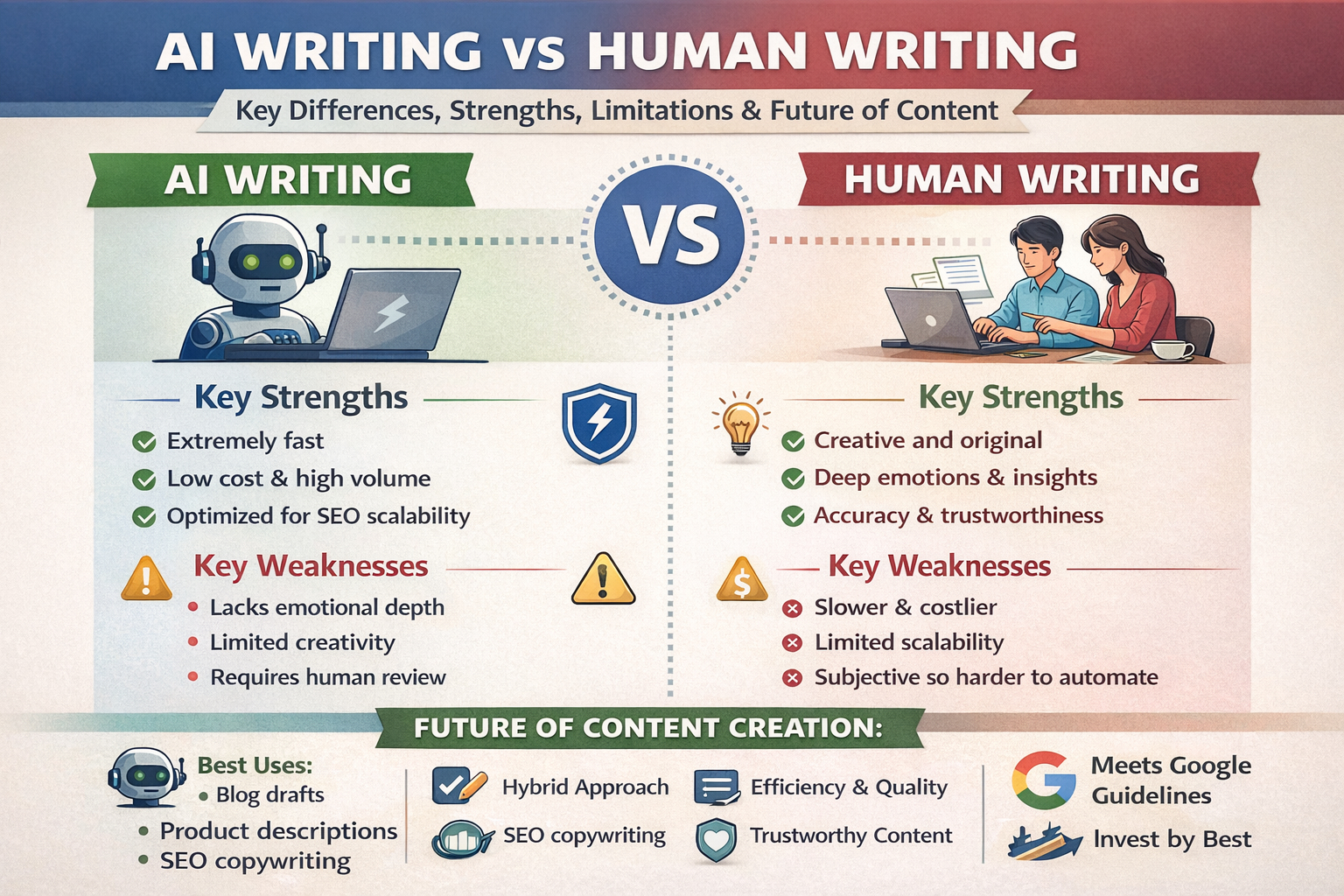
Comparison Table: AI Writing vs Human Writing
AI Writing vs Human Writing: Core Differences Explained
1. Creativity and Originality
AI writing recombines existing patterns. Human writing creates new meaning. While AI can produce novel‑looking sentences, it cannot originate ideas rooted in personal insight or emotional memory.
Human creativity often emerges from contradiction, uncertainty, emotion, and subjective interpretation, elements AI cannot truly experience.
2. Emotional Depth and Empathy
AI can simulate emotional language, but it does not feel emotions. Human writers understand grief, joy, frustration, irony, and humor because they have lived them.
This distinction becomes critical in:
- Storytelling
- Brand narratives
- Opinion pieces
- Persuasive writing
- Mental health or social topics
3. Tone, Voice, and Personality
Human writing naturally varies in rhythm, sentence length, and phrasing. AI writing often shows:
- Predictable sentence structures
- Balanced but uniform tone
- Over‑polished grammar
Skilled human writers intentionally inject imperfection, pauses, rhetorical tension, and voice elements that make writing feel authentic.
4. Depth of Insight
AI excels at surface‑level synthesis. Human writers excel at interpretation and judgment. AI can explain what something is; humans explain why it matters.
This is especially visible in:
- Critical analysis
- Thought leadership
- Academic argumentation
- Ethical reasoning
SEO Performance: AI Writing vs Human Writing
Google does not penalize content simply because it is created using AI. Its ranking systems focus on content quality rather than the method of production. Pages are evaluated based on how helpful they are to users, whether the information is original and adds value, and if the topic is covered with sufficient depth and clarity. Accuracy is especially important, as incorrect or misleading content can quickly lose trust. Google also looks for trust signals, such as consistent messaging, reliable sources, and a clear purpose. Low-quality AI content tends to fail not because it is machine-generated, but because it often lacks depth, repeats common ideas, or does not fully satisfy user intent.
EEAT and Content Trust Signals
Human-written content naturally aligns with Google’s EEAT framework because it often includes visible signs of expertise and experience. This can appear through author credentials, firsthand insights, or informed opinions that show a deep understanding of the subject. Human writers also provide context, judgment, and nuance, which strengthens authority and trust. AI-generated content, on the other hand, does not possess experience or expertise on its own. To meet EEAT standards, it must be carefully reviewed, edited, and enhanced by humans who can add accuracy, insight, and credibility.
AI Content and Google AI Overview Inclusion
Google AI Overview prioritizes content that delivers clear, direct answers to user questions without unnecessary filler. Well-structured content with logical headings, concise explanations, and expert-level clarity is more likely to be selected. AI Overview also favors content that demonstrates real understanding rather than surface-level summaries. While AI can help create structured drafts efficiently, content that combines AI assistance with human expertise tends to perform best. This hybrid approach ensures the content is both easy to extract for AI Overview and valuable for real users.
Hallucinations, Bias, and Ethical Risks in AI Writing
One of the most critical weaknesses of AI writing is hallucination, the generation of false but plausible‑sounding information.
Common AI Writing Risks
- Fabricated citations or sources
- Confidently incorrect statements
- Cultural or data‑driven bias
- Outdated or context‑blind information
Because AI does not verify truth, human oversight is essential, especially in:
- Academic content
- Medical or legal writing
- News and journalism
- Policy or governance content
AI Detection and the Question of Authenticity
As AI writing becomes more sophisticated, AI detection tools have emerged to identify machine‑generated text. These tools analyze:
- Predictability patterns
- Sentence uniformity
- Repetition and probability markers
- Linguistic entropy
However, detection is not foolproof. The more human‑edited an AI draft becomes, the less detectable it is. This reinforces a key reality: the future is hybrid writing.
AI Writing in Education: Assistance or Academic Risk?
Educational institutions face a unique challenge. AI can:
- Help students brainstorm
- Improve grammar and clarity
- Support language learners
But it can also:
- Undermine learning outcomes
- Enable plagiarism‑like behavior
- Remove critical thinking from writing tasks
The most sustainable academic approach treats AI as a learning assistant, not a replacement for student reasoning.
AI Writing in Business and Marketing
In professional environments, AI writing has proven transformative.
Where AI Excels in Business
- SEO drafts and outlines
- Email templates
- Ad copy variations
- Internal documentation
- Proposal scaffolding
Where Humans Remain Essential
- Brand voice definition
- Strategic messaging
- Emotional persuasion
- Audience empathy
- Ethical positioning
The strongest brands use AI to accelerate workflows while preserving human editorial authority.
Creative Writing: Why Humans Still Lead
AI can write poems, stories, and scripts, but they often feel derivative. Creative writing depends on:
- Narrative risk
- Emotional vulnerability
- Cultural specificity
- Symbolism rooted in experience
AI can imitate style, but it cannot live the story it tells.
Future of Content Creation
AI is not replacing human writers; it is replacing repetitive tasks. Activities like drafting outlines, summarizing information, optimizing keywords, and scaling content production are increasingly handled by AI. However, thinking, judgment, creativity, and real-world experience remain uniquely human. Search engines and readers still rely on human insight to interpret information, form opinions, and provide trustworthy guidance. As long as content requires understanding context, emotion, and responsibility, human writers will continue to play a central role.
Role of Human Editors
The role of writers is shifting rather than shrinking. Writers are becoming content strategists who understand search intent, audience needs, and business goals. They are also acting as editors who refine AI-generated drafts for clarity, accuracy, tone, and originality. In addition, writers are increasingly valued as subject-matter experts who bring experience, authority, and credibility that AI cannot generate on its own.
AI Writing Trends to Watch
AI-assisted research is making it easier to gather and organize information quickly, while personalized content generation is improving relevance for different audiences. Hybrid SEO workflows, where AI supports efficiency and humans ensure quality, are becoming the standard approach for high-performing content teams.
AI Writing vs Human Writing: What Google Prefers
Google does not rank content based on whether it was written by AI or a human. Instead, it prioritizes content that genuinely helps users and aligns with its Helpful Content and EEAT guidelines. Pages that perform well in search typically solve real problems by providing clear, practical answers rather than generic explanations. They also demonstrate expertise through accurate information, informed opinions, and evidence of real understanding of the topic.
Most importantly, Google favors content that feels written for humans, not search engines. This includes natural language, meaningful examples, and a logical flow that matches user intent. While AI can assist with structure and efficiency, AI-generated content on its own often lacks depth, experience, and originality. Human involvement remains essential to meet all of Google’s quality expectations consistently.
Conclusion
AI writing and human writing are not rivals; they serve different purposes in modern content creation. AI excels at speed, structure, and scale, making it valuable for drafting, optimization, and efficiency. Human writing adds experience, judgment, emotion, and credibility, which are essential for trust, authority, and long-term search performance. Search engines reward content that is genuinely helpful, accurate, and written with real users in mind, regardless of how it is produced. The most effective strategy is a hybrid approach where AI supports the process, while humans guide quality, context, and expertise to create content that ranks, converts, and builds lasting trust.
Frequently Asked Questions:
1. Can AI-written content rank on Google?
Yes, but only if it is helpful, accurate, and human-reviewed.
2. Is AI writing detectable?
Detection tools exist, but quality and value matter more than detection.
3. Does AI writing affect EEAT?
AI alone cannot demonstrate experience or authority.
4. Should businesses replace writers with AI?
No. Businesses should empower writers with AI tools.
5. What is the best approach for SEO in 2026?
Human-led content creation supported by AI workflows.